Your menu might be the heart of your restaurant, but your food cost percentage is the financial heartbeat. This one number tells you how much of your revenue is spent on ingredients, giving you a clear picture of your kitchen's profitability. Getting a handle on it is the first step to building a restaurant that doesn't just survive, but thrives.
Understanding Your Kitchen's Core Metric
Think of your food cost percentage like this: for every dollar a customer spends, how many cents did you spend on the ingredients for their plate? If your food cost is 30%, it means that for every $1 in sales, 30 cents went right back out the door to pay for the raw ingredients.
Ignoring this metric is like flying a plane without a fuel gauge. You might be moving, but you have no idea if you're about to run out of gas. A high food cost can quietly eat away at your profits, while a number that's in check ensures every dish you sell is actually making you money. It's the key to unlocking insights into your:
- Profit Margins: Lower food costs directly translate to higher profits on every check.
- Menu Pricing: It gives you the hard data you need to set menu prices that are both competitive and profitable.
- Kitchen Efficiency: A rising food cost can be a red flag for problems with waste, inconsistent portioning, or even supplier issues.
Why It Matters More Than Ever
Keeping a close eye on your food cost has always been important, but in today's economy, it's absolutely critical. Inflation has hit the restaurant industry hard. Between December 2019 and May 2024, the price of food away from home jumped by a staggering 31.9%, rising even faster than grocery store prices.
When your ingredient costs are climbing that fast, a healthy 28% food cost can balloon to 32% or more before you even realize it, wiping out your margins. This is where modern tools are no longer a luxury but a necessity.
Instead of getting lost in spreadsheets, an all-in-one platform automates the tedious work of tracking inventory and sales. A system like TackOn Table connects the dots for you, turning raw data into clear, actionable insights. It’s one of the essential solutions for modern restaurant management that helps you proactively manage rising costs and protect your bottom line. Our all-in-one simplicity and easy setup mean you can take control without the headache.
Calculating Your Food Cost Percentage Step by Step
Let’s be honest: knowing your numbers is what separates the pros from the hopefuls. The good news is that calculating your food cost percentage isn't some dark art reserved for accountants. It’s a straightforward process that shows you exactly how much you're spending on ingredients for the food you actually sell.
At its core, the calculation revolves around one key figure: your Cost of Goods Sold (COGS). Think of COGS as the total cost of all the ingredients that made their way from your storeroom to a customer's plate over a specific time. Once you nail that down, the rest is easy.
The Essential Food Cost Formula
To get started, you'll need to track your inventory and purchases over a set period—say, a week or a month. This is how you find your COGS.
COGS = (Beginning Inventory + Purchases) – Ending Inventory
Let's quickly break down what each of those terms means in the real world:
- Beginning Inventory: This is simply the dollar value of all the food stock you have on hand when you flip the "Open" sign at the start of the period.
- Purchases: This is the total amount you spent on new inventory orders during that same period.
- Ending Inventory: This is the dollar value of whatever stock you have left over after the last service of the period.
Got your COGS? Perfect. Now you can find your food cost percentage by seeing how that number stacks up against your total sales for the same period.
Food Cost Percentage = (COGS / Total Food Sales) x 100
This little number is powerful. It tells you, down to the penny, what percentage of every dollar you earn is spent on the ingredients themselves.
This flow chart gives a great visual of how managing your ingredients and sales translates directly into the financial health of your restaurant.
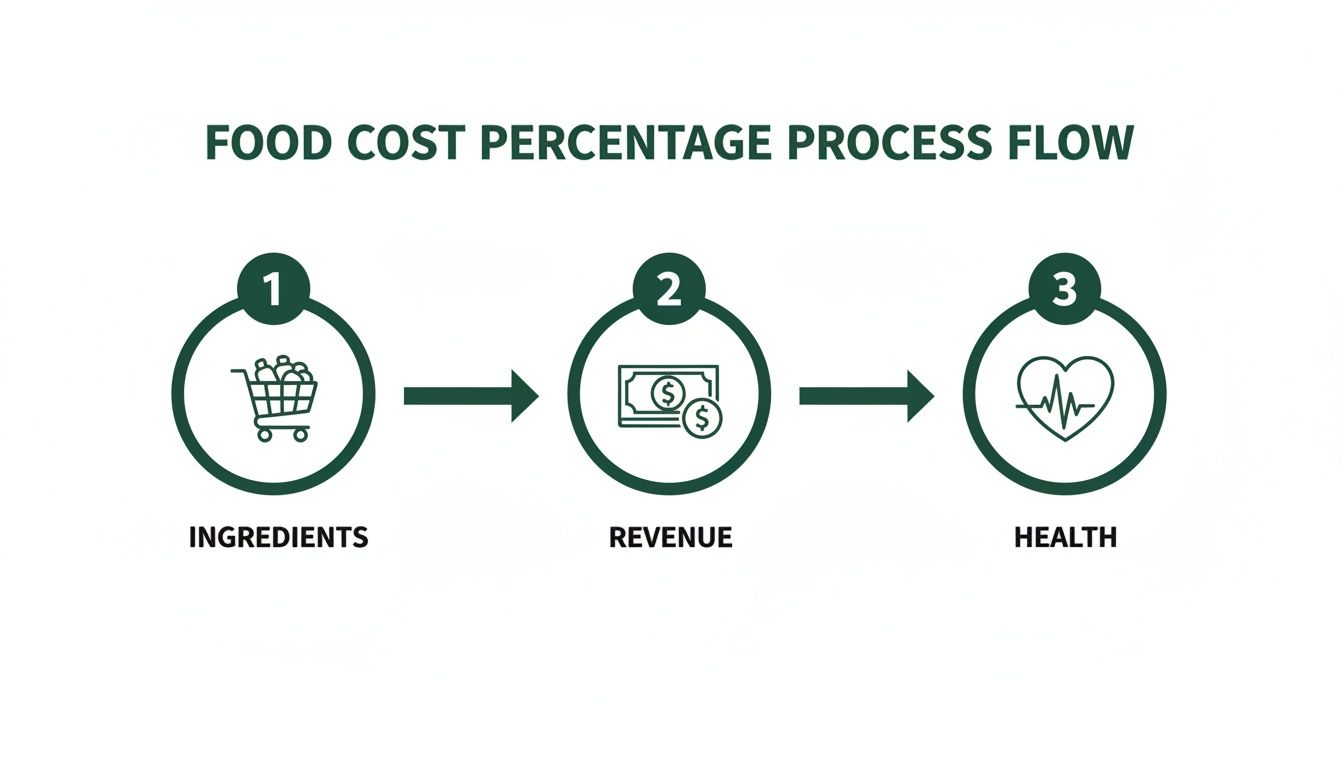
Ultimately, getting this process down is about turning raw data into real-world decisions that protect your bottom line.
A Practical Example for Your Café
Let's walk through this with a real-world example. Imagine you run a small café and want to figure out your food cost for the last week.
- Beginning Inventory: On Monday morning, you did a stock take and had $10,000 worth of ingredients.
- Purchases: You placed a few orders throughout the week, totaling $3,000.
- Ending Inventory: After your Sunday closing, you count everything up again and have $9,000 in stock remaining.
First, let's find your COGS for the week:
COGS = ($10,000 + $3,000) – $9,000 = $4,000
During that same week, your café brought in $12,500 in total food sales. Now, we plug it into the final formula:
Food Cost Percentage = ($4,000 / $12,500) x 100 = 32%
So, what does that mean? It means that for every dollar that came through your register, 32 cents of it went right back out to pay for ingredients.
Understanding Your Actual vs. Ideal Food Cost
The number we just calculated (32%) is your Actual Food Cost. It’s what really happened. But there's another number you need to know: your Ideal Food Cost. This is your food cost in a perfect world—one with no waste, no theft, and flawless portioning on every single dish.
This is where a modern restaurant POS system becomes your best friend. For example, TackOn Table’s integrated inventory system can calculate your ideal cost automatically. It knows the exact recipe for every item on your menu. When a server rings in a latte on our mobile POS, the system automatically deducts the precise amount of espresso beans and milk from your digital inventory, giving you that perfect "ideal" number.
The difference between your Actual and Ideal food cost is where your profit goes to hide. A big gap is a red flag, pointing straight to problems like over-portioning, unaccounted-for staff meals, or spoilage. This is why having a system that shows you both numbers is so critical. It’s not just about counting boxes; it’s about finding and fixing the leaks that are draining your profits.
Ready to stop guessing and start knowing your numbers? TackOn Table makes tracking food costs effortless.
What’s a Good Food Cost Percentage for Your Restaurant?
Pinpointing the "ideal" food cost percentage is a bit like asking a chef for the one "best" ingredient—it just doesn't exist. There's no magic number that works for everyone.
A "good" food cost really depends on your specific restaurant. A high-end steakhouse with complex dishes and premium ingredients can operate perfectly well with a higher percentage, while a busy food truck that thrives on speed and volume needs to keep that number much lower. The key is to stop chasing a universal figure and start defining a realistic target for your business. But first, it helps to know where you fit in the bigger picture.
Average Food Cost Percentage by Restaurant Type
Understanding the typical benchmarks for your corner of the industry is the best place to start. It gives you a solid point of reference to see how your own performance measures up and helps you set achievable goals for profitability.
Here’s a look at the typical target food cost percentages for different types of food service businesses. These ranges can help you see if you're in the right ballpark or if there's room for improvement.
| Restaurant Type | Average Food Cost Percentage Range |
|---|---|
| Quick-Service / Food Truck | 20% – 28% |
| Fast-Casual | 25% – 30% |
| Full-Service Casual Dining | 28% – 35% |
| Fine Dining | 30% – 40% |
| Catering / Events | 25% – 35% |
| Pizzeria | 20% – 28% |
| Bakery / Café | 18% – 30% |
As you can see, your target is heavily influenced by your service style. Quick-service spots prioritize volume and efficiency, so they aim for a lean 20%–28%. Fast-casual restaurants, which blend counter service with higher-quality ingredients, usually land between 25%–30%. Full-service restaurants have higher labor costs and more intricate menus, so their target is often in the 28%–35% range.
Of course, these numbers aren't set in stone, especially when food prices are always on the move. Recent data shows that the cost of food away from home has been climbing (3.7% year-over-year) faster than the cost of food at home (1.9%). This puts pressure on restaurant owners to strategically adjust menu prices just to hold their margins steady. Staying on top of these economic indicators and their impact on the restaurant industry is crucial.
Key Takeaway: Think of your food cost percentage as a living number, not a static goal. You need to revisit it regularly based on what your suppliers are charging, what’s selling, and what the economy is doing. It’s all about pricing for profit in real-time.
Café Management Software: Putting Benchmarks into Action
Knowing the industry average is one thing, but consistently hitting your own target is where the real work begins. This is where modern café management software or a restaurant POS system like TackOn Table becomes your secret weapon. It transforms those abstract percentages into daily, actionable insights.
Instead of biting your nails waiting for a monthly P&L statement, you get a live look at your numbers. The system tracks every ingredient that goes out the door, calculates the precise cost of each dish, and shows you exactly what’s selling. This lets you:
- Spot Problems Instantly: Notice the moment your burger's food cost starts to creep up, instead of finding out weeks later.
- Engineer Your Menu with Confidence: Use hard data to identify your high-profit "star" dishes and ditch the ones that are dragging you down.
- Manage Multiple Locations with Ease: If you're growing, TackOn Table provides seamless multi-location control. You can keep an eye on consistency and profitability across all your restaurants from one central dashboard.
This level of insight gives you a major leg up over many Toast vs Clover alternatives, delivering powerful features without the complexity or high price tag. TackOn Table simply puts the data you need to set, track, and crush your food cost goals right at your fingertips.
Ready to see how your numbers stack up and finally take control of your profitability?
Book a Free Demo
Practical Strategies to Lower Your Food Costs
Knowing your food cost percentage is one thing. Actually lowering it is where the money is made. This isn't about cutting corners or buying cheaper ingredients that will disappoint your regulars. It's about getting smarter, plugging the hidden leaks in your operation, and letting data, not guesswork, guide your decisions.
This is where the rubber meets the road. The best cost-control tactics all boil down to precision, strategy, and good old-fashioned discipline. By putting a few key practices in place, you can systematically stop bleeding cash and turn those would-be losses into real profit.
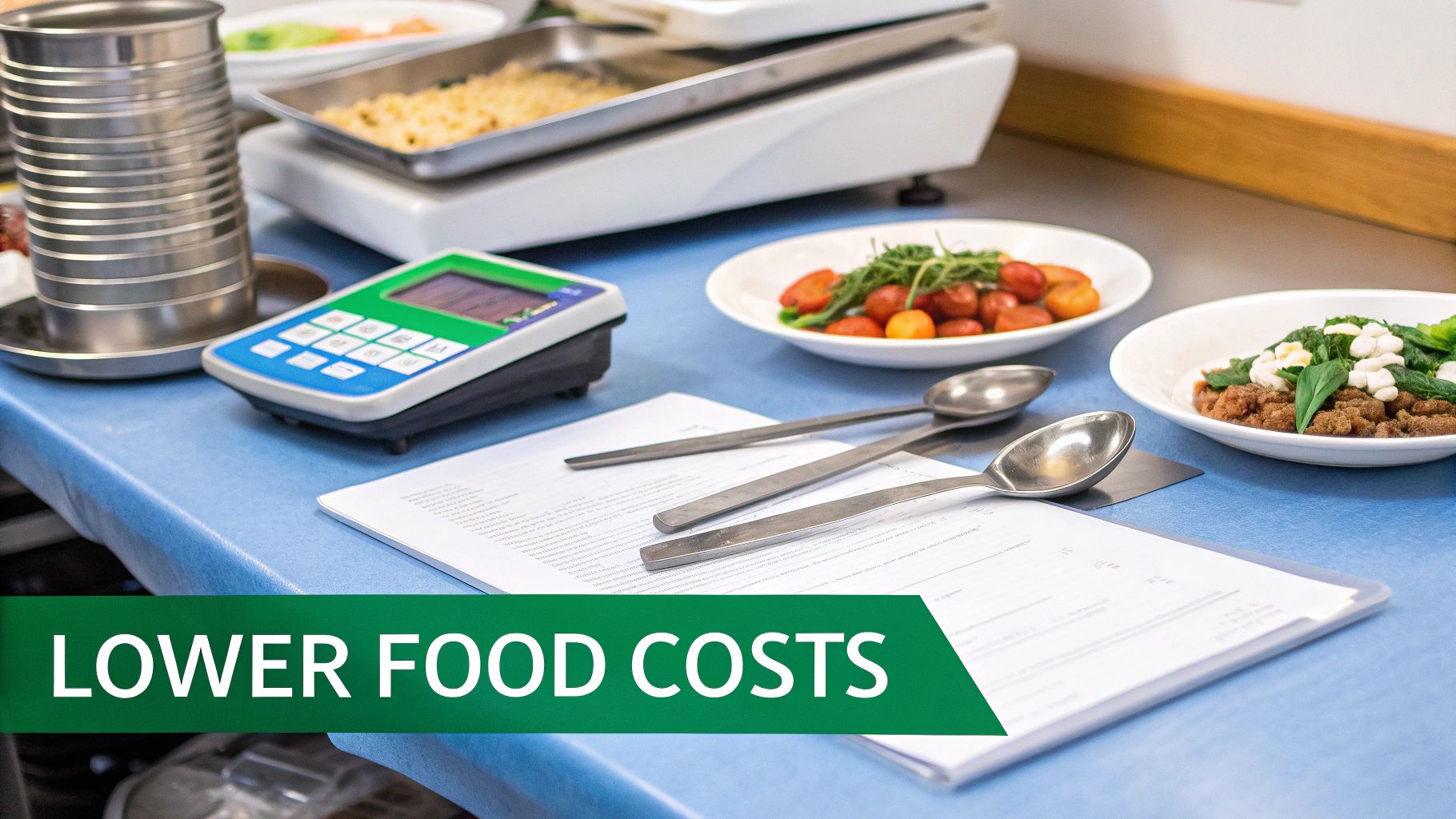
Let's walk through four powerful ways to tighten up your costs. These aren't just for the big chains; they work whether you're running a single food truck or a bustling neighborhood bistro.
Master Your Menu with Strategic Engineering
Your menu isn't just a list of what you sell—it's your most important marketing tool. Menu engineering is the process of digging into your sales data to figure out which dishes are popular, which are profitable, and—most importantly—where those two overlap.
The idea is to sort every single item into one of four categories:
- Stars: These are your knockout dishes. They're popular and highly profitable. Feature them prominently.
- Plow Horses: Everyone loves them, but they have thin margins. You don't want to get rid of them, but maybe you can raise the price a little or find a way to trim their ingredient costs.
- Puzzles: You make great money on these, but nobody's ordering them. It's a puzzle you need to solve. Tweak the recipe, give it a better name, or have your servers recommend it.
- Dogs: These dishes are unpopular and don't make you much money. They're dead weight on your menu. It’s usually best to cut them loose.
Once you know what's what, you can redesign your menu to subtly guide customers toward your "Stars." Simply placing them in a high-visibility spot, like the top-right corner, can give their sales a serious boost and directly help your bottom line.
Enforce Precision with Portion Control
Consistency is everything in this business. It keeps customers happy and keeps your costs in check. Portion control is the simple commitment to making sure every plate that leaves the kitchen is the same—same size, same look, and same cost. Without it, you're just flying blind.
Inconsistent portioning is one of the biggest culprits behind "menu variance"—that frustrating gap between what your food should cost and what it actually costs. An extra scoop of fries here or another ounce of chicken there might not seem like a big deal, but it adds up to thousands of dollars in lost profit over a year.
Getting portioning right comes down to three things:
- Standardize Your Recipes: Every dish needs a detailed recipe card that spells out the exact weight and measurement of every single ingredient. No exceptions.
- Use the Right Tools: Stock your kitchen with food scales, measured ladles, and portion scoops. Make them a non-negotiable part of the prep process.
- Train Your Team: Drill it into your kitchen staff. Everyone needs to understand why following the recipes to the gram is crucial for the restaurant's health.
This level of discipline takes the guesswork out of your plate costs. Systems like TackOn Table take this a step further, letting you plug those standardized recipes right into your Restaurant POS to automatically track the ideal cost of every dish you sell.
Optimize Your Supply Chain
Your relationship with suppliers directly impacts your food cost. Just accepting the price on the invoice is a quick way to shrink your margins. You need to be proactive and strategic about how you buy.
Start by auditing your invoices every week. Did the price of ground beef just jump 15%? Is cooking oil slowly creeping up? You can't manage what you don't measure.
Here are a few moves you can make:
- Build Strong Relationships: Good, loyal customers can often negotiate better pricing. Don't be afraid to ask for better terms.
- Shop Around: Regularly get quotes from a couple of different suppliers for your most-used ingredients. It keeps your main vendor honest and ensures you're getting a fair price.
- Consolidate Your Orders: If you can, place larger orders less frequently. You'll save on delivery fees and might even unlock volume discounts.
For a truly effective approach, think about the whole picture. For many restaurants, streamlining procure-to-pay processes with smart automation is key to ensuring that the entire purchasing cycle—not just the price—is as efficient as possible.
Eliminate Waste with Disciplined Inventory Methods
Every bit of food that ends up in the trash is pure profit you're throwing away. Solid inventory management is your best defense. The absolute gold standard here is the "First-In, First-Out" method, or FIFO. The concept is dead simple: use your oldest stock first.
To make FIFO a reality, your walk-in and dry storage need to be organized. When new deliveries arrive, they go behind the existing stock. Label everything with the delivery or expiration date. This one habit can dramatically reduce spoilage from forgotten items hiding in the back.
When you bring all these strategies together, especially with an all-in-one system, you create a powerful cost-control machine. TackOn Table’s integrated inventory management helps you track stock, watch supplier prices, and see sales data in one place. Want to see what that could mean for your bottom line? Check out our restaurant savings calculator and get a real sense of the impact.
Ready to turn these strategies into real savings?
How Our Restaurant POS Can Control Your Food Costs
Trying to manually track every ingredient, every sale, and every shift in supplier prices is an overwhelming task. It’s a lot like trying to count every car on a busy highway—by the time you think you have a number, the reality has already changed. An integrated Restaurant POS system, like TackOn Table, gives you a live dashboard to get ahead of the game and take firm control over your food cost percentage.
It’s time to stop guessing and start knowing. A modern POS is your secret weapon for mastering food costs, turning hours of tedious data entry into powerful, automated insights. Think of it as the central nervous system for your restaurant's financial health.
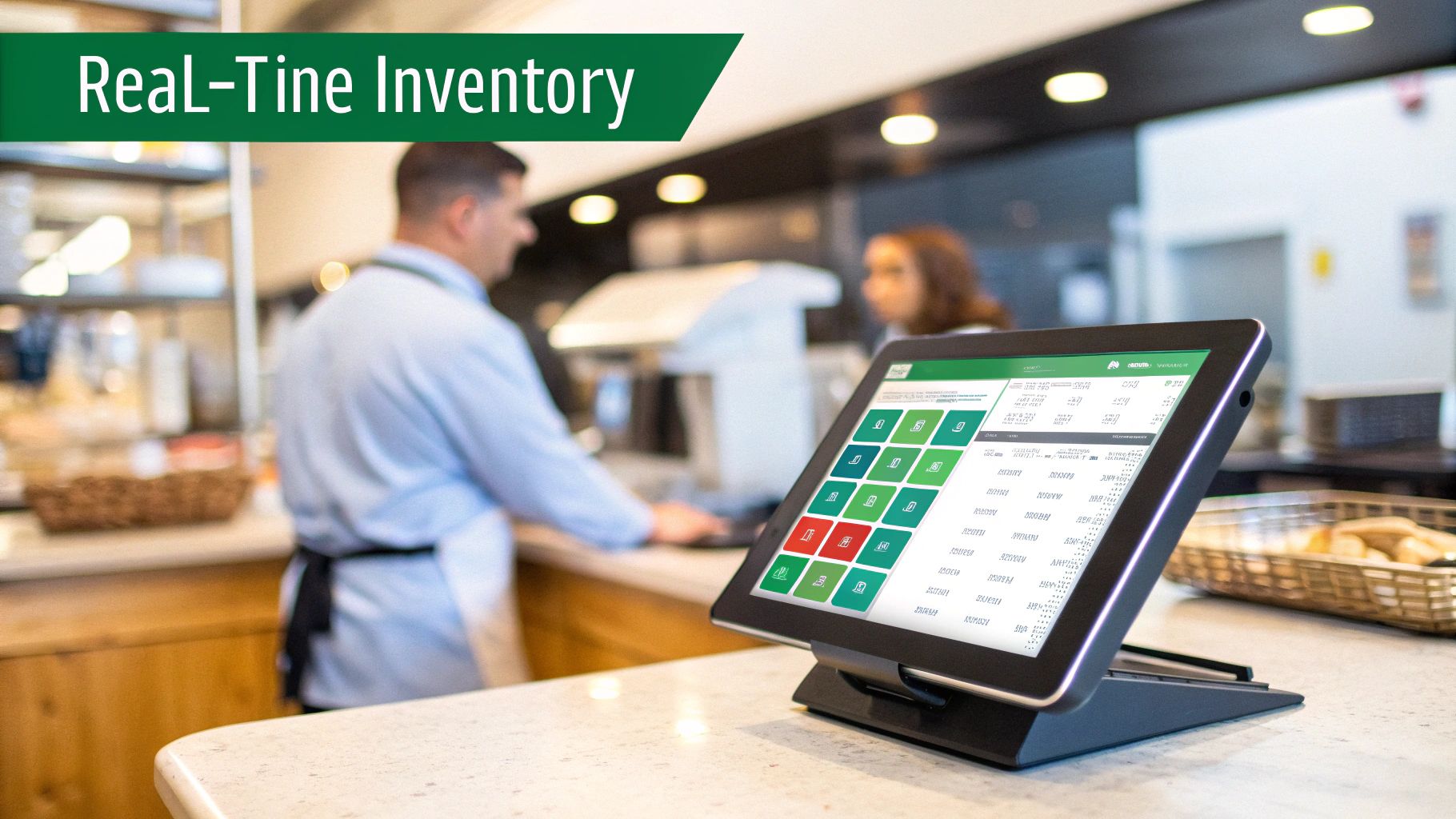
This technology connects every part of your operation, from the moment an order is placed to the second an ingredient is pulled from the shelf. It’s not just about processing payments; it’s about giving you the clarity needed to make profitable decisions, day in and day out.
Automate Inventory with Real-Time Tracking
The bedrock of food cost control is knowing exactly what you have on hand at any given moment. TackOn Table’s all-in-one system handles this automatically with real-time inventory tracking.
Here’s a simple breakdown of how it works: a server rings up your signature burger. Instantly, the system deducts the precise amounts of ground beef, brioche buns, cheese slices, and pickles from your digital stock count. This isn't just a minor convenience; it's a game-changer. You get an up-to-the-minute view of your inventory levels without ever having to manually count boxes in the walk-in.
This live tracking helps you:
- Prevent Stockouts: Set up low-stock alerts so you never have to 86 a popular dish during a Friday night rush.
- Reduce Spoilage: Easily spot slow-moving items and create a special before they expire, turning potential waste directly into revenue.
- Spot Variances Instantly: Compare what you physically have on the shelf with what the system says you should have. This immediately flags issues like over-portioning, unrecorded waste, or potential theft.
Price for Profit with Recipe Costing
Do you know the true cost of every dish on your menu, down to the penny? Without the right tools, this is a painful, spreadsheet-heavy chore. A POS with built-in recipe costing makes it surprisingly simple.
You only have to input the cost and measurement for each ingredient once. From that point forward, the system calculates the exact plate cost for every item you sell. This empowers you to set menu prices that guarantee a healthy profit margin on every single order.
This is absolutely essential when dealing with today's fluctuating ingredient prices. As global supply chains shift, your costs for commodities like grain, cooking oil, and meat can change quickly. For instance, the FAO’s Food Price Index saw a 2.9% decline over just two months, showing just how fast your costs can move. With TackOn Table, you can update a supplier's new price in one place, and the system automatically recalculates every affected recipe. Your profitability is always protected. You can explore trends like these on Statista's global food price index data.
Make Data-Driven Decisions with Sales Analytics
Perhaps the most powerful feature of an integrated POS is its ability to transform raw sales data into smart business decisions. TackOn Table’s analytics dashboard shows you exactly what’s selling, when it’s selling, and—most importantly—how profitable each item actually is.
This turns menu engineering from a gut-feel exercise into a data-driven strategy. You can instantly identify your:
- Stars: High-profit, high-popularity items you should be promoting.
- Puzzles: High-profit, low-popularity dishes that might just need a better description or a staff recommendation.
- Dogs: Low-profit, low-popularity items that are just taking up space on your menu.
This level of insight is invaluable. For restaurant groups, TackOn Table’s multi-location control provides a centralized command center to monitor performance across all your branches, ensuring consistency and profitability everywhere. This all-in-one approach offers a serious advantage, as we cover in our guide comparing TackOn Table vs Clover and Square alternatives.
By bringing your inventory, recipes, and sales together in one place, a system like TackOn Table gives you the tools to not just track your food cost percentage, but to actively manage it down.
Ready to see how an all-in-one POS can transform your profitability?
It’s Time to Take Control of Your Restaurant's Profitability
Mastering your food cost percentage isn't just an accounting exercise—it's one of the most powerful levers you can pull to secure your restaurant's financial future. We've walked through what it is, how to calculate it, and the strategies to keep it in line. The single most important lesson? Consistent tracking and smart, deliberate action are what separate struggling restaurants from thriving ones.
This might sound like a mountain of work, but modern tools are designed to make it not just manageable, but second nature. A great all-in-one system, like TackOn Table, puts all this critical data right where you need it, when you need it.
You don't have to spend your nights buried in spreadsheets anymore. The right system transforms those mind-numbing calculations into clear, simple insights that help you make better decisions on the fly.
Your Path to Higher Margins Starts Now
Every dollar lost to food waste, inefficient ordering, or inconsistent portion sizes is a dollar straight out of your pocket. It's time to stop the bleeding and take decisive action. With the right information and tools, you can turn your operation around and boost your bottom line faster than you might think.
This is exactly what TackOn Table was built for. Our system gives you:
- Real-time inventory tracking to slash waste and stop 86-ing popular items.
- Automated recipe costing so you know every single dish is priced for profit.
- Powerful sales analytics that turn menu engineering from a guessing game into a data-driven strategy.
- Seamless multi-location control to keep your standards high as you expand.
Our Café Management Software and Restaurant POS were designed from the ground up to be affordable and easy to use, giving you a real advantage over more complex Toast vs Clover alternatives. See for yourself how TackOn Table puts you back in the driver's seat.
Take that next step toward a more profitable, predictable, and successful restaurant.
Book a Free Demo and let us show you just how easy it is to get started.
FAQs: Your Food Cost Percentage Questions Answered
Let's tackle some of the most common questions restaurant owners have about food cost percentage. Nailing this number is fundamental to your restaurant's profitability, and getting the details right can make all the difference.
How Often Should I Be Calculating My Food Cost Percentage?
Ideally, you should be running this number weekly. That might sound like a lot, but this frequency gives you the power to spot and fix problems—like a sudden spike in waste, sloppy portioning, or a supplier price hike—before they can do real damage to your monthly profit.
Think of it this way: a month is a long time to let a problem fester. Weekly checks give you the agility to react quickly. This is where modern POS systems like TackOn Table really shine. Their real-time inventory tracking feeds you the data you need automatically, turning a tedious manual chore into a quick health check.
What’s the Difference Between Food Cost and Prime Cost?
This is a great question. They’re related, but they tell you different things about your business.
Food Cost Percentage is a laser-focused metric. It just looks at what you spent on ingredients versus the revenue you made from selling food. It’s the best way to judge your kitchen’s efficiency.
Prime Cost, on the other hand, is the big picture. It combines your total Cost of Goods Sold (that’s both food and beverage) with your total labor costs. Since ingredients and staff are your two biggest expenses, Prime Cost gives you a much clearer view of your restaurant's overall operational health. A solid target for Prime Cost usually lands between 60-65% of total sales.
Can I Actually Lower Food Costs Without Buying Cheaper Ingredients?
Yes, you can—and you absolutely should. The last thing you want to do is sacrifice the quality your guests love just to save a few pennies.
The goal is to plug the leaks, not change the recipe. Smart cost-saving is about efficiency, not compromise.
Instead of swapping out quality ingredients, focus your energy here:
- Attack Waste: Get serious about your inventory system. Using the First-In, First-Out (FIFO) method is a simple but powerful start.
- Dial in Portion Control: Standardized recipes, scoops, and scales aren't just for consistency; they're your best defense against profit-draining over-serving.
- Engineer Your Menu: Make sure your menu design naturally guides customers toward your most profitable dishes.
- Talk to Your Suppliers: Don't be afraid to negotiate. You might be able to get a better deal on the items you buy most often.
How Does a POS System Make Recipe Costing Easier?
A modern Restaurant POS completely changes the game here. With a system like TackOn Table, you enter each ingredient for a menu item, its cost, and how much you use in the recipe. The software does the math instantly, giving you the precise plate cost.
Here's where the magic happens: every time you sell that dish, the POS automatically subtracts the ingredients from your digital inventory. This gives you a perfect "ideal" food cost for every single item you sell. You can then compare this ideal cost to your actual cost to immediately spot any discrepancies. It's a game-changing feature that makes TackOn Table a powerful and straightforward alternative to systems like Toast or Clover.
Ready to stop guessing and start knowing your numbers? TackOn Table makes it simple to track your food cost percentage, manage inventory, and build a more profitable menu.
Book a Free Demo Today!