Let's get right to it. In simple terms, demand planning is how your restaurant predicts what customers are going to order and when they'll order it.
Think of it less like a mysterious crystal ball and more like a smart, data-backed weather forecast for your kitchen. It tells you precisely how many burger patties, bags of coffee beans, or pizza boxes you’ll actually need for the coming week. This isn't about gut feelings; it's about using real data from your restaurant POS system to make much smarter decisions.
Turning Guesswork into Predictable Profit
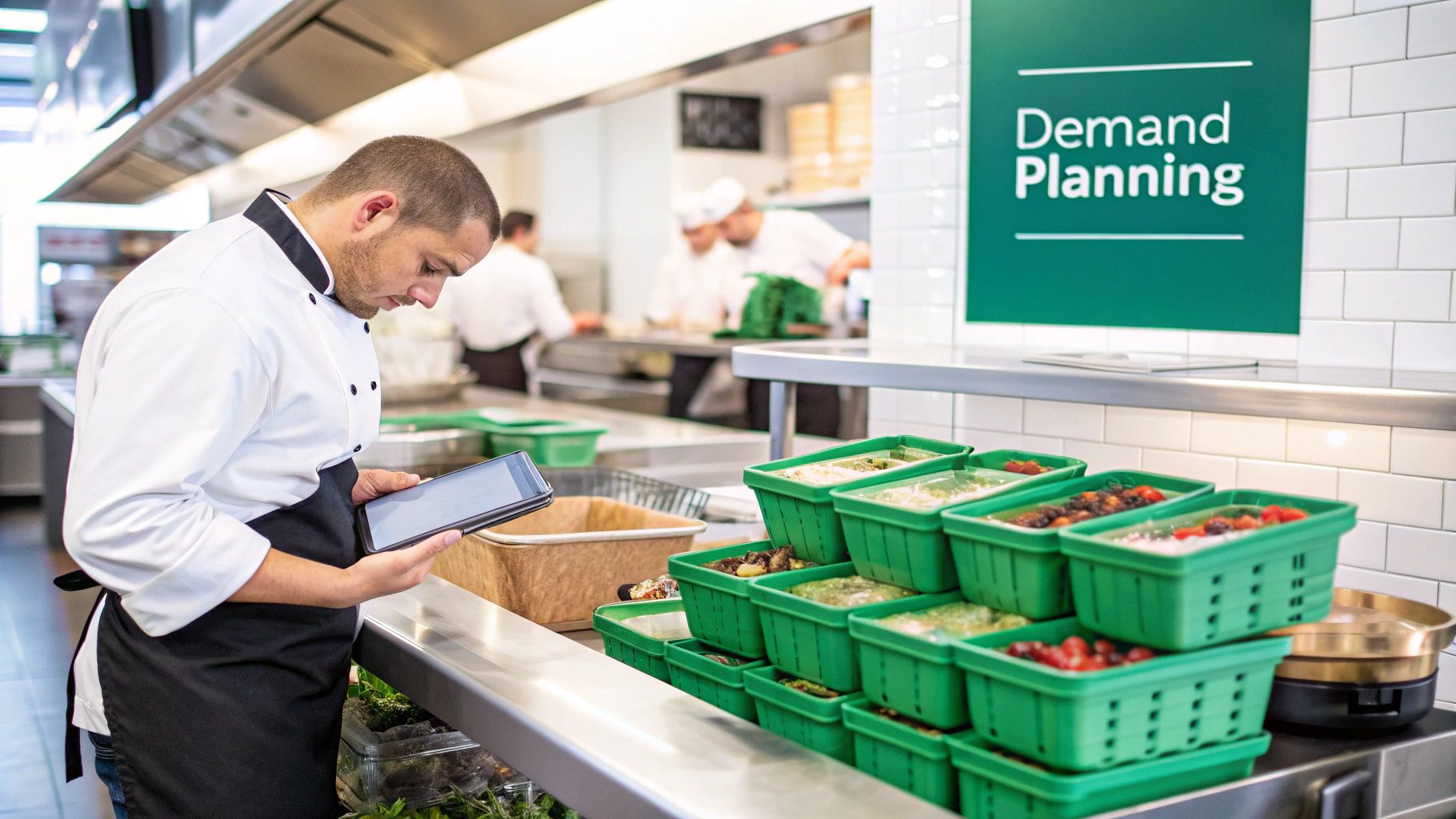
If you run a restaurant, café, or food truck, you know the constant juggling act. On one hand, you have the nightmare of overstocking—food spoils, and money goes straight into the trash. On the other, you have the frustration of stockouts, which means lost sales and disappointed customers you might never see again.
This is exactly where demand planning steps in to save the day.
Imagine this scenario: a traditional manager might order extra chicken wings just because last weekend was busy. But a manager using demand planning looks deeper. They see a big local football game on the calendar, check last year's sales data for similar game days, and confidently order the exact amount of wings needed to handle the coming surge.
That’s the difference. One is a reaction, the other is a strategy.
The shift from reactive management to proactive planning is profound. The table below illustrates how this changes almost every aspect of running your restaurant.
| Area of Operation | Traditional Guesswork | With Demand Planning |
|---|---|---|
| Inventory Ordering | Based on "gut feelings" or last week's sales. | Based on historical data, trends, and future events. |
| Food Waste | High, due to over-ordering "just in case." | Minimized by purchasing only what's needed. |
| Stockouts | Common, leading to lost sales and unhappy customers. | Rare, as popular items are always available. |
| Profit Margins | Squeezed by waste and inconsistent sales. | Protected and improved through cost control. |
| Staff Scheduling | Often results in being over or understaffed. | Aligned with predicted customer traffic for efficiency. |
This isn't just about ordering smarter; it’s about running a tighter, more profitable, and less stressful business. You're building a system that anticipates needs instead of just reacting to problems.
The Power of Data-Driven Decisions
This forward-thinking approach isn't just for massive chains anymore. The global market for Demand Planning Solutions is expected to explode, reaching an estimated $9.82 billion by 2032. Why? Because for businesses like quick-service restaurants and multi-location franchises, it’s a direct path to slashing waste and capturing sales you would otherwise miss.
So, where does this magical data come from? It's already there, hiding in your Restaurant POS system.
Every time you ring up a sale, your POS is capturing a valuable piece of the puzzle. A modern, all-in-one platform like TackOn Table gathers every order, every transaction, and every customer trend, turning that raw information into your secret weapon for accurate forecasting. Its all-in-one simplicity means you're not juggling multiple apps—you have one clear source of truth.
Instead of guessing, you can start seeing clear, actionable patterns:
- You'll know that your spicy chicken sandwich is a top-seller every Tuesday night.
- You can see exactly how holiday weekends drain your coffee bean supply.
- You can anticipate a dinner rush based on sales data from the same time last year.
By using this information, you can finally stop putting out fires and start building a predictable, profitable operation. And with the intuitive design of TackOn Table's restaurant management solutions, this powerful process is no longer out of reach. It’s about moving beyond reacting to yesterday's numbers and start preparing for tomorrow's success.
Why Accurate Forecasting Is Your Secret to Profitability
Think of great forecasting as the engine driving your restaurant’s profitability. It's not just an operational task you have to get through; it's the single best way to make smarter, more cost-effective decisions across your entire business, from the kitchen to the front of house.
When you have a solid idea of what your customers are going to order, you can finally stop guessing. This foresight is a direct attack on one of the biggest profit killers in the food industry: food waste. Instead of ordering ingredients based on a hunch and watching them spoil in the walk-in, you can buy exactly what you need. This also slashes your carrying costs—all the money tied up in storing and managing inventory that’s just sitting there.
Beyond Inventory Savings with a Restaurant POS
The financial wins don't stop in the stockroom. Accurate demand planning is also your key to smarter staff scheduling. It helps you dodge those classic pitfalls, like being overstaffed on a slow Tuesday night or getting caught completely unprepared for a surprise weekend rush. When you align your labor costs with actual customer traffic, you protect your margins in a big way.
This is where a modern Restaurant POS like TackOn Table really shines. Our system doesn't just process orders; it turns your raw sales data into clear, actionable insights.
With a few clicks, you can instantly see your top-selling dishes, spot sales trends by day or season, and get a real feel for customer behavior. This data gives you the power to stop making decisions based on guesswork and start making strategic moves that boost both profit and guest satisfaction.
The Financial Impact of Getting It Right
The numbers really drive the point home. Restaurants that nail their demand planning can slash inventory costs by 20-30% and improve their forecast accuracy by up to 65%. Even better, advanced tools are now reducing forecasting errors by as much as 50%, which is huge for any operator watching their budget. If you want to dive deeper, you can read more about the impact of AI on forecasting.
At the end of the day, every improved forecast means you’re not telling a customer you have to "86" a popular dish on a busy Friday night—a moment that costs you both revenue and goodwill. Each data-driven decision, from your weekly food order to your staff schedule, adds up to serious savings.
Want to see what that could look like for your business? Use our interactive savings calculator to get a personalized estimate. By turning your own sales history into a predictive tool, you're not just cutting costs—you're building a more resilient and profitable restaurant.
The Core Pillars of Demand Planning in Your Café Management Software
To really get a handle on demand planning, you need to understand its four key components. Think of them as the legs of a sturdy table—if one is wobbly, the whole operation feels unstable. For any restaurant owner, getting these four elements in sync is what turns operational chaos into a calm, controlled process.
These pillars aren't separate tasks; they work together inside a modern Café Management Software system to paint a clear picture of your business. This helps you stop guessing and start making smart, data-driven decisions every single day.
This diagram shows how it all connects. Accurate forecasting sits at the foundation, directly impacting profitability by cutting down on waste and helping you nail your staffing levels.
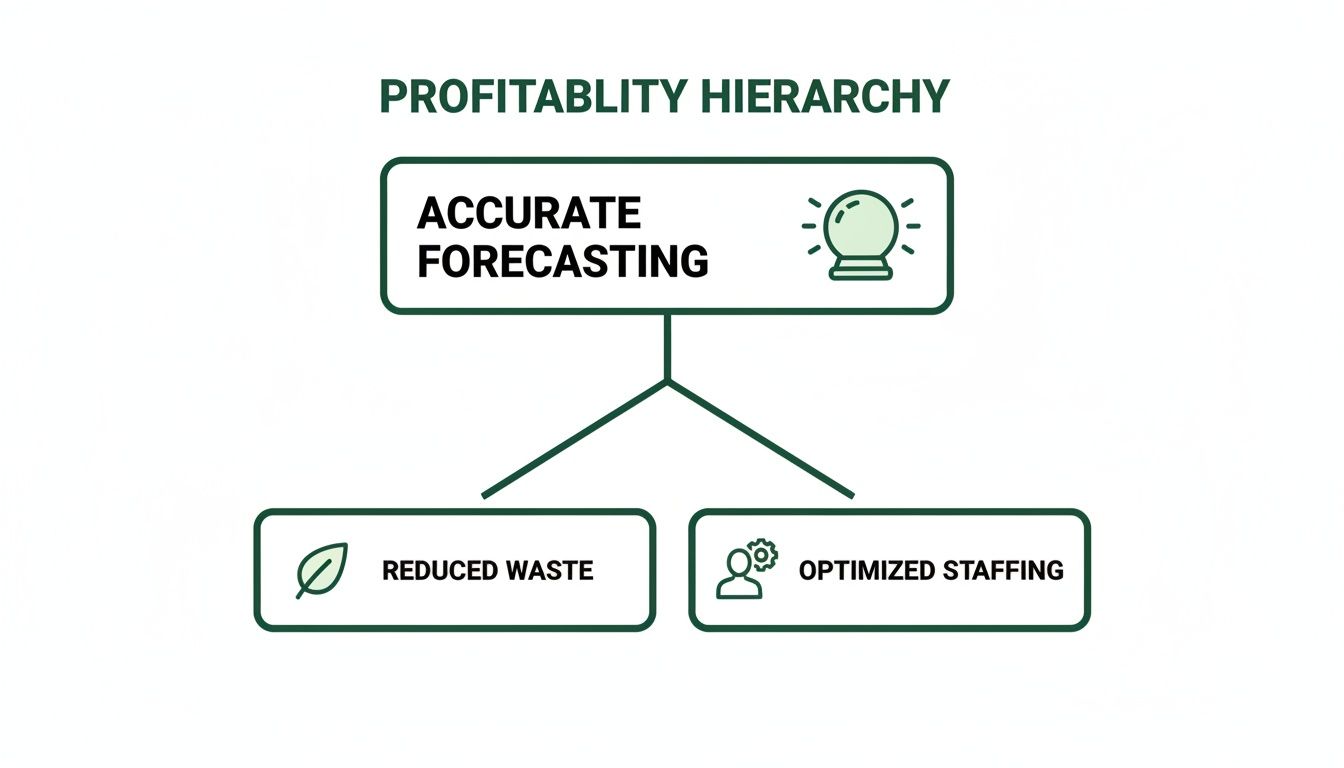
As you can see, better predictions have a direct, positive ripple effect on your two biggest expenses: food and labor. That's a straight line to a healthier bottom line.
Sales Forecasting: Using Your Data to See the Future
The first and most important pillar is sales forecasting. This isn't about gazing into a crystal ball. It’s about using the historical data from your POS to predict future sales with a high degree of confidence. You're looking at real numbers to figure out how many lattes you'll actually sell next Tuesday or how many burger patties you’ll need for the holiday weekend.
A system like TackOn Table does the heavy lifting by automatically collecting this data. It shows you trends by the hour, day, week, or even season, revealing patterns you'd never spot on your own. Your sales history becomes a reliable roadmap for what's coming next.
Inventory Optimization: The Art of Ordering Just Enough
Next up is inventory optimization. This is simply the art of getting the right amount of ingredients at precisely the right time. Your forecast tells you what you're likely to sell, and optimization uses that information to tell you what to buy. The goal is to keep your stock lean without the dreaded experience of 86-ing a popular dish mid-service.
This is absolutely critical for managing perishable items and freeing up cash that would otherwise be sitting in an overstocked freezer. With TackOn Table's real-time inventory tracking, you can set low-stock alerts and even automate purchase orders. Its affordability and simplicity make our platform a powerful contender for anyone exploring Toast vs Clover alternatives.
Your goal should be to maintain the lowest possible inventory level that still meets your forecasted demand. This protects your cash flow and dramatically reduces the risk of spoilage and waste.
Safety Stock: Your "Just-in-Case" Cushion
The third pillar is safety stock. Think of this as your "just-in-case" inventory—that small buffer of key ingredients you keep on hand for when things go off-script. A surprise catering order or a sudden dinner rush from a local event won't send you into a panic if you have a calculated safety stock.
The key word here is calculated. This isn't about randomly over-ordering. Your POS data helps you determine a sensible buffer for your most critical or popular items. It’s a safety net that doesn't tie up a ton of your capital.
Replenishment Cadence: Finding Your Ordering Rhythm
Finally, we have replenishment cadence. This is all about figuring out how often you should place orders with your suppliers. Should you get fresh produce delivered daily? Do dry goods make more sense on a weekly schedule? Your ideal cadence depends on things like ingredient shelf life, supplier lead times, and your available storage space.
Getting this rhythm right keeps ingredients fresh and minimizes ordering costs. A smart system helps you analyze sales velocity and supplier performance to fine-tune this schedule. It's the final piece of the puzzle that ensures your entire demand planning strategy runs like a well-oiled machine.
Ready to see how these pillars come together in an easy-to-use platform? Book a demo of TackOn Table and discover how our adaptability can transform your operations.
How to Sidestep Common Demand Planning Mistakes with a Better Toast vs Clover Alternative
Even the most seasoned restaurant owners can get tripped up by a few classic demand planning mistakes. The good news is, once you know what they are, they're much easier to avoid. Think of it as building a more resilient, profitable business by dodging the most common bullets.
The biggest trap? Relying on your gut instead of your data. While your intuition has gotten you this far, it's no match for the hard numbers in your sales history. Guessing how many salmon filets you'll sell on a Friday night or how busy the lunch rush will be is a direct path to either a fridge full of expiring food or an empty shelf when you need an ingredient most.
Another classic oversight is failing to account for the world outside your four walls. Things like local festivals, holidays, or even a sudden heatwave can completely change what your customers are craving. If you're not tracking these external factors, you're constantly playing catch-up, reacting to a surprise rush instead of preparing for a predictable one.
Are Outdated Tools Holding You Back?
Many restaurants are still trying to manage their entire inventory with a patchwork of spreadsheets. It feels simple at first, but this method is a breeding ground for human error, a nightmare to update in real-time, and simply can't offer the kind of insights you need for sharp forecasting. As soon as you add a second location or your menu gets more complex, that spreadsheet becomes a serious liability.
This is exactly where a unified platform changes the game. For operators exploring powerful Toast vs Clover alternatives, an all-in-one system like TackOn Table creates a single source of truth for your business, highlighting our core advantage in affordability and simplicity.
Instead of wrestling with different spreadsheets or apps that don't sync, every bit of your sales, inventory, and customer data lives in one spot. This complete picture is the foundation of good demand planning, and it's what stops those costly mistakes that stem from disconnected information.
The Hidden Cost of Data Silos
What happens when your online ordering site, your in-house POS, and your delivery apps aren't communicating? You get data silos. Each system holds a piece of the puzzle, but you never see the full picture.
This makes accurate forecasting impossible. You might be fully stocked for your dine-in service but constantly run out of the packaging and ingredients needed for your most popular delivery items.
A truly integrated system fixes this problem from the ground up. TackOn Table pulls every single order channel into one, easy-to-read dashboard. Its powerful multi-location control means you can zoom in on the real-time analytics for a single coffee shop or get a bird's-eye view of your entire franchise from anywhere. Every decision is finally based on a complete, accurate set of data.
- Ditch the Guesswork: Make ordering decisions based on what's actually selling, not what you think is selling.
- Spot the Patterns: Easily see how holidays, seasons, and local events affect your sales over time.
- Cut Out the Errors: Swap manual data entry on spreadsheets for automated inventory tracking that works 24/7.
Making this shift—from constantly putting out fires to strategically planning ahead—is what separates the businesses that struggle from the ones that thrive.
Ready to see how a smarter, all-in-one system can protect your bottom line? Book a personalized demo to discover how TackOn Table makes expert demand planning surprisingly simple.
How To Implement Demand Planning With A Modern Restaurant POS
Alright, let's move from theory to action. Getting started with demand planning doesn't require a team of data scientists or a massive budget. With a modern, cloud-based system like TackOn Table, you can kick things off in four practical steps, turning your raw sales data into your most powerful operational tool.

This whole process is about building a foundation for smarter decisions. It all begins by getting your sales data into one place, which is exactly what a good Restaurant POS is built to do.
Step 1: Consolidate Your Sales Data
Your first move is to centralize every single transaction. A system like TackOn Table automatically captures every sale—from dine-in and takeout to online orders—and pulls it into a single, unified dashboard. This immediately gets rid of tedious manual data entry and gives you a complete, accurate picture of what's actually selling.
With TackOn Table’s signature easy setup, you can be up and running in under 30 minutes. That means you start collecting valuable data on day one without complex installations or downtime, creating a seamless launchpad for your demand planning journey.
Step 2: Identify Trends And Top Sellers
Once your data is flowing, it's time to start looking for the story it tells. Use your POS analytics to pinpoint your best-selling items, busiest service hours, and slowest days. Look for patterns tied to seasonality, holidays, or even those weekly specials you run.
This is where the magic happens. You’re no longer just reacting to a busy night; you’re proactively spotting the trends that cause it. TackOn Table’s intuitive reports make this simple, showing you exactly which menu items are driving profit so you can forecast their demand with confidence. If you're weighing your options, you can see how this integrated analytics capability sets us apart in our guide to TackOn Table vs. other POS systems.
Step 3: Set Initial Reorder Points
With a clear view of what’s flying out of the kitchen, you can set initial reorder points for their key ingredients. A reorder point is just the minimum stock level that triggers a new purchase order. Start by setting conservative levels for your most critical items to avoid ever running out.
TackOn Table’s inventory management features let you automate this process with low-stock alerts. As your system learns your sales velocity over time, you can fine-tune these thresholds for maximum efficiency and minimal waste.
The goal is to evolve from manual stock checks to an automated, data-driven system that orders what you need, right when you need it. This simple shift is a game-changer for cash flow and operational stress.
Step 4: Collaborate With Suppliers
Finally, use all this data to have smarter conversations with your suppliers. Instead of placing the same standing order every week, share your forecasts. Let them know you expect a spike in chicken wing sales next month because of the local sports tournament, or a dip in soup sales as the weather warms up. This helps them prepare and ensures you get what you need without interruption.
This kind of proactive communication is becoming essential across the board. In fact, a recent survey found that 77% of supply chain executives now rank demand planning tools as their top priority to protect against disruptions. For restaurants, this means using a system like TackOn Table to manage orders and cut processing time, giving you a real competitive edge. Read more on how demand planning is shaping business priorities.
Your 4-Step Demand Planning Starter Kit
Jumping into demand planning might seem complex, but it boils down to these four foundational steps. This simple checklist can guide you as you get started.
| Step | Action Item | How TackOn Table Helps |
|---|---|---|
| 1. Centralize Data | Connect all sales channels (dine-in, online, takeout) to a single POS system. | Automatically syncs every transaction into one dashboard with our all-in-one simplicity. |
| 2. Analyze Trends | Review weekly and monthly sales reports to identify your most popular menu items and peak hours. | Provides clear, visual reports to spot top sellers and patterns instantly. |
| 3. Set Thresholds | Establish initial reorder points for the ingredients used in your top-selling dishes. | Automates low-stock alerts to prevent stockouts of critical items. |
| 4. Talk to Suppliers | Share your sales forecasts with key vendors to give them a heads-up on upcoming order changes. | Generates accurate data to support smarter, more collaborative supplier conversations. |
By following these steps, you build a robust demand planning process that saves money, reduces waste, and keeps your customers happy.
Ready to see how easy it can be? Start your free trial of TackOn Table today.
{ " "@type": "FAQPage", "mainEntity": [ } Your Demand Planning Questions Answered
We’ve walked through the what, why, and how of demand planning. But let's be honest, putting it into practice can bring up some very real questions. Here are the most common ones I hear from owners of restaurants, cafés, and food trucks.
We'll tackle these head-on, giving you straight answers to show how a smart system makes all this data-driven stuff genuinely accessible for everyone, not just the big chains.
{ " "@type": "Question", "name": "Can a small café or food truck really benefit from demand planning?", "acceptedAnswer": { "@type": "Answer", "text": "Absolutely. For smaller businesses with tight margins, every dollar saved on wasted food or optimized inventory makes a huge difference. Demand planning helps you avoid overstocking perishable goods and ensures you never run out of best-sellers during a rush. An affordable and easy-to-use solution like TackOn Table gives even a single-operator food truck the same data-driven power as a large chain, without the complexity or cost." } } Can a Small Café or Food Truck Really Benefit from Demand Planning?
Absolutely. In fact, you could argue it matters more for smaller businesses. When your margins are tight, every ingredient you don't throw away and every dollar you don't tie up in overstocked inventory makes a massive difference.
Demand planning is your best defense against wasting money on perishable goods. It's also how you make sure you never have to tell a customer you're out of your best-selling sandwich during a chaotic lunch rush. An affordable and easy-to-use solution like TackOn Table gives even a one-person food truck the power of smart, data-backed ordering. You don’t need a dedicated analyst—you just need a system that puts your own sales data to work for you.
{ " "@type": "Question", "name": "Isn't demand planning too complex for a busy restaurant owner?", "acceptedAnswer": { "@type": "Answer", "text": "It used to be, but modern café management software has changed the game. Platforms like TackOn Table automate data collection and present insights in simple, visual reports. Instead of complex spreadsheets, you get clear, actionable information that saves time and money. Our all-in-one simplicity and easy setup mean you can focus on your food and customers, not on crunching numbers." } } Isn't Demand Planning Too Complex for a Busy Owner?
It definitely used to be. The old way involved wrestling with clunky spreadsheets and trying to make sense of manual calculations. Thankfully, those days are over.
Modern Café Management Software does all the heavy lifting. Platforms like TackOn Table automatically track every sale in real-time and turn that raw data into simple, visual reports you can actually understand. What was once a complicated, frustrating task becomes a quick check-in that saves you both time and money. That frees you up to focus on what really matters: your food and your customers.
Demand planning is no longer about adding more work to your plate. It's about using the right tool to make smarter, faster decisions that protect your bottom line.
{ " "@type": "Question", "name": "How is demand planning different from just reordering best-sellers?", "acceptedAnswer": { "@type": "Answer", "text": "Reordering best-sellers is reactive—it's based on what already happened. Demand planning is proactive—it uses historical data to predict what's coming next. It accounts for factors like seasonality (more iced coffee in summer), holidays, and local events (a street fair driving foot traffic). This foresight allows you to plan inventory, staff, and promotions with confidence, giving you a major competitive advantage." } } How Is This Different from Just Reordering What Sells Well?
That's a great question, and the difference is huge. Reordering your best-sellers is a decent starting point, but it's fundamentally reactive. You’re looking at what happened yesterday to decide what to buy today.
Demand planning, on the other hand, is proactive. It helps you look ahead and anticipate what's coming. It digs deeper, using your historical data to see the patterns that simple reordering completely misses:
- Seasonality: Planning for the summer surge in iced coffee sales and stocking up on soup ingredients as winter approaches.
- Holidays: Preparing for the Thanksgiving week rush or knowing to scale back for a typically slow Christmas Day.
- Local Events: Staffing up and ordering extra buns because there's a concert or street fair happening down the block.
This foresight is a game-changer. It allows you to plan your inventory, staff schedules, and promotions with real confidence, giving you a major edge over competitors who are just reacting to the previous day's sales.
{ " "@type": "Question", "name": "How can I manage demand across dine-in, online orders, and delivery?", "acceptedAnswer": { "@type": "Answer", "text": "The key is a unified, all-in-one platform. Trying to manage data from separate systems for your in-house POS, online store, and delivery apps creates information silos and makes accurate forecasting impossible. TackOn Table solves this by integrating all order channels into a single dashboard. Our mobile POS and multi-location control features give you a complete view of your total demand, allowing you to plan accurately across your entire operation." } } How Can I Manage Demand Across Dine-in, Online Orders, and Delivery?
The secret is having a single source of truth. Trying to piece together data from your in-house POS, a separate online ordering system, and various delivery apps is a recipe for disaster. It’s nearly impossible to get an accurate picture.
This is where an all-in-one platform is non-negotiable. TackOn Table pulls orders from every channel—in-store sales on our mobile POS, orders from your own website, and even third-party apps—into one clean, unified dashboard. This gives you a complete and accurate view of your total demand. From there, you can forecast precisely across your entire operation, whether you're running one location or ten.
Ready to stop guessing and start planning with confidence? TackOn Table gives you the all-in-one simplicity and powerful insights needed to make demand planning a reality for your business.
Book your personalized demo today!