Running a restaurant on gut feelings is like a chef cooking without tasting. You might get it right sometimes, but you'll never really know why. Restaurant data analytics software is the tool that lets you taste-test every decision, turning a mountain of raw sales and operational data into a clear recipe for profitability and growth.
From Guesswork to Growth With Restaurant Data Analytics
In today's competitive market, running on intuition just doesn't cut it anymore. The line between a thriving restaurant and one that's just getting by often comes down to the quality of its decisions. Data analytics is what gets you out of the guessing game. It helps you shift from thinking you know what customers want to knowing what they order, when they come in, and what makes them return.
Let's make this real. Imagine an empty dining room on a Tuesday. Your gut tells you it was just a slow night. But your analytics software tells a different story: your Tuesday lunch special has been tanking for six straight weeks, while your Wednesday happy hour promo consistently pulls in a 25% increase in traffic. Suddenly, you've moved from a vague feeling to a specific, fixable problem. That's the power of turning simple information into business intelligence you can act on.
Why Your Restaurant POS Is Your Data Goldmine
Your Point of Sale (POS) system is the heart of your entire operation, and it's sitting on a goldmine of data. Every single order, payment, and menu change is a clue. An all-in-one system like TackOn Table is designed with this in mind, building powerful analytics right into its platform. This makes getting to your data incredibly simple and accessible, even for owners who aren't tech experts.
This kind of built-in integration is key. It means you're not trying to patch together different software just to get a clear picture of your business. With a system like TackOn Table, you can easily track the metrics that matter most, right out of the box.
The system does the heavy lifting for you, automatically gathering and organizing information on:
- Top-Selling Menu Items: Find out which dishes are your real moneymakers and which ones are just dead weight on the menu.
- Peak Service Hours: Stop guessing on staffing. Know your busiest times down to the hour so you can schedule smarter and avoid being over or understaffed.
- Sales Trends Over Time: See the rhythm of your business by comparing daily, weekly, and monthly performance. This makes forecasting future demand much more accurate.
- Employee Performance: Identify your rockstar staff members and understand how they're driving sales and keeping customers happy.
Unlocking Potential for Any Restaurant Type
This isn't just for big chains. Whether you're running a single food truck, a cozy neighborhood café, or a growing multi-location bistro, the core ideas are the same. A food truck owner can use location-based sales data to figure out which corner of the city is most profitable. A café can dig into order histories to create a loyalty program that actually rewards what its regulars love.
When a restaurant truly adopts data analytics, it shifts from constantly reacting to problems to proactively building a strategy. It’s about making smarter, faster, and more profitable decisions that are backed by hard evidence from your own operations.
Modern solutions like TackOn Table bring this power to everyone, offering the flexibility and affordability that small and growing businesses need. With its straightforward setup and mobile POS features, you can start collecting valuable insights from the moment you turn it on. If you're ready to stop guessing and start knowing, the first step is to start using the data you already have.
How Restaurant Analytics Software Actually Works
So, how does this software actually work behind the scenes? The best way to think about it is as the central nervous system of your restaurant. It plugs into every part of your operation—from the moment a customer orders to when a supplier drops off fresh produce—and turns all that activity into clear signals you can actually use.
The process starts with your most critical tool: your restaurant POS. Every single order, every payment, every menu update—it all gets logged. This isn't just a simple list of transactions; it's a constant stream of thousands of individual data points flowing through your business every single day.
Without an analytics platform, all that information is basically just background noise. It's a jumble of numbers that's impossible to make sense of on its own. But a good integrated system, like the analytics built into platforms like TackOn Table, acts as your interpreter. It automatically scoops up all these scattered data points and weaves them into a coherent story about what's really going on.
From Raw Numbers To Actionable Insights
Once the data is collected, the software does the heavy lifting of translating it. This is where you start to see the real value. Instead of getting bogged down in spreadsheets, you get the key findings presented in visual, easy-to-understand formats.
This is all about shifting from making decisions based on a gut feeling to making them based on cold, hard facts.
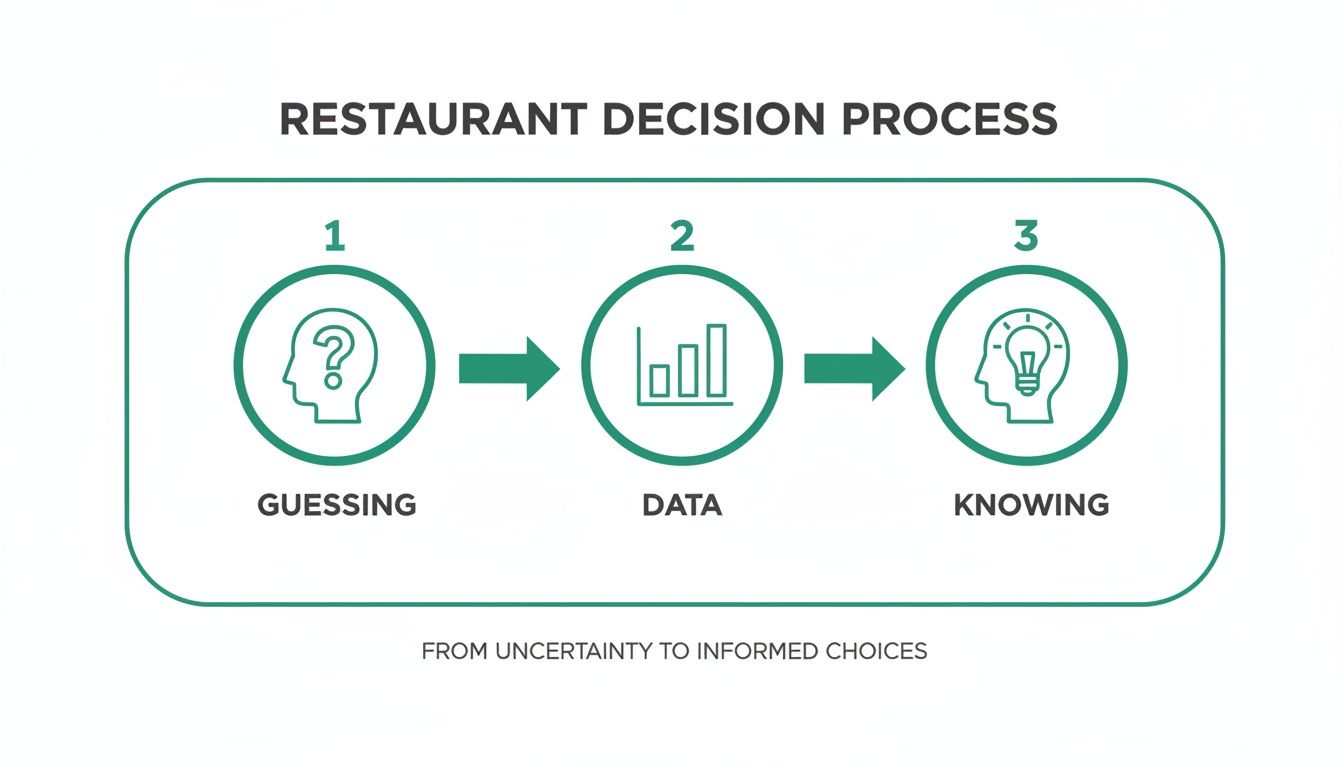
This workflow shows exactly how you move from guesswork and uncertainty to making confident choices backed by data. It’s the difference between saying "I think we're busy on Fridays" and "I know we need two extra servers from 7 PM to 8:30 PM."
Good restaurant analytics software connects the dots between your menu, your staff, and your sales, revealing patterns you'd almost certainly miss otherwise. For instance, it can tell you:
- Your Real Busiest Hours: Not just Tuesday versus Saturday, but that your sales consistently spike between 7 PM and 8:30 PM on Fridays, letting you nail down your staffing schedule perfectly.
- Your Most Profitable Dishes: It might show you that while your burger sells the most, your salmon dish actually has a 40% higher profit margin. That's a huge tell—maybe it's time to feature the salmon in a promotion.
- Sales Growth Trends: You can see a clear trend line showing how that new marketing campaign has actually boosted your weekend brunch sales over the last month.
The Power Of An All-In-One Platform
This smooth flow of information is exactly why an integrated, all-in-one platform is so powerful. When your analytics are built right into your Café Management Software or restaurant POS, nothing gets lost in translation. Every piece of information lives in one place, giving you a single, reliable view of your entire business.
You don't need to be a data scientist to get value from these tools. The whole point of great software is to do the complex analysis for you and deliver simple, clear takeaways you can act on immediately.
Systems like TackOn Table were designed for this. A mobile POS and simple setup mean you can start gathering useful data right away, without a massive, complicated rollout. Whether you’re running a single food truck or managing several locations, the platform gives you clear, centralized control. It’s a powerful but straightforward alternative to more complex systems like Toast vs Clover, giving you the insights you need without the headache.
By turning raw data into clear reports, restaurant analytics software gives you the power to make smarter, faster, and more profitable decisions. Ready to find out what insights are hiding in your own sales data? Book a demo with TackOn Table to see it for yourself.
Key Restaurant Metrics That Drive Success
Relying on total sales alone to gauge your restaurant's health is like judging a meal by its price tag. It tells you nothing about the quality, the cost of the ingredients, or whether your guests actually enjoyed their experience. To get the full picture, you have to dig deeper into the Key Performance Indicators (KPIs) that restaurant data analytics software brings to light.
These metrics are the vital signs of your business, showing you exactly where you're thriving and where you’re bleeding money.
The industry is catching on fast. The global market for restaurant analytics software was valued at around USD 2.4 billion in 2023 and is expected to explode to USD 6.7 billion by 2033. This isn't just a fleeting trend; it’s a fundamental shift. Restaurants of all sizes are embracing data to stay competitive in a global market projected to hit USD 5.3 trillion by 2027. You can read more about these market trends and what they mean for operators like you.
Essential Restaurant KPIs and What They Reveal
Let's break down the most important KPIs that modern analytics platforms track. Think of this table as your restaurant's dashboard—a quick-glance guide to what's really happening behind the scenes.
| Metric | What It Measures | Why It's Critical for Your Business |
|---|---|---|
| Cost of Goods Sold (CoGS) | The total cost of ingredients and beverages used to create the items you sold. | A high CoGS can signal supplier price hikes, poor portion control, or kitchen waste, directly eating into your profits. |
| Prime Cost | Your CoGS combined with all labor costs (the two biggest expenses). | This is your profitability powerhouse. Keeping it between 55-65% of sales is the gold standard for a healthy bottom line. |
| Table Turnover Rate | How many parties are served at a single table during a specific service period. | It’s a direct measure of efficiency. Too low, and you're leaving money on the table; too high, and you might be rushing guests. |
| Average Check Size | Total sales divided by the number of customers served. | This tells you the average spend per guest and shows whether your upselling and menu engineering efforts are working. |
| RevPASH | Revenue Per Available Seat Hour, a metric for maximizing dining space profitability. | This advanced KPI helps you optimize seating, reservations, and staffing to ensure every chair is generating maximum revenue. |
Each of these numbers tells a story. When you track them together, you get a complete narrative of your restaurant's performance, allowing you to make smarter, faster decisions.
Financial Health and Cost Control
The first place every owner should look is at the costs. If you don't have a firm grip on your expenses, you'll never protect your margins. A platform like TackOn Table gives you a clear, real-time view of these numbers, turning what used to be complex accounting into simple, actionable information.
Your Cost of Goods Sold (CoGS) is a perfect example. It's more than just an expense line; a rising CoGS can be a warning sign of anything from supplier price increases to inefficient portioning in the kitchen.
Then there's Prime Cost, arguably the most important number for profitability. By combining your CoGS and labor costs, it gives you a powerful snapshot of your core expenses. For most successful restaurants, the sweet spot for prime cost is between 55% and 65% of total sales. If your number creeps above that, it's a clear signal that either food costs or labor are out of whack.
Operational Efficiency and Guest Experience
Beyond the bottom line, you need to understand how smoothly your restaurant runs day-to-day. These metrics measure the flow of your service and the value you get from every single guest. A good Restaurant POS with built-in analytics makes tracking this stuff almost automatic.
Your table turnover rate isn't just a number—it's a direct reflection of your service speed, kitchen efficiency, and customer satisfaction. A small improvement here can lead to a significant boost in nightly revenue.
The Table Turnover Rate is a classic. A slow turnover on a busy night means lost revenue, plain and simple. On the other hand, if it’s too fast, you risk making customers feel hurried and unwelcome. It’s all about finding that perfect balance.
Similarly, your Average Check Size tells you how effective your team is at upselling and creating a valuable guest experience. Using a mobile POS from TackOn Table, servers can see opportunities to suggest a dessert or a premium drink right at the table, directly boosting that number.
Finally, for those who want to get really strategic, there’s Revenue Per Available Seat Hour (RevPASH). This advanced metric shows how well you're monetizing your physical space, helping you make smarter decisions about seating layouts and reservation policies.
Tracking these KPIs is no longer a luxury for big chains. Modern café management software has made these powerful insights accessible to everyone. As a leading Toast vs Clover alternative, TackOn Table puts this data at your fingertips in a way that’s easy to understand, so you can make immediate adjustments to pricing, staffing, or promotions.
Ready to see how your restaurant's metrics stack up? Start your free trial and get the insights you need to succeed.
Turning Restaurant Data Into Smarter Decisions
Knowing your key metrics is one thing. Actually using them to make smarter, faster decisions is where the real magic happens. Good data analytics software doesn't just spit out numbers; it hands you a clear roadmap for fixing what's broken and finding opportunities you didn't even know existed.
Let's get practical and look at how real restaurant owners put this stuff to work.
Imagine a café owner who’s been struggling with labor costs that are all over the map. Instead of just gut-feeling her way through the schedule, she pulls up her hourly sales reports. The data tells a story: there's a serious sales dip every single weekday between 2 PM and 4 PM. Yet, she’s still staffed up like it's the middle of the lunch rush.
Armed with that simple insight, she adjusts the schedule, cutting one server during that slow afternoon window. The result? She slashes labor costs by 15% without hurting service when it actually matters, which flows right back to her bottom line. That's the kind of high-impact decision data makes possible.
Uncovering Hidden Opportunities in Your Operations
Data isn't just about plugging leaks; it’s also about finding new revenue streams you might have totally missed.
Take a food truck operator trying to figure out where to park for the weekend. Instead of just picking a spot that feels busy, he starts tracking sales by location with his mobile POS. A few weeks later, the numbers are crystal clear. The downtown spot is great for steady weekday lunch traffic, but the park-side location on Saturdays brings in 40% more revenue per hour. Boom. He immediately pivots his weekend strategy to maximize his earnings. It's all about being in the right place at the right time, backed by proof.
This proactive approach is fast becoming the industry standard. The Restaurant Business Intelligence & Analytics Software market was valued at US$632 million and is on track to hit US$1,065.2 million by 2030. That growth is being fueled by restaurants using BI tools to analyze everything from sales patterns to customer behavior, with early adopters reporting they can make decisions 20% faster.
Scaling Success Across Multiple Locations
For restaurant groups, centralized data isn’t a nice-to-have; it's the only way to survive. It’s what lets you maintain consistency, replicate success, and manage a complex business without having to be everywhere at once. A multi-location brand, for example, can use a system with robust multi-location control like TackOn Table to see how all its branches stack up against each other.
The main analytics dashboard might show that the "Spicy Chicken Sandwich" is a bestseller at three locations but is seriously underperforming at the other two.
By digging into the data, managers can stop guessing and start asking the right questions. Is the recipe off? Is the staff at those two locations not upselling it? Is the pricing different? Centralized data turns a vague problem into a specific, solvable one.
Once they pinpoint the issue—maybe it's a simple training gap—they can roll out a fix across the board. This ensures a star menu item performs like a star everywhere, lifting the entire group's performance.
This is where a true all-in-one platform really shines. Instead of fighting with separate reports from different systems, TackOn Table gives you a single, clear picture of your entire operation.
- Standardize Your Winners: Spot your top-selling menu items and promos, then easily push them out to all locations for consistent wins.
- Optimize Staffing Across the Board: Analyze sales trends from every branch to build smarter schedules that keep labor costs in check without sacrificing service.
- Maintain Brand Consistency: Ensure your menu, pricing, and promotions are identical everywhere, creating a reliable experience that keeps customers coming back.
These aren't just hypotheticals; they show the real, tangible return you get from good analytics. The right system pays for itself by helping you cut costs, drive sales, and just plain operate more efficiently. Curious what that looks like for you? Use our interactive tool to calculate your savings with TackOn Table and see the potential firsthand.
Integrated data isn't a luxury anymore. It's the engine for profitability in the modern restaurant world, giving you the clarity to make confident choices that push your business forward.
How To Choose The Right Restaurant POS With Analytics
When you’re looking for the right restaurant data analytics software, you’ll quickly run into a fundamental choice: do you go with a standalone tool or a fully integrated, all-in-one system? It might be tempting to piece together different software, but that approach often ends up creating data silos, constant integration headaches, and a lot of hidden costs.
For most modern restaurants, the smarter path is a unified POS system with analytics built right in.
The whole point is to find a solution that delivers clear, actionable insights without a massive learning curve. Let’s be honest, you’re a restaurateur, not a data scientist. Your software should be doing the heavy lifting for you, not the other way around.
This isn’t just a trend; it's where the entire industry is heading. The restaurant management software market is on track to hit USD 17.1 billion by 2032, growing at an impressive 18.1% annually. Why the surge? After the recent industry shake-ups, a whopping 78% of restaurants are making digital tools a top priority. As market analysis reports show, cloud-based systems are leading the charge, giving owners the flexibility and access they need to thrive.
The All-In-One Advantage
An all-in-one Restaurant POS like TackOn Table bridges the gap between your day-to-day operations and your data. Since the analytics are baked directly into the system that handles every order, payment, and inventory count, the insights you get are immediate and, most importantly, accurate.
You can finally say goodbye to manual data exports, frustrating syncing issues, and that nagging feeling that your numbers aren't telling the whole story.
This integrated approach delivers a few huge wins:
- Effortless Setup: You can be up and running in under 30 minutes. Forget about complex installations that take days; TackOn Table is built for speed and simplicity.
- Real-Time Insights: Your data is always live. This means you can make sharp decisions based on what’s happening in your restaurant right now, not what happened last week.
- Lower Total Cost: One subscription gets you everything. This is a much cleaner and more affordable model than juggling multiple software vendors and their compounding fees.
An all-in-one system creates a single source of truth for your entire business. It connects every transaction to every report, giving you a complete and trustworthy picture of your restaurant’s health.
Key Features To Look For In Your Café Management Software
As you weigh your options and look at Toast vs Clover alternatives, it’s crucial to focus on the features that actually deliver value without adding complexity. You want a tool that simplifies your life, not one that gives you more homework.
Here are the four things you should demand from any platform:
- A Truly User-Friendly Interface: Your dashboard should be intuitive. It needs to present key metrics—like your top-selling items and peak business hours—in a clean, visual way. If you can't understand your data at a glance, you're not going to use it.
- Seamless POS Integration: The analytics must be native to the POS system. This is non-negotiable. It guarantees that every shred of data, from sales to staffing, is captured and analyzed automatically without any extra work from you.
- Multi-Location Control: If you’re growing your brand, you need the ability to see and compare performance across all your locations from one central dashboard. TackOn Table gives you that powerful, centralized control for easy management.
- Transparent Pricing: Don’t get locked into a system with confusing contracts and surprise fees. Look for a provider with clear, straightforward pricing that can grow with your business. You can check out our simple and transparent pricing plans to see just how affordable powerful analytics can be.
Simplicity vs Complexity
When you put an all-in-one solution next to a cobbled-together system, the choice becomes pretty clear. Patching together different tools creates a ton of unnecessary work and opens the door to costly errors. An integrated system, on the other hand, is built from the ground up for efficiency.
Let's break down the real-world differences.
TackOn Table vs. Traditional Analytics Solutions
| Feature | TackOn Table (All-in-One POS) | Standalone Analytics Software |
|---|---|---|
| Setup Time | Under 30 minutes, designed for immediate use. | Can take days or weeks to integrate and configure. |
| Data Accuracy | Real-time and automatic, pulled directly from sales. | Relies on manual exports or APIs that can break. |
| Ease of Use | Intuitive dashboards designed for restaurant owners. | Often complex, requiring technical expertise to navigate. |
| Total Cost | One predictable subscription fee for everything. | Multiple subscriptions and potential integration costs. |
Ultimately, choosing the right platform is about investing in a tool that will save you time and give you clarity. With its mobile-first design, lightning-fast setup, and powerful built-in analytics, TackOn Table is designed to do exactly that.
Ready to see how an all-in-one system can transform your operations? Book a personalized demo and discover what your data can do for you.
Making Data Your Most Valuable Ingredient
We've walked through how data has become the secret sauce for modern restaurants. It's no longer a tool just for the big chains; it's a vital ingredient for any successful restaurant, café, or food truck looking to get ahead. Today's all-in-one platforms have put powerful restaurant data analytics software within reach, making it affordable and surprisingly simple to use. When you start looking at your business through a data-driven lens, you can fine-tune your menu, sharpen your operations, and build a stronger, more profitable restaurant from the ground up.
The trick is to find a tool that fits your workflow, not one that makes you change it. Instead of wrestling with a patchwork of complicated systems, a single, integrated solution gives you the clarity you need to make decisions with confidence.
When you turn raw numbers into real, actionable insights, you give your team the freedom to focus on what they do best: creating an incredible experience for your guests.
This is exactly why we built TackOn Table. With its mobile POS, dead-simple setup, and powerful multi-location management, it’s designed to help you turn those insights into action right away. We stripped away the complexity you often find with analytics, creating a powerful but flexible Toast vs Clover alternative.
Ready to see what your own data is trying to tell you? It's time to unlock your restaurant's true potential.
Start Your Free Trial or Book a Demo today
Your Top Questions About Restaurant Analytics Answered
Jumping into the world of data analytics can feel a little overwhelming, so it’s natural to have questions. Let's clear up some of the most common ones so you can feel confident about what this technology can do for your restaurant.
Do I Need to Be a Data Scientist to Use This Stuff?
Not at all. In fact, it's quite the opposite. Modern platforms like TackOn Table are built for restaurant owners and managers who are juggling a million things at once—not for data analysts.
The whole point is to take all that complicated data and present it through simple, visual dashboards. You can instantly see your best-selling dishes, your busiest times of day, or your sales trends with just a few clicks. It's about getting straight to the answers without ever needing to touch a spreadsheet.
Will Analytics Actually Make a Difference for My Small Café or Food Truck?
Absolutely. Analytics isn't just for big chains anymore. For a small café, it could be as simple as discovering that your new lavender latte is bringing in 20% more repeat customers. For a food truck, it means you can track sales by location to figure out which street corner is really your moneymaker.
Modern analytics tools are designed to be accessible. Affordable, cloud-based systems level the playing field, giving independent operators the same kind of powerful insights that larger chains have been using for years to get ahead.
It's all about making smarter, data-backed decisions, no matter your size. If you have more questions, you can find a lot more answers in our complete restaurant software FAQs.
How Is an Integrated POS with Analytics Different from a Standalone Tool?
Think of it as the difference between a custom-built kitchen and one where all the appliances are from different brands that don't quite fit together. An integrated system, where analytics is part of your Restaurant POS from the start, is a seamless experience.
All your data—sales, inventory, staff hours, customer orders—flows into one central place automatically. You don't have to waste time exporting reports or wrestling with software that won't sync up. This gives you a single, reliable source for real-time information, which saves a ton of time and cuts down on the human error that often comes with juggling separate tools.
What’s the Easiest Way to Get Started?
Your best bet is to start with an all-in-one restaurant management platform that has analytics built right in. This approach removes all the technical hurdles right from the get-go.
For instance, with a platform like TackOn Table, you can finish the easy setup in under 30 minutes. As soon as you're up and running, the system begins gathering data. A great first step is to just look at your sales report, find your top-selling menu item, and use that single piece of information to make your very next marketing decision. It’s that simple.
Ready to stop guessing and start knowing what truly drives your restaurant's success? TackOn Table offers the all-in-one solution you need to turn everyday data into your most powerful tool for growth.
Book a Demo to see firsthand how our platform provides the clarity you need to run a smarter business.