Inventory control is one of those behind-the-scenes jobs that can either make or break a small restaurant, café, or food truck. At its core, it’s about managing your stock to boost your profits and slash your waste. This isn't just about counting boxes in the walk-in; it's a smart system for making sure you have exactly what you need for a slammed Saturday night, without burning cash on ingredients that will just spoil on the shelf.
Getting that balance right is the secret sauce to a healthier bottom line.
Why Smart Inventory Control Is Your Biggest Profit Lever
The real difference between a bustling café and one that's barely scraping by often comes down to what's happening in the stockroom. When inventory control is an afterthought, it becomes a silent profit killer. You end up with wasted food, surprise stockouts during the weekend rush, and customers who leave disappointed.
Think about it: a popular coffee shop running out of espresso beans on a Saturday morning isn't just an inconvenience. That's a direct hit to your sales and your reputation.
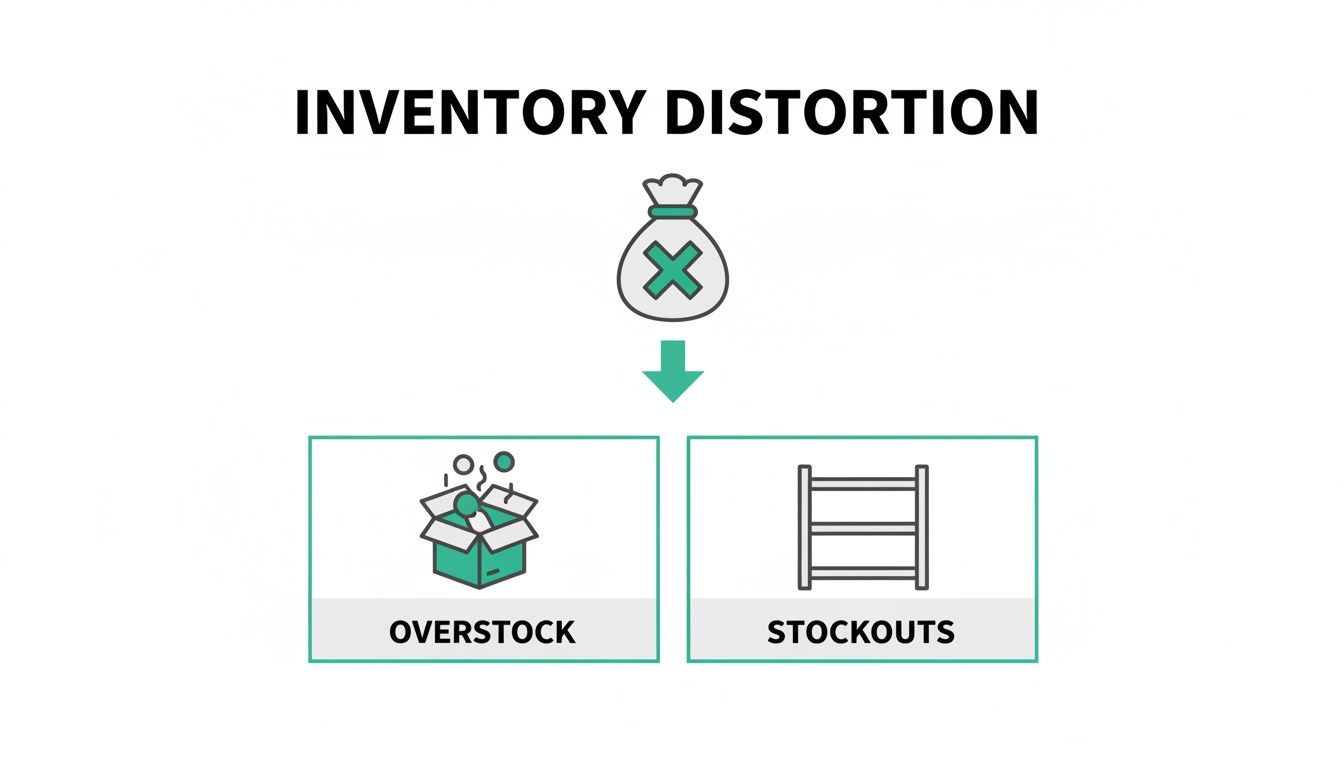
This costly mix of having too much (overstock) and not enough (stockouts) has a name: inventory distortion. The financial damage is shocking. Globally, inventory distortion wipes out around $1.1 trillion in retail value every single year. For a small restaurant, sloppy management can cost you up to 11% of your annual revenue in losses you could have easily avoided.
Let's put that in perspective. If your business does $800,000 in sales, that’s nearly $88,000 gone—money that should have been pure profit. The good news? Tightening up your process can cut inventory costs by about 10%. You can explore more inventory management statistics to get the full picture of the impact.
Moving Beyond Manual Spreadsheets
So many owners start out with a spreadsheet. It seems simple enough, but it quickly becomes a massive headache. They're a huge time sink, they're loaded with human errors, and they give you zero real-time information about what's actually happening in your business.
By the time you finish a manual count and find a problem, the damage is already done. This is where a modern, all-in-one platform like TackOn Table completely changes the game. Instead of being a chore you dread, inventory control becomes your most powerful tool for driving profitability.
A great inventory system gives you clarity. It tells you exactly what sold, when it sold, and how much you need to reorder, turning guesswork into a clear, data-driven strategy for growth.
An integrated system like TackOn Table connects every single sale from your mobile POS directly to your stock levels. When a server puts in an order for a latte, the system automatically deducts the milk, coffee, and syrup from your digital inventory count.
This kind of real-time tracking gives you the accuracy you need to make smart, profitable decisions on the fly. You can even use our savings calculator to get a quick estimate of how much your business could save by getting its operations in order. TackOn Table is designed with all-in-one simplicity to turn inventory chaos into a clear path to profit, with an easy setup that gets you running fast.
Picking the Right Inventory Control Methods for Your Restaurant
There's no one-size-fits-all solution when it comes to managing restaurant inventory. The best method for a bustling café is probably different from what a high-end steakhouse or a nimble food truck needs. The key is to understand the different approaches and then pick and choose what works for your specific menu, sales volume, and even the size of your storeroom.
Think of it like having a set of chef's knives. You wouldn't use a cleaver for delicate garnish work, right? The same logic applies here. You need to match the right inventory strategy to the right ingredient to keep waste down and profits up.
When you get it wrong, you end up with "inventory distortion"—a fancy term for having either way too much cash tied up in overstocked ingredients or losing sales because you've run out of a key item. Both scenarios hurt your bottom line.
Let's break down the most common and effective methods to help you avoid that trap.
First-In First-Out (FIFO)
This is the golden rule of any kitchen. FIFO (First-In, First-Out) is a simple but non-negotiable principle: use the oldest stock first. It’s what you do instinctively when you rotate milk cartons in your home fridge, pushing the new one to the back.
In a restaurant setting, this means organizing your walk-in and dry storage so that older products are always used before newer deliveries. For anything perishable—produce, dairy, meat—FIFO is your first line of defense against spoilage. Of course, proper stock rotation goes hand-in-hand with food safety; this guide to food handler certificate training is a great resource for getting your team up to speed.
ABC Analysis
Let's be honest: not all your inventory items carry the same weight. A case of truffle oil is a much bigger deal than a box of salt packets. ABC analysis is a smart way to prioritize your attention by sorting items based on their financial impact.
Here’s how it works:
- 'A' Items: These are your most valuable products. Think filet mignon, premium liquor, or fresh lobster. They might only make up 20% of your inventory items but can account for up to 80% of your total inventory cost. You need to watch these like a hawk with frequent, careful counts.
- 'B' Items: These are the workhorses of your kitchen—mid-range items like chicken breasts, standard cheeses, and house wines. They're important but don't need the same obsessive tracking as your 'A' items. Regular checks are sufficient.
- 'C' Items: This group includes your low-cost, high-volume stuff like flour, sugar, spices, and napkins. While you can't run out of them, their low value means you can manage them with less frequent, more relaxed inventory counts.
This method stops you from wasting time counting every last salt shaker and instead focuses your energy where it really counts—on the items that can make or break your budget.
Par Level Inventory
The Par Level system is one of the most practical and straightforward methods out there. You simply set a minimum quantity—the "par"—for each item that you should always have on hand. When your stock count dips below that number, it’s the trigger to reorder. Simple as that.
For instance, a coffee shop might set its par level for whole bean espresso at 20 pounds. During the morning shift, a quick check shows they're down to 15 pounds. That's the signal to place an order to get back up to par. It takes the guesswork out of ordering and turns it into a predictable routine.
A good Par Level system acts like a safety net. It prevents that dreaded moment when you tell a customer you're out of their favorite dish during the dinner rush.
Just-In-Time (JIT) Ordering
A bit more advanced, Just-In-Time (JIT) ordering is exactly what it sounds like: you order ingredients to arrive right when you need them for service. It’s perfect for operations with very little storage space, like a food truck, or for farm-to-table restaurants that build their brand on using ultra-fresh, daily-delivered produce.
The big win with JIT is that it dramatically cuts down on storage costs and virtually eliminates spoilage from overstocking. The catch? It demands incredibly accurate sales forecasting and suppliers who are as reliable as a Swiss watch. If a delivery is late, you might have to 86 a menu item for the night. It's a high-risk, high-reward strategy that isn't for everyone.
Comparing Inventory Methods for Your Business
Choosing the right mix of these methods is the secret sauce. To make it easier, here’s a quick breakdown to help you see which approach might be the best fit for different parts of your operation.
| Method | How It Works | Best For | Pros | Cons |
|---|---|---|---|---|
| FIFO | Use the oldest stock first to ensure freshness. | All restaurants, especially those using perishable goods. | Reduces spoilage, ensures food quality, simple to implement. | Requires disciplined staff and organized storage. |
| ABC Analysis | Categorize items by value ('A' high, 'B' mid, 'C' low). | Restaurants with diverse menus and price points. | Focuses time on high-value items, optimizes control efforts. | Can be time-consuming to set up categories initially. |
| Par Level | Reorder when stock drops below a set minimum quantity. | High-volume staples like coffee, flour, or house wine. | Prevents stockouts, simplifies ordering, easy for staff to follow. | Can lead to overstock if par levels aren't updated with sales trends. |
| JIT | Order ingredients to arrive just before they're needed. | Food trucks, fine dining with daily specials, limited storage. | Minimizes waste and storage costs, ensures peak freshness. | Highly dependent on supplier reliability, high risk of stockouts. |
Ultimately, you'll probably use a combination of these. You might use Par Levels for your dry goods, apply strict FIFO for everything in the walk-in, and use ABC analysis to keep a close eye on your prime rib and high-end scotch.
A modern Restaurant POS like TackOn Table is built to handle this kind of blended approach. It can send automated alerts for par levels, give you the sales data you need for JIT forecasting, and help you categorize inventory for ABC analysis, making it a powerful Toast vs Clover alternative designed with the affordability and adaptability small food businesses need.
How POS Software Automates Your Inventory Management
Let's be honest: manual counts and clunky spreadsheets are a massive time sink. In today's fast-paced food business, a modern Restaurant POS system is your new best friend. It acts as the central brain for your entire operation, turning inventory control from a dreaded chore into a smart, automated process that practically runs itself. It’s what connects the front of the house to the back, making everything work together seamlessly.
Picture this: a server takes an order for a bacon cheeseburger and a latte on a handheld POS. The moment they hit "send," the ticket fires to the kitchen and the bar. But behind the scenes, something else happens instantly. The system automatically subtracts one burger patty, one bun, two slices of cheese, two strips of bacon, and the exact amounts of espresso and milk from your digital stock count. This happens for every single sale, in real time.
That kind of live tracking gives you an incredible level of accuracy that a spreadsheet could never hope to match. You’re no longer waiting until the end of the week to find out you're out of avocados. You see your stock levels change with every order, giving you a live, up-to-the-minute look at what you have on hand.
The Power of an All-in-One Café Management Software
The real magic happens when your POS, sales data, and inventory are all part of the same system. When they're integrated, the software does all the heavy lifting for you. This is where tools like TackOn Table really shine, offering a simple but powerful solution that puts automation within reach for any small business.
With an easy setup that takes less than 30 minutes, you can easily tie your menu items to the ingredients they use. For instance:
- Menu Item: "Classic Margherita Pizza"
- Linked Ingredients: 1 dough ball, 4 oz tomato sauce, 3 oz mozzarella, 5 fresh basil leaves.
Once you’ve done that, every Margherita pizza you sell automatically deducts those specific ingredients from your inventory count. This is about more than just tracking; it’s about getting smart, actionable insights. You can see at a glance what’s selling best and which ingredients you’re burning through, all from one clean dashboard.
Go Beyond Basic Tracking with Smart Features
A truly great POS inventory system does more than just subtract items—it helps you build a smarter, more profitable business. For growing brands, features like multi-location control are a game-changer, letting you monitor stock levels across all your cafes or food trucks from a single screen.
This shift to digital isn't just a "nice-to-have"; it's a competitive necessity. While 46% of small and medium businesses have adopted inventory software, a surprising 17% still aren't using any dedicated tracking tools. Considering overall inventory accuracy in retail sits at a dismal 63%, businesses using automated systems gain a massive advantage. They often see stockouts drop by 30% and operational efficiency jump by up to 50%. You can explore detailed inventory management statistics to get a better sense of the impact.
TackOn Table is built with the unique features that get you these kinds of results:
- Low-Stock Alerts: Set custom par levels for your key ingredients. The system then pings you automatically when it's time to reorder, saving you from those last-minute panic runs to the store.
- Supplier Management: Keep all your vendor info organized in one place. You can even generate purchase orders right from the system based on real sales data and current stock levels.
- Waste Tracking: Easily log any spoiled or wasted items. This keeps your inventory numbers perfectly accurate and helps you pinpoint where you might be losing money on food costs.
An integrated POS doesn't just count your inventory—it gives you the data to control it. It turns sales information into smart purchasing decisions, preventing waste and maximizing profit on every plate.
A Superior Toast vs Clover Alternative
For too long, powerful inventory tools felt out of reach for small businesses, trapped inside the complex and expensive systems of providers like Toast or Clover. TackOn Table was designed to change that. We offer an affordable, flexible, and refreshingly simple platform that gives you all the power without the headaches. Our streamlined mobile POS lets your team serve customers anywhere—tableside, at the counter, or even curbside—while every order feeds that crucial data right back into your inventory system.
By automating your inventory, you free up countless hours of manual work, get rid of costly human error, and gain the clarity you need to make better business decisions. You're no longer just guessing what to order; you’re making choices backed by data that directly boost your bottom line. Take a look at the full range of TackOn Table's inventory and management solutions for restaurants to see how an all-in-one system can work for you.
Ready to stop guessing and start automating?
Book a Personalized Demo Today
Tracking the Inventory KPIs That Actually Matter
Just knowing what you have on the shelf is only half the story. If you really want to get a grip on your inventory, you need to measure what actually moves the needle for your business. This is where Key Performance Indicators (KPIs) come in. Think of them less as boring metrics and more as a financial report card for your stock. They show you what's working, what's not, and where your money is really going.
It’s a bit like a chef tasting a sauce. You don’t just check if the pot is full; you analyze its balance, its flavor, and how it complements the main dish. Inventory KPIs do the same thing for your stock, giving you a clear picture of its financial performance so you can make smarter, more profitable decisions.
The good news? With a modern Café Management Software like TackOn Table, tracking these numbers isn't some complex accounting chore anymore. It becomes an automatic, intuitive part of your daily routine.
Inventory Turnover Ratio
If you only track one KPI, make it this one. The Inventory Turnover Ratio is one of the most powerful metrics for any restaurant because it tells you how many times you sell through your entire stock over a certain period. A high turnover is usually a fantastic sign—it means your ingredients are flying off the shelves (and are fresh!), and your cash isn't locked up in products that just sit there.
For instance, a high turnover for fresh fish is exactly what you want. It means you're selling it fast while it's at peak quality. On the flip side, a really low turnover on that expensive bottle of wine might be a red flag. That bottle is just taking up space and capital without making you a dime.
This KPI is a direct measure of how efficient your operation is. A healthy turnover rate shows you're hitting that sweet spot between meeting customer demand and keeping waste to a minimum.
Here’s the formula to calculate it:
Cost of Goods Sold (COGS) / Average Inventory Value = Inventory Turnover Ratio
Of course, a system like TackOn Table calculates this for you automatically in its reporting dashboard. You can spend less time punching numbers into a calculator and more time figuring out what the trends mean for your business.
Sell-Through Rate
While turnover gives you the 30,000-foot view, the Sell-Through Rate zooms in on individual items. This metric shows you the percentage of a product you sold compared to the amount you brought in from your supplier. It's the perfect way to judge whether that new menu special or seasonal cocktail was a hit or a miss.
Let's say you ordered 100 portions of a limited-time pumpkin spice cheesecake and sold 85 of them in October. Your sell-through rate is a solid 85%. That tells you it was a huge success. But if you only sold 15 portions (a 15% rate), you know not to bother bringing it back next year without some serious tweaks.
The formula is dead simple:
(Units Sold / Units Received) x 100 = Sell-Through Rate (%)
This KPI is your secret weapon for fine-tuning your menu. It helps you double down on the dishes your customers truly love and cut the ones they’re ignoring.
Gross Margin Return on Investment (GMROI)
Finally, we have the king of profitability metrics: Gross Margin Return on Investment (GMROI). This tells you exactly how much profit you make for every single dollar you invest in inventory. It reveals which items are your true moneymakers. A high GMROI means an item isn't just selling well—it's selling profitably.
You might discover that your gourmet burgers have a fantastic sell-through rate, but their GMROI is pretty low because of the high cost of that premium beef. At the same time, your simple house-made pasta dish might have a stellar GMROI because its ingredients are cheap, but you can sell it at a great price point. This is the kind of insight you need for smart menu engineering.
Here’s how you calculate it:
Gross Profit / Average Inventory Cost = GMROI
Understanding your GMROI helps you focus your energy and marketing on the items that deliver the biggest bang for your buck, ensuring every dollar you spend on inventory is working as hard as you do.
TackOn Table’s all-in-one platform makes keeping an eye on these KPIs effortless. By connecting sales data from our mobile POS directly with your inventory levels, the system gives you real-time dashboards that bring these numbers to life. You can instantly spot your turnover rate, analyze sell-through on a new special, and identify your most profitable items, turning complex data into clear, actionable steps for growth.
Ready to see how easy it is to track the metrics that matter?
Start Your Free Trial of TackOn Table Today
Using Sales Data for Smarter Forecasting and Ordering
Great inventory control isn't just about counting what’s on your shelves today. It’s about getting good at predicting what you’ll actually need tomorrow, next week, and even next month.
If you're just guessing, you're going to make expensive mistakes. You'll either over-order fresh ingredients that spoil and get thrown out, or you'll run out of a key item right in the middle of a dinner rush. The good news is, the key to stopping the guesswork is already sitting in your sales records.
Your POS system is a goldmine of information about what your customers love to buy and when they buy it. By digging into that data, you can shift from just reacting to your inventory levels to proactively planning for them. It’s the difference between ordering based on a hunch and ordering based on hard facts.
Turning POS Data into Real-World Insights
Every single sale you ring up tells a part of a larger story. Are you always selling more steaks on Fridays? Do soup sales shoot up every time the weather gets chilly? Spotting these kinds of patterns is the first step to truly smart ordering.
A modern system like TackOn Table does more than just process payments; its analytics dashboard automatically flags these trends for you. You can see your best-selling dishes, your busiest times of the week, and seasonal shifts without having to piece it all together from old reports. That clarity is what lets you build a sales forecast you can actually trust.
For instance, if your data clearly shows you sell an average of 50 burgers every Saturday, you know exactly how many buns, patties, and slices of cheese to have on hand. No more over-ordering "just in case." This is how you run a lean, strategic, and ultimately more profitable restaurant.
From Forecasting to Smarter Ordering
Once your forecast is solid, the next logical step is to make your ordering process easier. Instead of building purchase orders from scratch every time, a good system can generate them for you based on those sales trends and your current stock levels. It closes the loop between knowing what you need and actually getting it delivered.
A truly smart inventory system doesn't just show you the past; it helps you prepare for the future. It turns historical sales data into an intelligent ordering tool that protects your cash flow and prevents waste.
TackOn Table makes this surprisingly straightforward. Here’s how it works:
- Identify Bestsellers: The system instantly shows you which dishes are most popular, so you never run out of the ingredients for your biggest moneymakers.
- Track Ingredient Usage: Since menu items are linked to their recipes, you get a precise look at how much ground beef or lettuce you're using week to week.
- Set Smart Reorder Points: You can set dynamic par levels that automatically adjust for things like seasonal demand, taking the guesswork out of reordering.
This kind of proactive management makes a huge difference in your day-to-day operations and your bottom line. In fact, data-driven forecasting is quickly becoming the standard for small restaurants that want to turn inventory control from a headache into a profit center.
Companies that embrace demand forecasting tools often see a 10–15% reduction in their overall inventory levels, which frees up a ton of cash. And it doesn't stop there; businesses using analytics report cost reductions around 20%, with real-time data boosting stock accuracy by about 35%. You can find out more about the latest inventory management research here.
When you start using your own sales data, you stop reacting to inventory problems and start preventing them from ever happening. The result is less food waste, healthier cash flow, and a business that runs on intelligent insights instead of hope.
Ready to turn your sales data into your most powerful business tool?
Book a Personalized Demo of TackOn Table
Ready to Take Full Control of Your Restaurant's Inventory?
Inventory control isn't some complex puzzle only big restaurant chains can solve. For a small business like yours, it’s the absolute foundation of a healthy, profitable operation.
As we've walked through in this guide, relying on old-school manual counts and spreadsheets is a direct path to food waste, missed sales, and a whole lot of stress. The answer isn’t working harder; it’s working smarter with a system built for the real-world chaos of a restaurant, café, or food truck. It’s time to stop letting profit leak out of your storeroom.
The right technology gives you the confidence to finally get a handle on your stock. That’s where TackOn Table comes in, giving you all the essential tools you need in one straightforward, affordable package.
Why TackOn Table Is the Smarter POS for Your Restaurant
We built our platform from the ground up to solve the problems we saw small food businesses facing every single day. We packed in powerful features but kept the interface simple, creating the perfect alternative for owners who feel overwhelmed and overpriced by systems like Toast or Clover.
Here’s what you get with TackOn Table:
- A Simple Mobile POS: Your team can take orders and payments from anywhere, and every single sale updates your inventory counts instantly. No more guessing what's left.
- Seriously Effortless Setup: You can get your entire system live in under 30 minutes. Our team is right there with you to make sure it's a smooth process.
- Multi-Location Control: Juggling more than one spot? Manage stock levels, update menus, and pull reports for all your locations from one clean dashboard.
- All-in-One Simplicity: Sales, inventory, staff management, and analytics—everything you need to run your business is finally in one place.
Don’t just manage your inventory—master it. The right system turns your stockroom from a source of stress into your biggest driver of profitability.
To dive even deeper into perfecting your back-of-house, check out these Top Inventory Management Best Practices for Commercial Kitchens. It's a great resource for taking your operations to the next level.
Experience the difference for yourself and see just how easy it can be to manage your inventory like a pro.
Ready to see how TackOn Table can change the game for your business? Request a free trial today and take the first real step toward total inventory control.
Frequently Asked Questions
Jumping into inventory control for your small business can feel overwhelming. You've got questions, and we've got answers. Here’s what we hear most often from fellow owners of restaurants, cafes, and food trucks.
{ "@type": "Question", "name": "What is the first step in setting up inventory control for my small restaurant?", "acceptedAnswer": { "@type": "Answer", "text": "Everything starts with a full, physical count. Before you can track anything, you need to know exactly what you have. That means counting every single item in your storeroom, walk-in, and bar to get a solid baseline. Don't rush this part—accuracy is everything. Once you have that master list, you can plug it into a system like TackOn Table. Our platform is built to make this easy. You'll create your inventory items, set ideal stock levels (or par levels), and connect them right to your menu recipes. Our team even walks you through it with free setup and training, so you’re working with good data from the very beginning." } }
{ "@type": "Question", "name": "How can a POS system reduce food waste?", "acceptedAnswer": { "@type": "Answer", "text": "A smart Restaurant POS like TackOn Table tackles food waste in a few key ways. For starters, real-time tracking stops you from over-ordering because you always know what you have on hand. Next, detailed sales reports show you which menu items are gathering dust, letting you adjust ordering or run a special to move that product before it goes bad. Finally, connecting your sales data directly to your inventory reveals the true cost of every dish, helping you make smarter purchasing decisions that cut down on spoilage." } }
{ "@type": "Question", "name": "Is an integrated inventory system affordable for a small café or food truck?", "acceptedAnswer": { "@type": "Answer", "text": "Definitely. It used to be that this kind of tech was only for the big chains, but that’s changed. Modern cloud-based systems like TackOn Table are built with small businesses in mind, offering clear, affordable pricing with no scary long-term contracts. The cost of the software is quickly offset by the savings you'll see from reduced food waste, fewer emergency supply runs, and better cash flow management. It's an investment that pays for itself." } }
{ "@type": "Question", "name": "Can I manage inventory for multiple locations with TackOn Table?", "acceptedAnswer": { "@type": "Answer", "text": "Yes, our platform is designed to scale right alongside you. TackOn Table's multi-location control is a huge advantage for businesses that are expanding. It gives you a single dashboard to monitor and manage inventory across every one of your restaurants or food trucks. You can check sales data, track stock levels, and even transfer ingredients between locations if one spot runs low. It gives you the operational consistency you need to maintain quality and profit as you grow, making it a powerful Toast vs Clover alternative for ambitious owners." } }
Ready to see how an all-in-one system can simplify your inventory control and boost your profits? TackOn Table is designed for the speed and simplicity that small businesses need.
Book a Demo Today