Calculating your overhead rate is refreshingly simple. Just divide your total monthly overhead costs by your total monthly revenue, then multiply that number by 100 to get a percentage. This single figure tells you exactly how much of every dollar you earn is eaten up by the essential, non-food, non-labor costs that keep your business running.
Getting a handle on this formula is the first real step toward taking full control of your restaurant's finances.
Why Your Overhead Rate Is the Most Important Number You're Not Watching
Staring at a profit and loss statement can feel like trying to read a foreign language. But what if one metric could cut through the noise and give you a clear, honest snapshot of your restaurant's financial health?
For any food business, from a local food truck to a multi-location café chain, that number is your overhead rate. It's a total game-changer.
Knowing this figure helps you sidestep huge miscalculations, like setting menu prices too low to be profitable or, even worse, expanding before your finances are truly solid. Every dish you sell has to cover more than just its ingredients; it has to chip in for the rent, the electricity, and the marketing that keep your doors open.
The True Cost of Doing Business
In an industry famous for its razor-thin margins, understanding your overhead is a matter of survival. A recent study found that restaurants that calculated their overhead monthly managed to cut waste by 15%, which boosted their net margins from an average of 5% to 8%. That’s a massive jump. You can find more insights on overhead rate formulas and their impact over at Wall Street Prep.
This isn't just a boring accounting chore. It's a powerful tool for building a sustainable business. When you know your overhead rate, you can make smarter, more confident decisions about:
- Menu Pricing: You can finally be sure that every item is priced to cover all its associated costs, not just the food.
- Budgeting: It becomes much easier to forecast your expenses and put your money where it matters most.
- Operational Efficiency: You can spot where costs are creeping up and find real opportunities to trim the fat without hurting quality.
- Growth Strategy: It gives you a clear answer to whether you have the financial stability to open a new location or invest in that shiny new espresso machine.
Think of it this way: Your overhead rate tells you the bare-minimum cost of opening your doors each day. A lower rate means more of every dollar you earn goes straight to your bottom line.
Keeping track of all these numbers without a headache requires a modern, all-in-one platform. TackOn Table offers powerful and intuitive café and restaurant management solutions that simplify everything from sales tracking to cost analysis. With a mobile POS and multi-location control, you get a live, real-time view of your financial health, making it easier than ever to calculate and manage your overhead.
Ready to see how an all-in-one system can give you control over your costs?
Book a Personalized Demo
Pinpointing Every Restaurant Overhead Cost
Before you can even think about calculating your overhead rate, you have to get a perfectly clear picture of every single indirect cost. These are all the expenses that keep your lights on and your doors open but aren't directly tied to the food you buy or the hourly wages of your kitchen and serving staff. Getting this list right is the absolute foundation of an accurate calculation.
Think of it like building a house. If you get the foundation wrong, everything else you build on top of it will be unstable. The same goes for your overhead; missing even a few small costs will throw off your numbers, leading you to make bad decisions on everything from menu pricing to staffing.
Fixed vs. Variable Overhead: A Simple Breakdown
Your overhead costs can be sorted into two main buckets. Understanding the difference is crucial for smart financial planning and forecasting.
-
Fixed Costs: These are your predictable, consistent expenses that you pay every single month, no matter if you're slammed or having a slow week. They're the steady pulse of your business. This includes things like your monthly rent or mortgage, insurance premiums, salaried manager pay, and recurring software subscriptions (like your POS system).
-
Variable Costs: These expenses go up and down with your business activity. When you have a busy month, these costs will naturally rise. Think of your utility bills (gas, electricity, water), marketing and advertising spending, and those pesky credit card processing fees that climb with every sale.
One of the most common mistakes restaurant owners make is miscategorizing costs. For example, a manager's salary is a fixed overhead cost, but the overtime you pay an hourly cook during a busy holiday rush is a direct labor cost, not overhead. To really nail this, you need solid strategies for how to track business expenses — it’s the only way to build a truly accurate list.
Uncovering Hidden and Often Forgotten Costs
It’s easy to remember the big stuff like rent and utilities. But so many new restaurant owners completely miss the smaller, sneaky costs that quietly drain their profits day after day. A truly comprehensive list ensures nothing falls through the cracks.
Pro Tip: Building your master list of costs isn't just a boring accounting task—it’s a strategic deep-dive that shows you the real price of keeping your restaurant running. An all-in-one system like TackOn Table, which is a powerful Toast vs Clover alternative, makes this so much easier by pulling all these expenses into one place for you.
To help you get started, here's a table breaking down the typical overhead costs you'll encounter.
Common Restaurant Overhead Costs by Category
This table outlines the typical fixed and variable overhead costs that most restaurants deal with. Use it as a starting point to make sure you're not missing anything in your own financial tracking.
| Category | Fixed Overhead Examples | Variable Overhead Examples |
|---|---|---|
| Occupancy | Rent/Mortgage, Property Taxes, Building Insurance, CAM Fees | Water, Gas, Electricity Bills |
| Administrative & Tech | Restaurant POS software, Accounting/Payroll Services, Internet/Phone, Manager Salaries | Credit Card Processing Fees, Office Supplies (paper, ink) |
| Operations | Pest Control Contracts, Waste Removal Services, Recurring Licenses/Permits | Cleaning Supplies, To-Go Containers, Napkins, Replacement Smallware |
| Marketing | Website Hosting, Social Media Management Fees, PR Retainers | Online Advertising (PPC), Print Ads, Special Event Promotions |
| Maintenance | Scheduled HVAC service, Hood Cleaning Contracts, Landscaping Services | Emergency Equipment Repairs, Plumbing Issues, Incidental Maintenance |
Remember, this isn't an exhaustive list, but it covers the major areas where indirect costs hide. Every restaurant is unique, so take the time to customize this for your specific operation.
Once you have this detailed list of every single cost, you've got the raw data needed for the next step: plugging it into the right formula.
Choosing the Right Overhead Formula for Your Restaurant
Once you have all your overhead costs tallied up, the next crucial step is picking the right formula to make sense of it all. This isn't a one-size-fits-all situation. The best way to calculate your overhead rate really depends on the kind of restaurant you're running.
Think about it: a high-volume café where coffee beans and milk are the biggest line items is a completely different beast than a fine-dining spot where the sommelier's salary is a major expense. If you use the wrong formula, you'll get a skewed picture of your finances, which can lead to some seriously bad decisions.
Revenue-Based Method for Cafés and QSRs
The simplest and most direct way to look at overhead is the revenue-based method. You just divide your total overhead costs by your total revenue for a given period. It's the perfect fit for quick-service restaurants (QSRs), food trucks, and busy coffee shops where success is all about volume.
This approach tells you exactly what percentage of every dollar you earn is immediately consumed by overhead. For a business built on speed and a high number of transactions, it’s a straightforward and powerful way to keep a pulse on your financial health.
This decision tree gives you a quick visual guide for sorting your costs before you even touch a calculator.
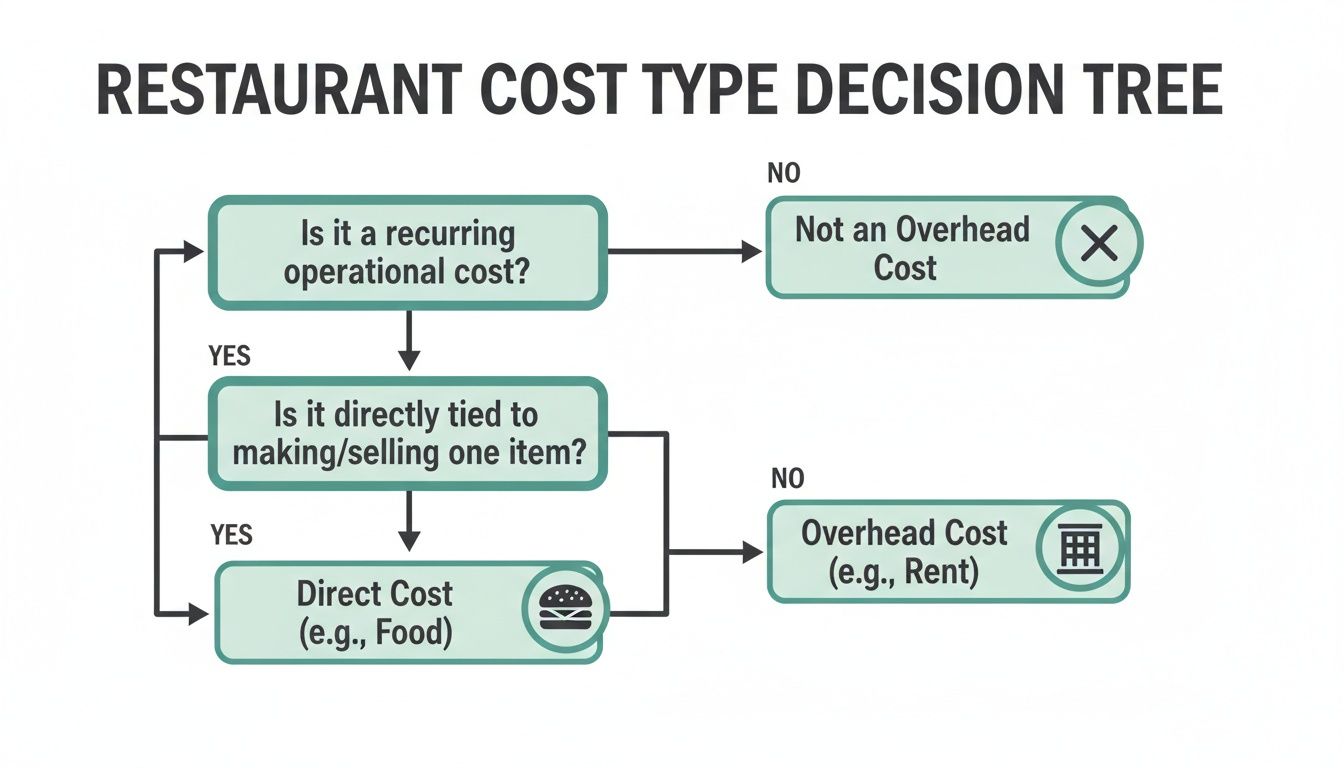
As you can see, if a cost pops up regularly but isn't directly tied to a specific dish you sell, it belongs in the overhead bucket. Getting this distinction right from the start is fundamental to an accurate calculation.
Labor-Based Method for Full-Service Restaurants
On the other hand, for full-service restaurants, bistros, or any place where service is a huge part of the experience, the labor-based method often tells a much more useful story. This formula shines when the skill and cost of your staff are major drivers of both your brand and your bottom line.
For service-heavy restaurant groups and bistros that use TackOn Table for staff and inventory management, looking at overhead as a ratio of labor provides a really precise way to allocate costs. The formula is: Overhead Rate (%) = (Total Overhead ÷ Direct Labor Costs) × 100.
Let's walk through an example. Imagine a full-service bistro with $500,000 in annual direct labor costs. Its overhead totals $125,000, which breaks down into:
- $60,000 for rent
- $20,000 for utilities
- $30,000 for managers' salaries
- $15,000 for maintenance
Plugging those numbers in gives you an overhead rate of 25%. This tells the owner that for every dollar spent on labor, another 25 cents goes toward overhead. That’s critical information for pricing labor-intensive menu items correctly. For a deeper dive, you can explore more about the importance of overhead calculations.
Tying overhead to labor costs reveals the true cost of service. It’s a detail that some of the big-name Toast vs Clover alternatives can make surprisingly difficult to track, but it's central to the TackOn Table philosophy of clarity and simplicity.
Picking the right formula isn’t just an accounting chore—it's a strategic decision that shapes how you price your menu, schedule your staff, and plan for growth. TackOn Table’s all-in-one platform, with its mobile POS and effortless setup, gives you instant access to the sales and labor data you need to apply either of these formulas with total confidence.
Ready to see how simple it can be to get the right data for your calculations?
Start Your Free Trial Today
Putting the Numbers to Work: Overhead Rate Examples in Action
Alright, let's get out of the weeds of theory and into the real world. Seeing the math play out with actual numbers is where the lightbulb really goes on. We'll walk through three very different restaurant models—a food truck, a small café chain, and a classic full-service spot—to give you a solid blueprint you can adapt for your own business.
Before you start, you'll need to pull the right documents. Grab your recent Profit & Loss (P&L) statement and your latest payroll reports. These are your sources of truth for all the costs we've been talking about.
The Food Truck: A Revenue-Based Approach
Food trucks live and die by their variable costs. Sure, your fixed expenses are lower, but things like propane, generator fuel, and commissary kitchen fees can swing wildly depending on your event schedule and how busy you are. It’s a completely different ballgame.
Let's cook up some numbers for "The Rolling Taco." Last month, things looked like this:
- Total Revenue: $15,000
- Total Overhead Costs: $4,500 (This includes commissary rent, insurance, marketing, POS fees, fuel, etc.)
For this model, the simplest formula works best: (Total Overhead ÷ Total Revenue) x 100.
Plugging in the numbers, we get: ($4,500 ÷ $15,000) x 100 = 30%.
That 30% is a critical number. It means that for every single dollar The Rolling Taco brings in, 30 cents is already spoken for just to keep the lights on and the truck on the road.
The Multi-Location Café: Using Consolidated Data
Once you're running more than one shop, you have to see the big picture. This is where consolidating all your financial data becomes non-negotiable. A modern café management software like TackOn Table makes this a breeze, rolling up the data from all your locations into one clean dashboard.
Let's check in on "Morning Grind," a three-location coffee shop.
- Total Consolidated Revenue (all locations): $90,000
- Total Consolidated Overhead (all locations): $27,000
We use the same formula: ($27,000 ÷ $90,000) x 100 = 30%.
The overhead rate for the entire business is 30%. Armed with this consolidated view, the owner can now dig deeper. They can compare individual store performance and quickly spot if one location has unusually high utility bills or maintenance costs that need attention.
For a business like a café, you can get even more granular by calculating overhead per item. If one Morning Grind location has $10,000 in monthly overhead and sells 5,000 lattes, the overhead cost per latte is $2. This kind of insight is pure gold when you're setting your menu prices.
The Full-Service Restaurant: A Labor-Based Method
In a full-service restaurant, labor isn't just a cost—it's a huge part of the product. The experience your servers and kitchen staff provide is what people are paying for. That's why tying your overhead directly to your labor costs can give you a much more insightful look at your operation.
Let's sit down at "The Gilded Spoon."
- Total Direct Labor Costs (hourly kitchen/serving staff): $40,000
- Total Overhead Costs: $30,000
Here, we'll switch to the labor-based formula: (Total Overhead ÷ Direct Labor Costs) x 100.
The math looks like this: ($30,000 ÷ $40,000) x 100 = 75%.
This tells the owner something powerful: for every dollar they spend on direct labor, they need to budget an additional 75 cents to cover overhead. It’s an essential metric for accurately pricing those complex, labor-heavy dishes on the menu.
The real key to making this work consistently is to automate your data inputs. When you use an all-in-one system, you eliminate the tedious (and error-prone) manual entry and get reports in real time. You can even model out different scenarios with our free restaurant savings calculator to see how small changes could impact your bottom line.
Using a Modern Restaurant POS to Automate Overhead Tracking
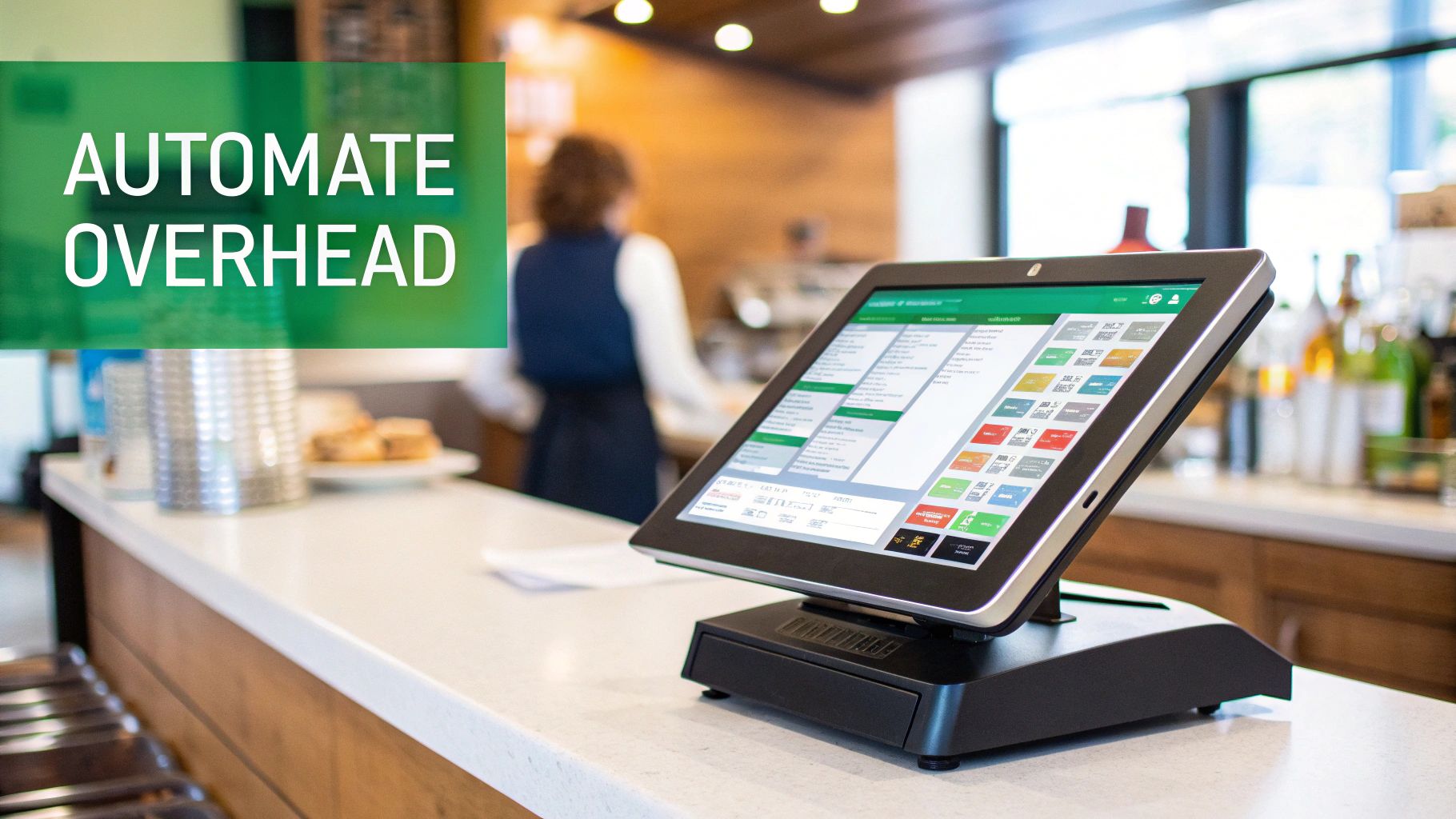
Let's be honest, manually crunching overhead numbers in a spreadsheet is a painful process. It’s slow, tedious, and one simple typo can send your entire financial strategy off course. You didn't get into this business to become a data entry clerk.
This is exactly where a modern restaurant management system changes the game. Instead of spending hours wrestling with numbers from different sources, you can put the whole process on autopilot.
An all-in-one platform like TackOn Table pulls every piece of financial data you need into one place. Your sales, labor costs, inventory expenses, and even utility bills are all captured in real-time and live in a single, easy-to-read dashboard. This isn't just about making life easier; it's about getting numbers you can trust.
From Manual Drudgery to Real-Time Insight
The real magic happens when you turn a dreaded quarterly task into a continuous stream of business intelligence. Good reporting and analytics dashboards do the heavy lifting, turning raw numbers into clear, actionable information.
You no longer have to wait until the end of the month to figure out where you stand. You can spot cost trends as they emerge, giving you the power to make smart, data-driven decisions on the fly. And for operators looking to automate more than just financials, this guide on A Restaurant Owner's Guide to QR Codes for boosting business and trimming costs is a great resource.
A modern POS system gives you back your most valuable asset: time. By automating data collection and reporting, you can stop crunching numbers and start using them to actually grow your business.
Why All-in-One Simplicity Wins
A truly integrated system acts as the single source of truth for your entire operation. It cuts through the guesswork and eliminates the data silos that happen when you're trying to stitch together different software for different tasks. We built TackOn Table on this very principle.
With a TackOn Table Restaurant POS, you get a clear, complete picture:
- Centralized Data: All sales, labor, and cost data are automatically synced. No more manual imports or exports.
- Real-Time Reporting: Pull up P&L statements, sales trend reports, and labor cost analyses instantly.
- Multi-Location Control: If you're running more than one spot, you can consolidate financials with a single click to calculate a business-wide overhead rate.
- Easy Setup: You can be up and running in less than 30 minutes, a huge departure from the complex setups of many other systems.
This clarity and control are what make TackOn Table a powerful tool for restaurant owners. For a side-by-side look at how our platform compares to other big names, check out our TackOn Table vs Clover and Square comparison. Our whole approach is about giving you an affordable, adaptable solution to manage overhead proactively, not reactively.
Ready to stop guessing and start knowing?
Book a Personalized Demo Today
Answering Your Top Questions About Restaurant Overhead
Even with the formulas laid out, it's normal to have a few lingering questions. Let's walk through some of the most common ones I hear from restaurant owners to make sure you're totally clear on how to calculate your overhead rate and, more importantly, how to use it.
What’s a Good Overhead Rate for a Restaurant?
Everyone wants that one magic number, but the truth is, it depends. A healthy overhead rate for most restaurants usually lands somewhere between 25% and 35% of your total revenue.
But context is everything. A food truck with minimal fixed costs might happily sit at the low end of that scale. On the other hand, a sprawling fine-dining spot in a high-rent district could be perfectly healthy operating closer to the top of that range.
The real key isn't hitting a specific number; it's watching the trend. If you see a sudden spike, that’s your red flag. It’s time to dig into your indirect costs and find out what changed.
Should I Include Manager Salaries in Overhead?
Yes, you absolutely should. The salaries for your non-production team—think general managers, bookkeepers, or a marketing person—are textbook examples of fixed overhead. They're critical to keeping the lights on and the business running, but they aren't directly making the food that goes out to a table.
On the flip side, the hourly wages for your line cooks, servers, and baristas are considered direct labor costs. You'll want to keep those separate from your overhead calculation, especially if you’re using one of the labor-based formulas we talked about.
How Often Should I Calculate My Overhead Rate?
Do it at least once a month. Seriously. Waiting a full quarter to check in is a recipe for disaster. It leaves you wide open to hidden cost increases that can silently chip away at your profits for weeks before you even realize something is wrong.
Think of monthly calculations as a proactive management tool, not just a reactive accounting task. This rhythm helps you spot trends early, make quick adjustments, and keep a firm grip on your restaurant's financial pulse.
This is where modern restaurant POS systems like TackOn Table really shine. They give you access to real-time data, so you can pull current reports whenever you need them instead of waiting for your bookkeeper to close out the month.
Can I Lower My Restaurant's Overhead Rate?
You bet. Trimming your overhead is one of the quickest ways to fatten up your profit margins. A great place to start is by auditing all your recurring expenses.
- Talk to your suppliers. Can you renegotiate better pricing on non-food items like cleaning supplies, linens, or takeout containers?
- Audit your software subscriptions. Are you still paying for tools you barely use? Moving to an all-in-one system can often save you a surprising amount of cash.
- Get smart about utilities. Simple things, like training your staff on energy-saving habits, can make a real dent in those monthly bills.
Remember, every single dollar you manage to cut from your overhead drops directly to your bottom line.
Ready to stop wrestling with spreadsheets and get your overhead calculations on autopilot? With its straightforward setup and powerful controls for single or multiple locations, TackOn Table delivers the real-time data you need to make smarter financial decisions.
Book a Free, Personalized Demo