Think of a mobile card reader as a pocket-sized payment terminal. It's a small, portable device that lets restaurants, bustling cafes, and food trucks take card payments from literally anywhere. When integrated into a powerful mobile POS system, it connects to a smartphone or tablet so you're ready to process transactions on the spot—a must-have for any modern food business that wants to deliver fast, convenient service.
Why a Mobile Card Reader is Essential for Restaurant POS Systems
Remember the clunky, stationary payment terminal? That single, counter-tethered machine created logjams at the register and had staff sprinting back and forth with credit cards. Moving to a mobile card reader is like ditching your old landline for a smartphone—it cuts the cord and opens up a new world of efficiency and freedom.
This isn't just a minor upgrade; it's a fundamental shift in how restaurants operate. The global market for these devices is booming, with projections showing a massive USD 28.8 billion jump between 2023 and 2028. This growth isn't about technology for technology's sake; it's a direct response to a real need for faster, more flexible payment options in the food and beverage industry.
Boosting Speed and Service Quality in Your Café or Restaurant
A mobile card reader completely transforms the payment experience. Instead of being a slow, clunky final step, it becomes a smooth, integrated part of the meal. When you equip your team with a handheld mobile POS from TackOn Table, you empower them to take payments wherever they're needed.
- Tableside Payments: No more awkward waits. Servers can take payment right at the table, swipe the card, and close the check in seconds.
- Line-Busting: Got a long queue during the lunch rush? Staff can walk the line, taking orders and payments to get everyone served faster.
- Off-Site Transactions: Perfect for catering gigs, farmers' market stalls, or pop-up events. A mobile reader means you can make a sale anywhere you do business.
This adaptability is a game-changer for businesses that aren't tied to a single location. For example, having the right mobile setup can be the difference between a frustratingly long queue and a line of happy, well-fed customers. A great mobile POS for food trucks is crucial for this.
By bringing payments directly to the customer, restaurants can see up to 40% faster order processing and slash the errors that come from manual entry. This isn't just about making things easier; it's about building a smarter, more profitable business.
As you plan your restaurant, think of this technology as a core part of your foundation. Our guide works hand-in-hand with resources like this detailed step-by-step guide on how to start a restaurant. A mobile card reader tied into an all-in-one system like TackOn Table isn’t just another gadget—it’s a vital ingredient for success.
How Mobile Payment Technology Works for Café Management Software
Think of a mobile card reader as the crucial link between your customer’s credit card and your bank account. It’s the device that takes a physical tap, dip, or swipe and translates it into a secure, digital transaction, all from a gadget that fits in the palm of your hand. For any modern restaurant, café, or food truck, this isn't just tech; it's a tool for better service.
These little powerhouses usually connect to your main POS device, like an iPad or smartphone, in one of two ways: Bluetooth or Wi-Fi. Bluetooth is your go-to for tableside ordering and line-busting, creating a stable, close-range connection that doesn't rely on your often-overloaded Wi-Fi. On the other hand, Wi-Fi is fantastic for bigger spaces where your staff needs to roam freely across a wider area.
This simple flowchart lays out the very first decision you need to make.
The takeaway is clear: the way you run your service—whether you’re behind a fixed counter or weaving between tables—is the single biggest factor in choosing the right hardware.
From Swipe to Tap: The Evolution of Payment Types
Today's mobile card reader has to be ready for anything. Customers expect to pay their way, so your device needs to be a jack-of-all-trades to keep the checkout line moving.
- Magstripe (The Old-School Swipe): We all know this one. It reads the data off the magnetic stripe on the back of a card. It works, but it’s the least secure method out there and is quickly becoming obsolete.
- EMV (The Secure "Dip"): That little chip on the front of every modern card is a game-changer for security. When a customer "dips" their card, the chip creates a unique, one-time code for that specific transaction, making it incredibly tough for fraudsters to clone.
- NFC (The Speedy Tap): Near Field Communication is the magic behind contactless payments. It’s what powers Apple Pay, Google Pay, and those tap-to-pay cards. For a busy counter-service spot, nothing beats the speed and convenience of a simple tap.
You can think of these security features as a digital armored truck for every transaction. They operate silently in the background, making sure every dollar is protected from the moment a card is presented until it lands safely in your account.
Why Security Is Not Optional
When you accept card payments, you're also accepting the huge responsibility of protecting your customers' sensitive information. Two terms you absolutely need to know are PCI compliance and end-to-end encryption (E2EE).
PCI compliance is the industry's rulebook for handling card data safely. E2EE takes it a step further by scrambling that data the instant the card is read, making it completely useless to anyone who might try to intercept it.
This is where an integrated system really shines. A platform like TackOn Table handles all this for you, building these protections right into the hardware and software. That built-in security means you can stop worrying about compliance and focus on what you do best—serving fantastic food. When you look at the whole picture of modern payment gateway integration, it's clear that a secure, unified system isn't just a nice-to-have; it's the only way to operate.
Key Features to Look For in a Restaurant Mobile Card Reader
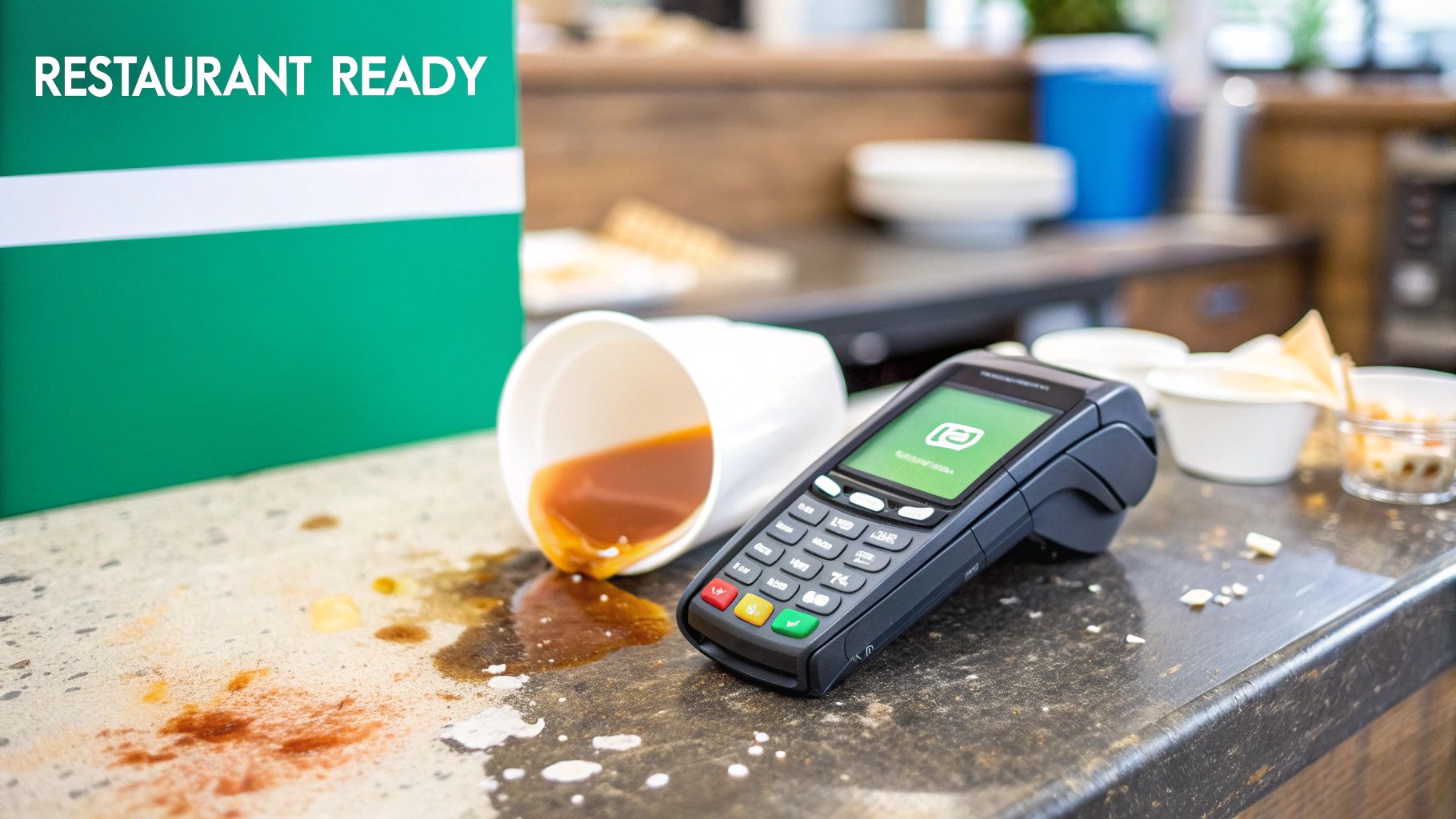
A mobile card reader that works for a quiet retail shop just won't cut it on a chaotic restaurant floor. The environments are worlds apart. Spills, drops, and the constant pace of service demand hardware built specifically for the restaurant industry. Getting the right features isn't about chasing the latest tech fad; it's about preventing a meltdown during your busiest dinner rush.
Think of it like this: you wouldn't use your family minivan to haul lumber. You'd get a pickup truck. In the same way, your mobile card reader needs to be a rugged, reliable workhorse, not just a simple payment device.
Battery Life That Goes the Distance
The absolute last thing your staff needs during a slammed Saturday night is a dead card reader. A basic, consumer-grade reader might give you a few hours, but a real restaurant device has to power through an entire double shift—from morning prep to the last customer out the door. All-day battery life isn't a "nice-to-have"; it's a fundamental requirement for smooth, uninterrupted service.
When a mobile reader dies mid-shift, it sends your servers scrambling back to a fixed terminal. This creates the exact payment bottlenecks you were trying to solve in the first place and can slow down your table turnover by up to 15%, which is a direct hit to your revenue.
Durability to Survive the Daily Grind
Let’s be honest, restaurants are tough on equipment. Devices get bumped against tables, dropped on hard floors, and splashed with everything from soda to hot soup. A durable, ruggedized mobile reader is non-negotiable. You need hardware that can take a beating and keep on working, so one little accident doesn't bring your entire payment system to a halt.
This is where TackOn Table's all-in-one handheld POS systems really shine. They combine the reader, software, and screen into a single, sturdy unit that's far more resilient than a flimsy reader plugged into a smartphone. We offer a great alternative to Toast vs Clover with hardware that's actually built for the realities of a busy kitchen. You can check out our tough, restaurant-grade mobile card reader and see the difference for yourself.
Offline Mode: Your Ultimate Safety Net
We've all been there: the Wi-Fi suddenly cuts out during a pop-up event or a thunderstorm. What do you do? Without an offline mode, your only options are to turn customers away or jot down card numbers on paper—neither of which is a good look. This feature is your safety net, and it's absolutely critical for any food business, especially food trucks and caterers.
A good offline mode lets your card reader securely save transaction details when the internet is down. As soon as you're back online, it automatically processes all the queued payments. It turns a potential disaster into a minor hiccup.
- Take Payments Anywhere: Keep the line moving, even if your internet connection is spotty or completely gone.
- Keep Data Secure: All payment information is encrypted and stored safely until a connection is restored.
- Prevent Lost Sales: You never have to say "we're cash only right now," protecting your bottom line.
Nailing these three features—long battery life, serious durability, and a reliable offline mode—is the foundation of a solid mobile payment strategy. With TackOn Table's all-in-one design, these capabilities are already built-in, giving you a powerful system designed to keep your restaurant running, no matter what the shift throws at you.
The Power of a Fully Integrated POS System with Multi-Location Control
Grabbing a standalone mobile card reader can feel like an easy win, but it often creates more headaches than it solves. When you're juggling a separate payment device and your main point of sale, you’re signing up for a chaotic workflow. Think manual entries, painful end-of-day reconciliation, and sales data that just never seems to match up.
It’s a recipe for mistakes and wasted time. Imagine a server takes an order on a tablet, then has to hunt down a separate card reader. They punch the total from the POS into the reader, hoping they don't make a typo. Later, a manager is stuck trying to make sense of sales reports from two different systems. It's tedious, frustrating, and prone to error.
Creating a Single Source of Truth
This is where an all-in-one, integrated system like TackOn Table completely changes the game. Our all-in-one simplicity ensures that your mobile card reader is a native part of your POS, so every single transaction flows through one seamless, automated system. No more double entry. No more manual math.
When a payment is processed on a TackOn Table handheld, the system instantly gets to work:
- The order status flips from open to paid.
- Your inventory levels are adjusted in real-time.
- The sale is synced with all your financial reports.
This creates a single source of truth for your entire business. Every piece of data, from your best-selling dishes to your daily revenue, is accurate and available on demand. You can finally stop guessing and start making smart, data-driven decisions that actually grow your restaurant.
Centralized Control for Multi-Location Restaurants
For anyone running more than one location, this unified approach isn't just convenient—it's essential. An integrated system gives you the power to see everything happening across your entire enterprise from one dashboard. You can check sales at all your cafes, push a menu update to every food truck, and manage staff permissions from anywhere, at any time.
TackOn Table's cloud-based platform delivers this crucial multi-location control. It simplifies management and keeps your brand consistent, which is exactly what separates thriving restaurant groups from those bogged down by operational chaos.
The entire industry is moving toward this kind of unified commerce. The huge demand for mobile card readers is driven by the need to bridge the gap between online and in-person payments, with the market projected to grow by USD 60,937.5 million by 2030. A cloud-based platform like TackOn Table helps you do just that, unifying orders and payments from all channels and reducing errors by up to 95%. Discover more insights about omnichannel convergence.
Choosing a fully integrated system is more than a convenience—it's about building a scalable, efficient, and profitable future.
Ready to see how an all-in-one system can transform your operations? Book a personalized demo and discover the power of TackOn Table.
A Practical Checklist for Choosing Your System
Picking the right mobile card reader and POS system can feel like a huge task, but if you break it down into a simple checklist, it becomes much more straightforward. Think of it less as just buying hardware and more like choosing a long-term partner for your restaurant, café, or food truck. The goal here is to find a solution that’s transparent, dependable, and ready to grow right alongside you.
It's no surprise that mobile card readers are everywhere. The global market was valued at a massive USD 25.41 billion in 2024 and is expected to explode to USD 133.54 billion by 2035. This isn't just a trend; it's a fundamental shift in how businesses operate. As you start looking at your options, use this checklist to ask the hard questions and steer clear of common traps. You can see more on these mobile payment market trends if you want to dig deeper.
Evaluating Costs and Contracts
First things first: you need a crystal-clear understanding of what this is really going to cost you. Plenty of providers love to hide fees in the fine print, so you have to look past the shiny advertised monthly rate. A genuinely affordable system is one with no surprises.
- Hardware Costs: Is the card reader and other equipment included, leased, or a separate purchase? TackOn Table keeps it simple with an all-in-one handheld POS, so you aren't stuck trying to piece together a system from different vendors.
- Transaction Fees: Get a full breakdown of the processing fees. Is it a simple flat rate, or does it change based on the type of card a customer uses? Watch out for confusing tiered pricing that makes it impossible to guess what your bill will be each month.
- Contract Terms: Are they trying to lock you into a multi-year contract with hefty cancellation fees? We believe in earning your business, which is why we offer flexible, month-to-month agreements that give you the freedom to pivot as your business evolves.
Be cautious of "free" hardware offers. They almost always come with the catch of inflated processing fees and ironclad contracts that are nearly impossible to get out of. A transparent partner will be upfront about every single cost, which lets you actually plan your budget with confidence.
Assessing System Features and Support
Once you’ve got the costs nailed down, it's time to make sure the system can actually handle the day-to-day grind of your restaurant. This is where you can tell a generic payment processor from a real-deal restaurant POS. As a leading Toast vs Clover alternative, TackOn Table is built around making things both simple and powerful.
- All-in-One Simplicity: Does the system bring payments, orders, inventory, and reporting together under one roof? Trying to manage a bunch of disconnected systems is just a recipe for chaos. An integrated platform like TackOn Table gives you one central place to see what’s happening across your entire operation.
- Ease of Use: How fast can you get a new server trained and taking orders? An intuitive interface means less time spent in training sessions and more time focused on your guests. Our easy setup means TackOn Table can be up and running in under 30 minutes.
- Customer Support: What’s the plan when something goes wrong during a Saturday night dinner rush? You absolutely need 24/7 support from actual humans. Waiting around for an email reply simply isn’t an option when your payment system goes down.
Using this checklist will help you confidently compare your options side-by-side. You can even use our free savings calculator to see how TackOn Table's straightforward pricing compares to what you're paying now.
Choosing the right system is a big decision, but it doesn't have to be a gamble. Arm yourself with these questions, and you’ll find a partner that delivers on affordability, simplicity, and the rock-solid support you need to thrive.
Ready to see a system that checks all the boxes? Start your free trial today and experience the TackOn Table difference.
Mobile Card Reader FAQs: Your Questions Answered
Jumping into new tech always brings up a few questions. And when it’s something as crucial as how you get paid, you need answers you can trust. Here are the most common things we hear from restaurant, café, and food truck owners who are thinking about making the switch.
What’s the Real Difference Between Mobile and Traditional Terminals?
Think of a traditional terminal as that clunky machine bolted to your counter, tethered by wires. A mobile card reader, on the other hand, is a compact, handheld device that talks to your smartphone or tablet through Bluetooth or Wi-Fi.
This little bit of freedom changes everything. It means you can take payments anywhere—right at the table, down a long line of hungry customers, or even at a pop-up event across town. The key difference is mobility. It’s what lets you speed up service, make paying feel effortless for your guests, and chase business opportunities well beyond your front door.
Are Mobile Card Readers Secure Enough for My Business?
They absolutely are, but with one major condition: you have to choose a provider that takes security seriously. Today's mobile readers are built from the ground up with powerful security features, like end-to-end encryption that scrambles card data the instant it’s swiped or tapped.
On top of that, they must be PCI compliant. This isn't just a buzzword; it's the industry-wide set of rules for protecting sensitive cardholder information. A truly integrated system like TackOn Table bakes these protections right into its hardware and software, so every single payment is handled securely, protecting you and your customers from fraud.
Think of it this way: a secure mobile POS doesn't just process payments; it acts as a digital bodyguard for your customers' data and your restaurant's reputation. This is a non-negotiable feature, not a luxury.
Can I Still Take Payments if My Internet Goes Down?
Yes, you can—but only if your system has a feature called offline mode. This is an absolute lifesaver for any restaurant, especially for food trucks at festivals or cafes in buildings with notoriously flaky Wi-Fi.
Offline mode lets your card reader safely store transaction details even when it can't connect to the internet. As soon as you're back online, the system automatically pushes all those saved payments through. It’s the feature that prevents a temporary internet hiccup from turning into a pile of lost sales.
Do I Need a Separate System for My Mobile Reader?
For the sake of your sanity, please don't. The best approach is always to use a mobile reader that’s part of a single, fully integrated POS system. Trying to juggle a standalone reader that doesn’t communicate with your main POS is a recipe for chaos and late nights spent reconciling reports.
A disjointed setup almost always leads to:
- A higher risk of human error as staff manually punch payment totals into separate devices.
- Headache-inducing reconciliation at the end of the day, trying to make two different reports match up.
- Completely unreliable sales and inventory data, leaving you guessing about your business's true performance.
An all-in-one system like TackOn Table makes sure every order, payment, and inventory item syncs up automatically, in real-time. It’s the only way to get the clean data you need to run your business efficiently and make smart decisions. This simplicity and multi-location control make TackOn Table a powerful Toast vs Clover alternative.
Ready to upgrade to a system that’s simple, secure, and built for your restaurant? TackOn Table offers an all-in-one solution with easy setup and transparent pricing.
Book a demo today and see how our mobile POS can transform your operations.