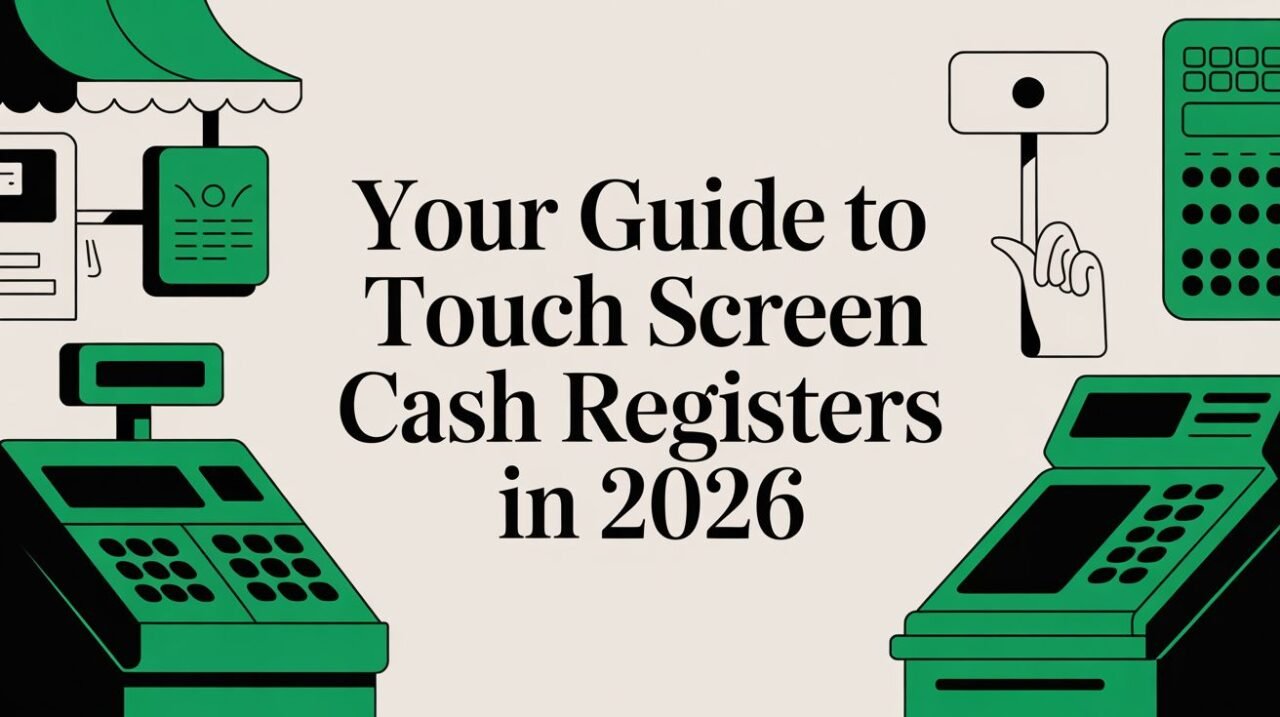
Forget the clunky cash drawers and receipt printers of the past. The modern touch screen cash register has completely changed the game, becoming the central nervous system for today's restaurants, cafés, and food trucks. They've grown far beyond simple transaction tools into powerful, all-in-one command centers for your entire operation.
What Is a Touch Screen Cash Register Today?

Here's the best way to think about it: a traditional register is like a basic calculator. It does one job, and that's it. A modern touch screen system, on the other hand, is like a smartphone powered by a cloud-based point of sale (POS). Sure, it handles payments, but it also runs your inventory, manages staff schedules, tracks customer loyalty, and gives you deep business insights from anywhere you have an internet connection.
This isn't just a minor upgrade; it's a fundamental shift in how restaurants operate. The global market for these systems was valued at a massive USD 7.01 billion in 2024 and is on a steep upward trajectory. Why the boom? Restaurants are ditching outdated hardware to speed up transactions and give customers a smoother experience.
From Register to Restaurant Command Center
Calling these systems "cash registers" almost feels inaccurate now. A modern Restaurant POS weaves every part of your business together into a single, intuitive interface. Instead of wrestling with separate tools for orders, payments, and back-office tasks, a true all-in-one platform like TackOn Table connects everything, offering unmatched simplicity.
To see just how much things have evolved, let’s compare the old with the new.
Traditional Register vs Modern Touch Screen POS
| Feature | Traditional Cash Register | Modern Touch Screen POS (like TackOn Table) |
|---|---|---|
| Primary Function | Basic transaction processing & cash storage. | All-in-one hub for sales, operations, and management. |
| Order Taking | Manual entry; prone to errors. | Digital menus, tableside ordering, online ordering integration. |
| Payments | Cash and basic card swipes. | Accepts tap-to-pay, mobile wallets, QR codes, and online payments. |
| Inventory | Manual, paper-based tracking. | Real-time tracking, low-stock alerts, and ingredient-level management. |
| Reporting | End-of-day sales totals ("Z-report"). | Detailed, real-time analytics on sales, staff performance, and top-selling items. |
| Accessibility | On-premise only. You have to be there. | Cloud-based; access your data from any device, anywhere. |
This table really highlights the jump from a simple tool to a complete business partner. You’re not just ringing up sales anymore; you’re actively managing and growing your business with clarity and authority.
This unification is what gives you real control. For instance, a system like TackOn Table acts as a central hub where you can:
- Take orders and payments anywhere—at the counter, at the table, or through your website.
- Manage your menu across all locations with just a few clicks.
- Track inventory in real time so you never run out of a best-selling dish during a rush.
- View sales reports and analytics to make smarter decisions about staffing, promotions, and menu changes.
A modern POS isn’t just about processing sales. It’s about giving you the tools to run a more efficient and profitable restaurant, simplifying the daily chaos so you can focus on great food and happy guests.
Why Simplicity and Flexibility Are Key
For busy owners of restaurants, cafés, and food trucks, complexity is the biggest roadblock. You need technology that just works, without needing a manual or an IT degree. That’s where the thoughtful design of a system like TackOn Table truly shines. With an easy setup that takes less than 30 minutes and a mobile POS that fits in your pocket, it’s built to adapt to your unique workflow, not the other way around. Its affordability makes it a superior alternative for businesses seeking powerful yet simple solutions.
Whether you're running a single food truck or managing a growing restaurant group with its multi-location control, the right touch screen system is the foundation for success. By bringing your ordering, payments, and back-office tasks together, you finally get the visibility and control you need to thrive. Learn more about TackOn Table's all-in-one restaurant solutions that deliver this power with unmatched simplicity.
Core Features That Boost Restaurant Efficiency

Let's get one thing straight: a modern touch screen cash register is so much more than a till. It's the central nervous system of your restaurant. The right system saves you time, slashes expensive mistakes, and hands you the data you need to make smarter business decisions. A great one, like TackOn Table, rolls all these functions into a single, intuitive platform, showcasing its all-in-one simplicity.
Let’s dig into the core features that actually move the needle for your restaurant.
Seamless and Secure Payment Processing
At its most basic level, your POS has to make getting paid fast, secure, and painless for everyone involved. In today’s world, that means accepting any payment method a customer might pull out, from classic credit cards to their smartphone. This isn’t a nice-to-have anymore; it’s table stakes.
Modern payment processing is built on speed and security. Your system needs to handle these without breaking a sweat:
- Contactless Payments: Tap-to-pay with cards and mobile wallets like Apple Pay or Google Pay are non-negotiable for keeping the line moving.
- EMV Chip Cards: This is the standard for secure transactions, protecting you from liability in fraud disputes.
- Online and QR Code Payments: A must for unifying your in-house dining with the growing demand for takeout and delivery.
And security can't be an afterthought. Your system absolutely must protect customer data with end-to-end encryption and follow strict PCI DSS compliance standards. This isn't just about building trust—it's about protecting your business from the nightmare of data breaches and massive fines.
For instance, a system like TackOn Table bundles all these payment options with top-grade security, ensuring every transaction is both quick and safe. This frees up your staff to focus on hospitality instead of fumbling with a clunky card reader.
Intelligent Inventory Management
We’ve all had that sinking feeling: running out of a key ingredient during the dinner rush. A smart POS system makes that a thing of the past by linking every sale directly to your stock levels. When a server punches in an order for a burger, the system automatically subtracts one patty, one bun, and a slice of cheese from your digital stockroom.
A solid inventory system is like having a digital stock manager who never sleeps. It replaces guesswork with precision, dramatically cutting food waste and making sure you never have to 86 a popular dish again.
This real-time tracking gives you an always-accurate picture of what you have on hand. More advanced systems, often found in modern Café Management Software, can even be set up to send you automatic low-stock alerts when it’s time to reorder. It's a proactive approach that stops money from walking out the door as spoilage and saves you from hours of tedious manual counts.
Powerful Reporting and Analytics
Which dishes are your moneymakers and which are just taking up space on the menu? How did last Friday’s lunch rush compare to this Friday's? A powerful touch screen POS puts the answers right at your fingertips with clear reports and analytics.
Think of it as having a business analyst built right into your register. It should provide simple dashboards showing you things like:
- Sales Trends: Pinpoint your busiest days, hours, and even specific tables so you can dial in your staffing.
- Product Mix Reports: See exactly which items are best-sellers and which are most profitable to help you engineer a smarter, more lucrative menu.
- Employee Performance: Track sales by server to reward your top performers and see who might need a little extra training.
This data is gold. Instead of running on gut feelings, you can use hard numbers to guide every strategic decision, from launching a happy hour on a slow Tuesday to promoting your most profitable dishes. It's a key reason many restaurant owners look for a capable Toast vs Clover Alternative—they want a system that provides clear, actionable insights without the high price tag or complexity.
Simple Staff and Menu Management
Your restaurant is always changing, and your POS needs to be able to keep up. Updating your menu, changing a price, or adding a daily special shouldn't require a call to IT. With a cloud-based system, you can make those changes from anywhere and watch them sync instantly across all your terminals.
That same simplicity should extend to managing your team. A good system allows you to:
- Set Custom Permissions: Decide exactly who can do what, from viewing sales reports to applying discounts or voiding a check.
- Track Hours: Many systems have a built-in time clock, making payroll a breeze.
- Improve Communication: Fire orders directly from a tableside tablet to the kitchen printer, which can lead to up to 40% faster order processing and virtually eliminate miscommunication.
With TackOn Table’s easy setup and straightforward controls, you can manage your menu and your staff in just a few clicks. That all-in-one simplicity means less time drowning in admin work and more time creating an unforgettable guest experience.
Ready to see how these features can transform your restaurant?
Start Your Free Trial or Book a Live Demo to discover the power of an all-in-one system.
Choosing Your Restaurant POS Setup

When you start looking at touch screen registers, one of the first big questions you'll face is about the hardware itself. Should you go with a powerful, fixed terminal at the counter? Or do you need flexible mobile devices for tableside service? Maybe a mix of both? There’s no single right answer—it all comes down to your restaurant’s unique workflow and style.
It’s a bit like deciding between a desktop computer and a laptop. The desktop is a stationary workhorse, powerful and reliable. The laptop gives you freedom and flexibility to work from anywhere. Neither is better than the other; their value is all about the job at hand.
The Stationary Powerhouse
For many restaurants, a fixed touch screen cash register is the command center. This setup is a perfect fit for high-volume spots like a busy bar, a quick-service restaurant with a constant queue, or a café where the line never seems to end.
These systems are built for one thing: performance. They act as the central hub for all orders and payments, with large, easy-to-read screens that make navigating even the most complex menus a breeze. They provide a solid, dependable anchor for your entire operation.
The Flexibility of Mobile POS
This is where things get really interesting. Mobile POS systems, which run on handheld devices like the ones offered by TackOn Table, bring incredible agility to your service floor. You're no longer tethered to a counter; you can take the entire point of sale system directly to your customers.
Just think about how this plays out in the real world:
- Tableside Ordering: A server takes an order right at the table and sends it to the kitchen instantly. This simple change cuts down on handwriting errors and gets food out faster.
- Line-Busting: During that crazy lunch rush, a staff member with a handheld can walk the line, taking orders and payments to keep things moving smoothly.
- Food Truck Efficiency: If you're running a food truck, a mobile POS isn't just a nice-to-have, it's a necessity. You can take payments anywhere, with all your management tools right in your pocket.
The rise of mobile devices is changing the game. While stationary registers still held a dominant 60.5% revenue share in 2024, thanks to their powerful integrations, the real growth is happening with mobile and tablet systems. This shift shows how much the industry is moving toward more adaptable ways of doing business.
The Hybrid Approach: A Best-of-Both-Worlds Solution
For a lot of restaurants, the smartest move isn't choosing one or the other—it's using both. A hybrid approach combines the muscle of a stationary terminal with the freedom of mobile devices. For instance, a full-service restaurant might keep a fixed terminal at the host stand and bar, while servers use handhelds to manage their sections.
To make this work seamlessly, you need a cloud-native platform. Understanding the fundamentals of how to accept credit card payments across these different devices is a crucial first step.
With a system like TackOn Table, every device is perfectly in sync. An order taken on a handheld instantly pops up on the main terminal and is fired to the kitchen, so everyone is always on the same page. This multi-location control and all-in-one simplicity is what makes a modern full-service restaurant POS system so effective.
Understanding the True Cost of Your POS
The price you see on a new touch screen cash register is rarely the price you actually pay. To get a real handle on your budget and dodge some nasty financial surprises later on, you have to look at the Total Cost of Ownership (TCO). This isn't just about the hardware; it’s every single expense that will hit your books over the system's entire life.
Unfortunately, many vendors deliberately muddy the waters, burying fees in the fine print. That flashy "free" terminal? It often locks you into a brutal multi-year contract with terrible support and payment processing rates that creep up over time. It's a classic bait-and-switch that traps far too many restaurant owners.
Decoding Different Pricing Models
As you start shopping around, you'll run into two main ways companies price their POS systems. The first is a big, one-time payment for the hardware and a software license. This is often followed by separate monthly fees for support or essential updates. While "owning" the hardware sounds good, it means a huge upfront cost and can leave you stranded with outdated technology in just a couple of years.
The more common approach today is a subscription, what the tech world calls Software-as-a-Service (SaaS). Here, you pay a predictable monthly fee that bundles the software, support, and sometimes even the hardware. This makes getting started much more affordable and ensures your system always has the latest features and security fixes. The key, however, is to read the fine print and see what’s really included.
A transparent, all-in-one subscription is the smartest way to go for most restaurants. It transforms a jumble of potential expenses into a single, predictable line item, which makes managing your cash flow a whole lot easier.
Your Total Cost of Ownership Checklist
To help you get a clear picture, we've put together a checklist of all the potential costs—both obvious and hidden. Use this table when you're talking to vendors to make sure you're comparing apples to apples and not just a pretty-looking sticker price.
| Cost Category | What to Look For | Questions to Ask Vendors |
|---|---|---|
| Hardware | The initial cost of terminals, printers, cash drawers, and kitchen display systems (KDS). | Is hardware leased or purchased? What are the warranty terms? What happens if a device breaks? |
| Software License | The fee for using the POS software itself. | Is this a one-time license or a recurring subscription? Are future software updates included? |
| Payment Processing | The percentage and per-transaction fees for every credit card payment. | What is your rate structure (flat-rate, interchange-plus)? Are there any monthly minimums or hidden fees? Can I use my own processor? |
| Installation & Setup | The cost to get the system physically installed and configured for your menu and staff. | Is professional installation included? Is there a separate fee for menu programming or data migration? |
| Training | The cost of teaching your managers and staff how to use the new system effectively. | Is on-site or remote training included? Is there a limit on training hours? Do you have online resources? |
| Customer Support | Access to help when things go wrong, especially during a busy service. | Is 24/7 support included? Are there extra charges for after-hours, weekend, or holiday support calls? |
| Add-On Modules | Fees for extra features like online ordering, loyalty programs, or advanced inventory. | Which features are standard and which cost extra? How are these add-ons priced? |
| Contract & Cancellation | The terms of your agreement, including length and any fees for ending it early. | What is the contract length? Is there an early termination fee, and if so, how much is it? |
Thinking through each of these categories forces a much more honest conversation about what you'll really be spending. A vendor who is cagey about answering these questions is waving a major red flag.
Beware of Hidden Fees and Sneaky Charges
This is where you need to put on your detective hat. Some POS providers are notorious for nickel-and-diming their customers with a laundry list of charges they don't advertise. These little fees can quickly turn a supposedly "affordable" system into a huge financial headache.
When you're evaluating any touch screen cash register, you have to ask direct questions about these common hidden costs:
- Payment Processing Rates: Are the rates simple and flat, or are you looking at a confusing interchange-plus model that’s impossible to predict month-to-month?
- Software Updates: Will you get dinged for new features and critical security updates, or are they part of your subscription?
- Customer Support: Is 24/7 help included, or does the clock start ticking (and billing you) every time you call for help, especially during a weekend dinner rush?
- Setup and Training: Are they going to tack on hundreds or even thousands of dollars for installation and training your team?
- Hardware Upgrades: What’s the plan when your hardware gets old? Are you on the hook to buy a whole new setup, or is there an upgrade path?
This is exactly where a straightforward Toast vs Clover alternative can make a world of difference. At TackOn Table, for instance, we built our business around a simple, all-in-one pricing model with no long-term contracts. Free setup, hands-on training, and 24/7 support are all baked in, so the price you see is what you actually pay. You can check out our transparent pricing tiers to see how this approach gives you complete cost certainty.
By asking these tough questions upfront, you can sidestep vendor lock-in and find a partner who’s genuinely invested in your success—not just in getting your signature on a dotted line. The right POS should be a tool that helps you grow, not a constant source of financial stress.
Ready to see how a simple, powerful, and truly affordable POS can change your business? Book a live demo and let us show you how TackOn Table gives you total control without the hidden costs.
How to Implement and Secure Your New System
Switching to a new touch screen register shouldn't feel like a chore. The whole point is to make your life easier, and a smooth, thoughtful rollout is the first step. Getting your new system up and running quickly—while also making sure it's secure from the get-go—sets the foundation for success.
The whole process really boils down to three main stages: getting your data moved over, plugging in the hardware, and getting your team comfortable with it. A clunky, old-school system can drag this out for days and become a real headache. A modern, intuitive one? You could be taking orders by the afternoon.
A Simple Path to Getting Started
We've all heard horror stories about legacy POS systems. They’re notorious for complicated installations that often require a paid technician and several long days just to get the basics working. Cloud-based solutions like TackOn Table were designed specifically to get rid of that friction. The goal should be an easy setup in under 30 minutes, and this is what that looks like in practice:
- Data Migration: Your menu is the heart of your restaurant. A great system lets you import your current menu—items, prices, and all those special modifiers—without forcing you to rebuild it all from scratch.
- Hardware Setup: In this day and age, hardware should just work. Your terminals, printers, and card readers ought to connect and start talking to each other right out of the box, no custom drivers or complicated network settings needed.
- Staff Training: The best systems are the ones that don't need a manual. The interface should be so natural that your crew can pick it up in minutes. A quick walkthrough should be all they need to start taking orders and payments with total confidence.

As you can see, the final cost is more than just the sticker price. It’s a mix of hardware, software, and other fees that you need to account for.
Your Guide to POS Security
Once you're operational, security moves to the front burner. When you run a restaurant, you're not just handling orders; you're safeguarding sensitive customer payment information. Protecting that data is absolutely non-negotiable. It's the bedrock of the trust your customers place in you.
When implementing your new POS, it's vital to protect sensitive customer data and ensure PCI compliance to avoid severe penalties and maintain customer trust. Failing to do so can result in fines that can cripple a small business.
The Payment Card Industry Data Security Standard (PCI DSS) isn't a friendly suggestion—it’s a mandatory set of rules for any business that accepts credit cards. Your POS provider has to be fully compliant, and this shields you from serious liability. It's one of the most important questions you can ask any vendor and a huge reason to stick with a reputable Restaurant POS system.
Beyond just compliance, here are the security essentials you should look for:
- End-to-End Encryption (E2EE): Think of this as a secret code for credit card data. It scrambles the information the second a card is swiped or tapped and keeps it scrambled until it safely reaches the payment processor. Even if a hacker intercepted it, the data would be completely useless.
- Automatic Cloud Backups: Your sales history, customer information, and menu are incredibly valuable. With automatic backups, you can rest easy knowing that if a terminal ever goes down or disaster strikes, you can get your whole operation back online in minutes without losing a thing.
The massive shift to contactless payments—which shot up 16% in Germany alone in late 2023—shows just how much customers want secure, fast transactions. This trend is pushing more businesses to upgrade their systems, fueling a projected 5.4% CAGR for intelligent registers in the U.S. You can dive deeper into this market shift by exploring the latest research on electronic cash registers.
A system like TackOn Table builds security directly into its platform from the ground up, so you can spend your time focusing on great food and hospitality, not worrying about data breaches.
Why a Cloud POS Is Your Best Investment
If you’re serious about helping your restaurant, café, or food truck thrive, your next touch screen cash register has to be a cloud-based POS. This isn't just an upgrade anymore; it's the central nervous system for a modern, competitive business. The cloud is where flexibility, data, and security meet to form a single, powerful system.
Think of an old, traditional system like a cash register physically chained to the counter. All of its data and functions are trapped in that one box. A cloud POS, on the other hand, is like having your entire operation securely accessible from anywhere with an internet connection. That single difference is what unlocks real freedom for a restaurant owner.
The Clear Advantages of the Cloud
We've walked through a lot of features, but they all boil down to a handful of core benefits that only a cloud platform can truly offer. This isn't about adding bells and whistles; it's about making your entire operation smarter and more resilient.
A cloud system gives you:
- Unmatched Flexibility: With a mobile POS, your team isn't stuck behind the counter. They can take orders and payments right at the table, manage a long queue, or even work a pop-up event. This adaptability directly translates into faster service and happier customers.
- Real-Time Data Access: Need to check tonight's sales numbers from your couch? Want to 86 an item on the menu for all locations from your laptop? The cloud makes this a reality, syncing every change instantly across all your devices.
- Seamless Multi-Location Control: For anyone running more than one spot, the cloud is a true game-changer. It gives you one central dashboard to manage menus, track inventory, and see analytics across the entire business, which means consistency and far less guesswork.
- Top-Tier Security: Good cloud POS companies invest a fortune in security. They handle things like end-to-end encryption and automatic cloud backups, protecting your business and customer data from everything from a spilled drink on your hardware to a cyber attack.
A cloud POS isn't just another tool; it's a strategic investment that grows with you. It’s the engine that powers a business built for the future, not one stuck in the past.
The Smart Choice for Modern Restaurants
At the end of the day, the best Restaurant POS is the one that simplifies the daily chaos, not adds to it. It shouldn't lock you into a confusing contract or surprise you with hidden fees. This is where a straightforward and affordable solution like TackOn Table really shines compared to more complex alternatives like Toast vs Clover. It's an all-in-one platform built to deliver powerful features with a focus on easy setup and an intuitive design anyone can learn quickly.
Your touch screen cash register should be a partner in your growth, not a hurdle. By choosing a cloud-based system that is both adaptable and affordable, you’re setting yourself up for a future of efficiency, smarter decisions, and a whole lot more potential.
Ready to see how a simple, powerful, and truly affordable cloud POS can change your business?
Start Your Free Trial or Book a Live Demo to discover the power of TackOn Table.
Frequently Asked Questions
When you're looking at new technology for your restaurant, a lot of questions pop up. Let's walk through some of the most common ones we hear from owners and managers just like you.
How Hard Is It to Set Up a New Touch Screen Cash Register?
That’s a common worry, but the answer really depends on the system you pick. Old, legacy registers could be a real headache, sometimes needing days of work and a paid technician to get running.
Thankfully, modern cloud-based systems like TackOn Table are built for an easy setup. Most owners find they can get everything up and running in under 30 minutes. You can import your menu, plug in the hardware, and be ready to take orders the very same day—no special tech skills required.
What Is the Difference Between a POS System and a Cash Register?
It's helpful to think of a classic cash register as just a box for taking money. A modern Point of Sale (POS) system, with its touch screen, is the central nervous system of your entire restaurant.
It does so much more than just process payments. It brings together your inventory, employee schedules, customer history, and sales reports into one place, offering true all-in-one simplicity.
A cash register rings up sales. A POS system helps you actually run the business, giving you the data you need to cut costs and boost profits.
Can I Use My Own Payment Processor?
This is a big one to watch out for. Some POS companies will lock you into their own payment processing, often with high, fixed rates you can't negotiate. You should always ask about this before signing anything.
More flexible systems, which many see as a better Toast vs Clover alternative, give you a choice. You can use their built-in processor for a smooth experience or bring your own. That freedom lets you shop around and find the best possible rates for your business.
Are Touch Screen Systems Secure for My Business and Customers?
They are, as long as you choose a system built with security in mind. Any reputable touch screen register must be fully PCI DSS compliant to protect your customers' card information.
Look for key features like end-to-end encryption, which scrambles payment data so fraudsters can't read it. Also, make sure it has automatic cloud backups. This protects all your sales history and business data from being lost. At TackOn Table, for instance, these security standards are built-in from the ground up.
How Does a Mobile POS Work with a Stationary One?
They work together perfectly, all connected through the cloud. A hybrid setup, like the one offered by TackOn Table, lets your team use a stationary terminal at the bar and a mobile POS device out on the floor.
When a server takes an order tableside, it instantly syncs with the main system and gets sent to the kitchen. This is a huge advantage of modern Café Management Software, creating flawless communication and much faster service for your guests.
Ready to see how an affordable, adaptable, and powerful TackOn Table system can transform your operations?
Start your free trial or book a live demo to see it in action.