

Finding the right restaurant manager is more than just filling a seat; it's about securing a leader who can navigate the complexities of modern hospitality. A great manager doesn't just oversee operations; they optimize them, from controlling costs and managing staff to using technology for growth. They understand that the right tools, like an all-in-one Restaurant POS, can transform a good restaurant into a great one.
This guide provides a curated list of essential interview questions for restaurant manager candidates, designed to uncover their true operational expertise, leadership style, and tech-savviness. Instead of asking generic questions, you will learn how to probe for specific skills and past behaviors that predict future success. To ensure you uncover real skills and experience managing a restaurant, consider incorporating structured behavioral questions. For instance, these 8 battle-tested STAR interview sample questions provide a great framework for getting detailed, evidence-based answers.
We'll explore questions that reveal how a candidate would handle everything from staff training on a new mobile POS to analyzing sales data to boost profitability. The goal is to ensure you hire a manager ready to lead your team and master your tech stack. We will show you how to identify leaders who appreciate the affordability and all-in-one simplicity of systems like TackOn Table, which combines easy setup and multi-location control to drive efficiency and growth across any restaurant type, from a single food truck to a multi-unit franchise. By asking the right questions, you can confidently choose a leader prepared to build a successful future for your business.
1. Tell me about your experience managing restaurant operations and staff
This open-ended question is one of the most effective interview questions for a restaurant manager because it serves as a foundation for the entire conversation. It invites candidates to provide a high-level overview of their career, showcasing their leadership style, operational competence, and ability to manage the complex, interlocking parts of a restaurant. You are not just asking for a resume summary; you are probing for the narrative behind their professional journey.
Their response reveals how they perceive their own role. Do they focus on people, processes, or profits first? Do they immediately mention specific metrics, such as revenue growth or reduced labor costs? This initial answer provides a roadmap for your follow-up questions and helps you gauge their suitability for your specific environment, whether it's a bustling quick-service restaurant (QSR), a high-touch full-service bistro, or a nimble food truck.
What to Listen For
A strong candidate will structure their answer around concrete achievements and responsibilities. They will move beyond just listing duties and instead provide context and results. Pay close attention to mentions of team size, revenue figures, and specific challenges they have overcome.
Key Insight: The best answers connect past experience directly to the future. A candidate who says, "In my previous role, I reduced food waste by 8% by using our POS to track ingredient-level variance, a skill I see being valuable here," is demonstrating forward-thinking and a solution-focused mindset.
Listen for their comfort level with technology. A manager who has experience transitioning a team to a modern, all-in-one system like TackOn Table is often more adaptable and prepared for the demands of a digitally integrated operation. Their ability to manage staff permissions, analyze sales data, and oversee inventory from a central hub is a significant advantage.
Actionable Follow-Up Questions
- For Team Management: "What was the largest team you directly managed, and what was your structure for training and development?"
- For Operational Metrics: "You mentioned improving table turnover. What specific steps did you take, and how did you measure the impact?"
- For Tech Proficiency: "Describe a time you implemented a new technology or software, like a POS or scheduling tool. What were the challenges, and how did you ensure staff adoption?"
- For Multi-Location Roles: "How did you maintain brand consistency and operational standards across different locations?"
2. How have you handled a situation where you discovered significant errors or discrepancies in POS transactions or inventory?
This behavioral question is a crucial test of a candidate's integrity, attention to detail, and problem-solving methodology. It cuts through generic claims of being "detail-oriented" and demands a real-world example of how they handle operational crises. Their response reveals their ability to identify root causes, implement corrective actions, and establish systems to prevent future occurrences. This is a vital skill, as even the most accurate restaurant POS requires vigilant human oversight.
How a manager reacts to a cash drawer shortage, inventory variance, or POS error speaks volumes about their character and competence. Do they panic and blame, or do they calmly investigate and resolve? This is one of the most revealing interview questions for a restaurant manager because it uncovers their process for managing financial and operational integrity, a cornerstone of a profitable business.
What to Listen For
A strong answer will follow a clear, logical structure: discovery, investigation, resolution, and prevention. The candidate should be able to articulate the specific steps they took to get to the bottom of the issue, whether it was reviewing transaction logs, conducting a surprise inventory count, or analyzing end-of-day reports. Vague responses like "we just fixed it" are a red flag; you want to hear the "how."
Key Insight: The best candidates don't just solve the immediate problem; they create a better system for the future. A manager who says, "After finding a recurring cash shortage, I instituted a mandatory blind closeout procedure and cross-referenced it with the POS audit trail, which reduced our discrepancies by 90%," demonstrates a proactive, systems-thinking approach.
Listen for their comfort level with POS analytics. A manager who can confidently discuss variance reports, transaction void tracking, and sales data is better equipped to manage a modern restaurant. For example, a candidate familiar with a modern full-service restaurant POS system like TackOn Table might mention using its real-time tracking features to spot anomalies as they happen, rather than waiting for the end-of-day report.
Actionable Follow-Up Questions
- For Process Improvement: "What specific systems or procedures did you put in place to prevent that issue from happening again?"
- For Accountability: "How did you communicate your findings to your team and to upper management?"
- For Tech Acumen: "Walk me through the reports you would use in our POS system to investigate a discrepancy between reported sales and cash on hand."
- For Future-Proofing: "How would you use a system with real-time inventory and sales tracking to catch these kinds of issues earlier?"
3. Describe your approach to training and developing staff, particularly with new POS systems or procedures
This question probes a candidate's ability to act as a teacher and change manager, not just an operator. Introducing a new piece of technology or a significant procedure change can be disruptive. How a manager handles that transition reveals their leadership style, communication skills, and understanding of team dynamics. It’s a critical interview question for restaurant managers because successful operations depend on staff buy-in and proficiency, especially with core systems like a POS.
A manager's response shows whether they see training as a one-time event or an ongoing process. Do they have a plan to support staff who struggle or resist change? Their answer is a strong indicator of how smoothly your café, food truck, or restaurant would adopt new efficiencies, like switching to an integrated platform such as TackOn Table. The goal is to find a leader who can guide the team through change with minimal friction and maximum adoption.
What to Listen For
A strong candidate will describe a structured, empathetic, and multi-faceted training plan. They won't just say "I show them how to use it." Instead, they will discuss specific methods like creating role-specific cheat sheets, using a peer-mentor system where tech-savvy staff help others, or implementing a phased rollout to avoid overwhelming the team. A key advantage of simple systems is reduced training time.
Key Insight: Top candidates articulate how they measure training success. They might mention checking POS reports to ensure orders are entered correctly, conducting brief follow-up quizzes, or simply observing staff during service to see if they are using the new system confidently. This is particularly important when using mobile POS devices for tableside ordering.
Listen for experience with modern, cloud-based restaurant systems. A manager who mentions using a vendor's support resources, like TackOn Table's 24/7 help desk, as part of their training program shows resourcefulness. They understand that they don't have to be the sole expert and know how to use all available tools to ensure their team's success.
Actionable Follow-Up Questions
- For Change Management: "How do you handle a veteran employee who is resistant to learning a new POS system?"
- For Training Methodology: "Walk me through the steps you would take in the first two weeks to get a 15-person team fully trained on a new ordering platform."
- For Documentation: "What kind of training materials or quick-reference guides have you created for staff in the past?"
- For Measuring Success: "How do you confirm that your training was effective and that staff are using new procedures correctly after the initial sessions are over?"
4. How do you use data and analytics to make decisions about menu optimization, pricing, and staffing?
This question separates managers who rely on gut feelings from those who make strategic, data-backed decisions. Modern café and food truck management is as much about understanding spreadsheets as it is about understanding service. Asking this probes a candidate's analytical skills and their ability to turn raw numbers into actionable plans that boost profitability and efficiency. It’s one of the most revealing interview questions for a restaurant manager in the current market.
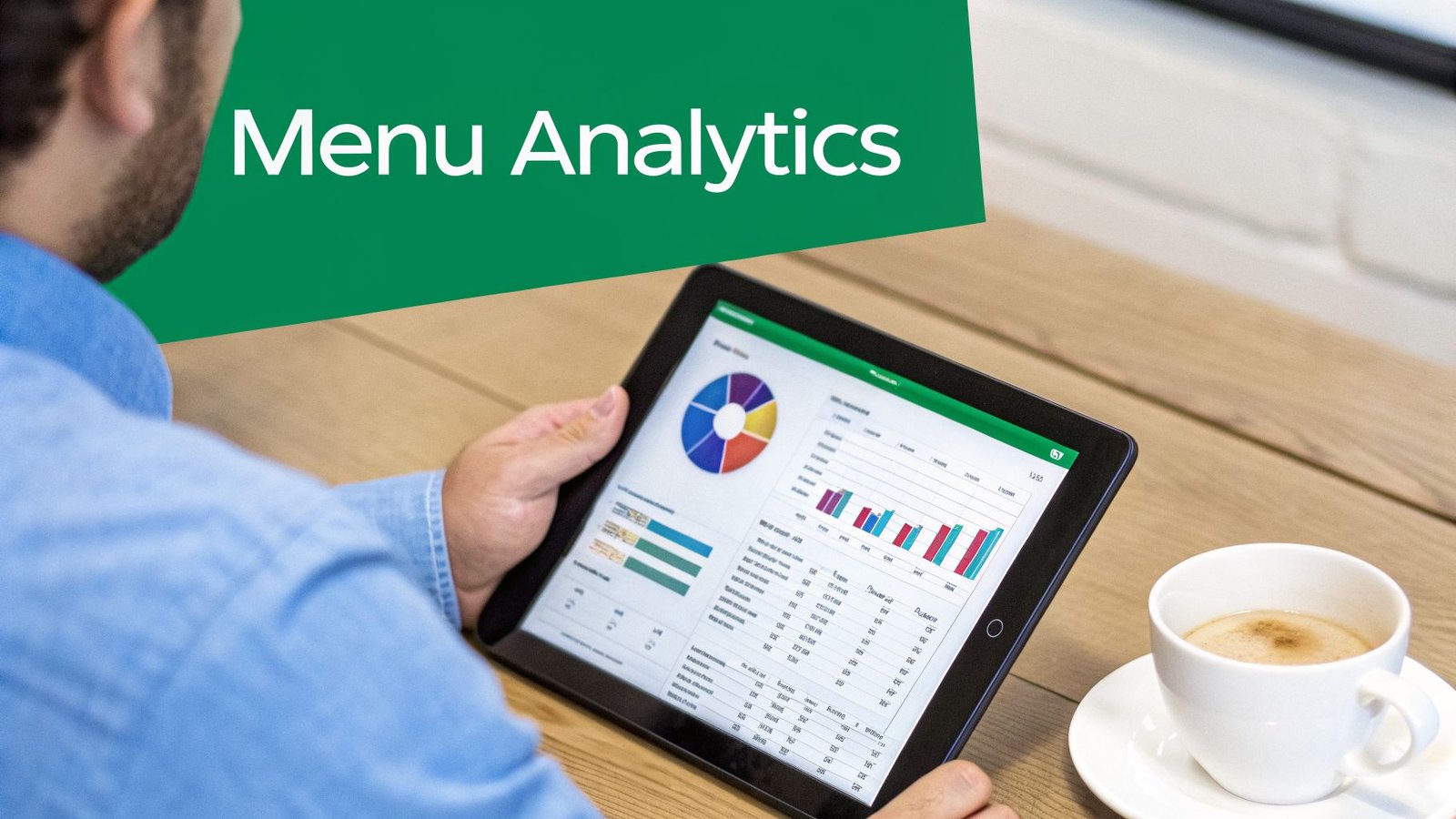
Their answer tells you if they can connect cause and effect using operational metrics. For example, can they link a dip in lunchtime sales to a specific menu item's long prep time that's hurting table turnover? A candidate who can speak fluently about sales trends, labor percentages, and food cost variance is prepared to manage the financial health of your restaurant, not just its day-to-day operations.
What to Listen For
A top-tier candidate will provide specific examples of how they've used data to drive results. They should comfortably discuss the metrics they track, the tools they use, and the outcomes they've achieved. Vague answers like "I look at the numbers" are a red flag; you want to hear the 'how' and the 'why' behind their decisions.
Key Insight: Look for a candidate who can translate data into a compelling story for their team and for ownership. Someone who says, "I used our sales report to show the kitchen team that our Thursday special was a low-profit item, and we brainstormed a new, higher-margin replacement together," demonstrates both analytical skill and collaborative leadership.
Proficiency with modern café management software is critical. Managers familiar with the built-in analytics of an all-in-one system like TackOn Table can hit the ground running. They already understand how to use real-time dashboards to identify top-selling items, adjust staffing based on sales forecasts, and pinpoint inventory waste. If you're looking for a better alternative to legacy systems like Toast vs Clover, a manager with this experience is invaluable.
Actionable Follow-Up Questions
- For Menu Engineering: "Walk me through how you would use sales data to redesign a menu. What key metrics would you analyze?"
- For Staffing: "Describe a time you adjusted staffing levels based on sales forecasts or hourly performance data. What was the result?"
- For Data Communication: "How do you share important data insights with your team or with ownership to get buy-in for a change?"
- For Impact: "What is the single biggest financial impact you've made at a previous job using data, and can you quantify it?"
5. Tell me about a time you successfully implemented a new system, process, or technology. What challenges did you face and how did you overcome them?
This behavioral question is one of the most revealing interview questions for a restaurant manager because it tests their change management skills, adaptability, and technical aptitude. The restaurant industry is constantly evolving, and a manager’s ability to guide a team through a significant operational shift, such as implementing a new POS or online ordering system, is critical for growth and efficiency.
Their answer shows you how they plan, communicate, and problem-solve under pressure. It’s not just about whether they can learn new software; it’s about whether they can lead others through the transition, manage resistance, and ensure the new tool delivers on its promised value. This is especially important when adopting modern, all-in-one systems where buy-in from both FOH and BOH is essential for success.
What to Listen For
A strong candidate will tell a story using the STAR method (Situation, Task, Action, Result). They will clearly define the initial problem, the goal of the implementation, the specific actions they took, and the measurable outcomes. Look for answers with quantifiable results, such as "reduced order errors by 30%" or "increased delivery orders by 45%."
Key Insight: Pay close attention to how they describe staff involvement. A great manager doesn't just impose change; they build consensus. Listen for phrases like, "I held training sessions during pre-shift," "I identified tech-savvy team members to act as champions," or "I gathered feedback after the first week to make adjustments."
Their experience with previous systems is a valuable indicator of how they might adapt to yours. A manager who describes a complicated, multi-week POS setup will immediately recognize the benefit of a system like TackOn Table, which is known for its quick and easy 30-minute setup. Their ability to manage this process with minimal disruption to service is a core competency for modern restaurant leadership. You can explore the different all-in-one restaurant solutions that require this kind of implementation skill.
Actionable Follow-Up Questions
- For Problem-Solving: "What was the single biggest obstacle you faced during the rollout, and what was your specific role in overcoming it?"
- For Communication: "How did you communicate the 'why' behind this change to your team to get their buy-in?"
- For Measuring Success: "What metrics did you track to determine if the implementation was successful? How long did you track them?"
- For Retrospection: "Looking back, is there anything you would do differently in your next technology implementation?"
6. How do you balance the need to control costs and maintain profitability while ensuring high quality food and service?
This is one of the most critical interview questions for a restaurant manager because it gets to the heart of their business acumen. The perpetual challenge in any restaurant is the strategic trade-off between financial health and guest experience. A manager who can only cut costs will eventually degrade quality, while one who only focuses on quality without regard to budget will sink the business. This question reveals their ability to navigate that delicate balance.
Their answer demonstrates their understanding of restaurant economics and operational priorities. A great manager sees this not as a conflict, but as a puzzle to be solved with smart processes, data, and team engagement. It’s an opportunity for them to show how they make informed decisions that protect both the bottom line and the brand's reputation.
What to Listen For
A strong candidate will provide specific, data-backed examples rather than vague philosophies. They should be able to articulate the connection between an action they took and the resulting financial and qualitative outcomes. Listen for their fluency with key performance indicators (KPIs) like food cost percentage, labor cost, and customer satisfaction scores.
Key Insight: Top-tier candidates discuss this balance as an integrated strategy, not a series of compromises. An answer like, "By using our inventory analytics to identify slow-moving ingredients, we were able to reduce spoilage by 8% and reinvest those savings into higher-quality proteins for our best-selling dishes," shows a manager who optimizes costs to enhance quality.
Their comfort with using technology to achieve this balance is a major plus. A manager who can explain how they use a modern POS like TackOn Table to monitor real-time sales data, track ingredient-level variance, and adjust menu pricing is demonstrating a sophisticated, data-driven approach. This shows they can identify cost-saving opportunities without resorting to blunt measures that harm the guest experience.
Actionable Follow-Up Questions
- For Cost Metrics: "What specific food and labor cost percentages did you target in your last role, and how did you track your progress toward them?"
- For Quality Control: "How do you systematically monitor food quality and service standards? Can you give an example of how you used customer feedback to make a change?"
- For Supplier Management: "Describe your process for negotiating with suppliers. How do you ensure you get a good price without sacrificing ingredient quality?"
- For Tech Application: "How would you use a system's real-time analytics to make immediate decisions about menu specials or staffing levels to control costs during a slow shift?"
7. Describe your experience with multi-location or multi-channel restaurant management (e.g., dine-in, takeout, delivery, catering)
This question separates managers who can run a single store from leaders who can scale operations. It assesses their ability to handle complexity across different revenue streams or physical locations. A modern restaurant is rarely just a dine-in establishment; it's a hub for takeout, third-party delivery, and sometimes catering or even a food truck. You need a manager who understands the distinct workflows, staffing needs, and inventory challenges each channel presents.
This is a critical interview question for a restaurant manager in any growing business. It reveals whether a candidate has the strategic mindset to maintain brand consistency, quality control, and profitability when operations are decentralized. Their answer demonstrates their capacity to manage multiple moving parts without letting standards slip, which is a core requirement for franchise owners and multi-unit groups.
What to Listen For
A strong candidate will provide specific examples of managing different channels or locations. They will discuss how they standardized processes, managed logistics, and used data to oversee performance from a central point. Look for answers that address the unique challenges of each stream, such as coordinating delivery driver handoffs or managing separate inventory for a catering division.
Key Insight: The best candidates will talk about unification. A manager who says, "I used a centralized system to sync menus and pricing across our three locations, which eliminated discrepancies and let us update specials instantly everywhere," shows they think about operational efficiency at a high level.
Their familiarity with technology is especially important here. A manager experienced with an all-in-one platform like TackOn Table, which offers robust multi-location control, can step in and immediately use tools to compare sales across sites, manage a universal menu, and consolidate reporting. This experience is a significant advantage, proving they can handle the technical side of scaling your business.
Actionable Follow-Up Questions
- For Multi-Location Roles: "What was your biggest challenge in maintaining brand consistency across multiple locations, and how did you resolve it?"
- For Multi-Channel Operations: "How have you managed inventory and prep schedules to support both dine-in and a high volume of delivery orders simultaneously?"
- For Data-Driven Management: "What reports or KPIs did you monitor daily or weekly to compare performance between your different locations or channels?"
- For Tech Proficiency: "Describe how you would use a system with central management features to standardize employee training and onboarding across several restaurants."
8. How do you approach building and maintaining team culture, engagement, and retention in a fast-paced restaurant environment?
This is one of the most critical interview questions for a restaurant manager because high staff turnover can cripple a restaurant’s profitability and service quality. This question moves beyond operational logistics to assess a candidate's emotional intelligence and ability to foster a positive, productive workplace. Their answer reveals their philosophy on leadership, employee motivation, and creating a stable team that works well together.
A manager who excels at building culture directly impacts your bottom line by reducing recruitment costs and ensuring a consistent customer experience. They understand that a happy, engaged team is less prone to burnout and more likely to deliver exceptional service. This stability is also key to getting the most out of your technology; a consistent team becomes highly proficient with systems like TackOn Table, leading to faster orders and fewer errors.
What to Listen For
A strong answer will go beyond generic statements like "I believe in an open-door policy." Look for specific, actionable strategies the candidate has personally implemented. They should be able to provide concrete examples of how they created a positive work environment and the measurable results that followed, such as improved retention rates or reduced absenteeism.
Key Insight: The best candidates connect culture-building activities directly to business outcomes. An answer like, "We started holding monthly team meetings where staff could suggest menu or process improvements. Acting on their feedback led to a new workflow that cut ticket times by 15% and our quarterly turnover dropped by 25%," shows a manager who understands that engagement drives performance.
Listen for how they use tools and processes to support their team. A manager who talks about using an intuitive POS to reduce staff frustration or creating clear advancement paths demonstrates a practical approach to retention. They see technology not just as an operational tool but as a way to improve the employee experience, recognizing that a slow, complicated system can be a major source of daily stress and a reason good employees leave.
Actionable Follow-Up Questions
- For Retention Metrics: "What was the average employee tenure or turnover rate in your last role, and what specific actions did you take to influence it?"
- For Motivation: "Besides compensation, what methods have you found most effective for motivating your team and recognizing top performers?"
- For Conflict Resolution: "Describe a time you had to manage a conflict between two staff members. What was your approach, and what was the outcome?"
- For Feedback Loops: "How do you gather and, more importantly, act on employee feedback to make meaningful changes in the workplace?"
8-Point Restaurant Manager Interview Comparison
| Question | Implementation complexity | Resource requirements | Expected outcomes | Ideal use cases | Key advantages |
|---|---|---|---|---|---|
| Tell me about your experience managing restaurant operations and staff | Low — straightforward open-ended prompt | Minimal — interviewer time, possible reference checks | Assess operational experience, leadership, multi-channel familiarity | Initial screening for managers, multi-location roles | Broad insight into experience, communication and operations priorities |
| How have you handled significant errors or discrepancies in POS transactions or inventory? | Medium — behavioral probe requiring specifics | Moderate — interview time, examples, possible data review | Evaluate problem-solving, integrity, audit and reconciliation skills | Roles focused on loss prevention, POS accuracy, financial controls | Reveals approach to root cause analysis and preventive controls |
| Describe your approach to training and developing staff, particularly with new POS systems or procedures | Low–Medium — structured examples preferred | Moderate — discussion, training materials or metrics helpful | Assess coaching ability, change management, and adoption tactics | New system rollouts, onboarding large or mixed-skill teams | Identifies trainers who can drive adoption and improve retention |
| How do you use data and analytics to make decisions about menu optimization, pricing, and staffing? | Medium–High — expects concrete metrics and tools | Moderate — time to probe metrics, examples or reports | Measure data literacy, KPI use, and data-driven decisions | Profit optimization, menu engineering, labor scheduling | Demonstrates analytics-driven margin and efficiency improvements |
| Tell me about a time you successfully implemented a new system, process, or technology | Medium — requires timeline, challenges, outcomes | Moderate — interview time, implementation details, references | Assess change management, stakeholder coordination, resilience | System migrations, POS upgrades, multi-site rollouts | Provides evidence of execution ability and risk mitigation |
| How do you balance controlling costs and maintaining quality food and service? | Medium — needs financial and operational examples | Moderate — access to cost metrics, examples of trade-offs | Evaluate business acumen, cost controls, and quality standards | Margin-focused management, pricing strategies, vendor negotiation | Reveals strategic trade-offs and margin optimization techniques |
| Describe your experience with multi-location or multi-channel management | Medium — broad scope requiring coordination examples | Moderate–High — time to verify scale, systems and processes | Assess scalability, consistency, and omnichannel coordination | Franchises, regional managers, operators with multiple outlets | Shows ability to unify operations and manage cross-channel complexity |
| How do you approach building and maintaining team culture, engagement, and retention? | Low–Medium — examples and retention metrics useful | Minimal–Moderate — interview time, turnover or engagement data | Gauge leadership style, engagement strategies, retention focus | High-turnover environments, leadership and people roles | Identifies people-focused leaders who improve morale and retention |
Empower Your New Manager with the Right Technology
Selecting the right leader is only half the battle won. The comprehensive set of interview questions for restaurant manager candidates we've explored is designed to identify individuals with the experience, mindset, and operational skills to drive your business forward. From handling POS discrepancies and analyzing sales data to building a resilient team culture, you now have a framework for finding a manager who can truly take ownership of your restaurant's success.
However, even the most capable manager will struggle if they are held back by outdated, clunky, or overly complex technology. Their ability to implement the brilliant strategies they described in their interview-from menu optimization to staff training-depends directly on the tools you provide. An inefficient system creates operational friction, frustrates staff, and obscures the very data your manager needs to make informed decisions. This is where a strategic investment in your restaurant's core technology platform becomes a direct investment in your new manager's effectiveness.
From Interview Answers to On-the-Job Action
Think back to the questions posed throughout this article. A candidate’s ability to answer them confidently is one thing; their ability to execute on those answers is another.
- On Data-Driven Decisions: When you asked, "How do you use data and analytics to make decisions?" a strong candidate likely talked about tracking sales trends, identifying popular menu items, and adjusting staffing based on peak hours. A system like TackOn Table provides this information through a clean, intuitive dashboard. Your manager won't need to be a data scientist to see which lunch special is underperforming or which server has the highest average check.
- On Implementing New Systems: A key question focused on a candidate's experience implementing new technology. The ideal manager can lead a team through change with minimal disruption. The setup process for your technology should support, not hinder, this effort. TackOn Table is designed for an incredibly easy setup, allowing your manager to get the system running and train staff in hours, not weeks, which is a major advantage over complex Toast vs Clover alternatives.
- On Managing Multiple Locations: For multi-unit operators, the question about overseeing multiple locations is critical. A manager needs a centralized view of performance, inventory, and sales across all sites. Our platform's powerful multi-location controls give managers the authority and visibility to maintain consistency and efficiency, whether they're managing two cafes or ten food trucks.
The Right Restaurant POS Is a Force Multiplier
Providing your new hire with an adaptable and user-friendly system is a sign of trust and empowerment. It shows you are committed to their success and are providing the resources they need to excel. A mobile POS that allows servers to take orders and payments directly at the table keeps service flowing and customers happy. Integrated inventory management that syncs with sales data prevents stockouts and reduces waste. These are not just features; they are solutions to the daily challenges your manager will face.
By choosing an all-in-one solution that combines these functions without a steep learning curve or a prohibitive price tag, you remove common barriers to success. Your manager can spend less time wrestling with technology and more time leading their team, engaging with guests, and executing the growth strategies you hired them for. The right technology acts as a force multiplier, amplifying your manager's skills and turning their potential into measurable results for your bottom line.
Equip the exceptional manager you just hired with a system built for clarity and control. TackOn Table provides the simple, powerful, and affordable all-in-one platform that turns interview promises into operational excellence. See how TackOn Table can support your new leader and fuel your restaurant's growth.
Ready to see how our simple and powerful POS can transform your restaurant? Book a demo today!