To get set up to accept credit cards, you'll need two key things: a payment processor to handle the transactions and the right hardware, whether that’s a full point-of-sale (POS) system or a simple card reader. For restaurants, this is where a unified, all-in-one platform like TackOn Table really shines, bundling payment processing with all the other tools you need to run your business. Our easy setup makes getting started incredibly straightforward.
Why Your Restaurant Can't Afford to Ignore Modern Payments
Let’s be honest: in today’s food scene, being a "cash-only" spot is a tough sell. Accepting credit cards has gone from a nice-to-have convenience to an absolute must. If your café, food truck, or bistro can't take card payments, you're not just losing out on sales—you're getting left behind.
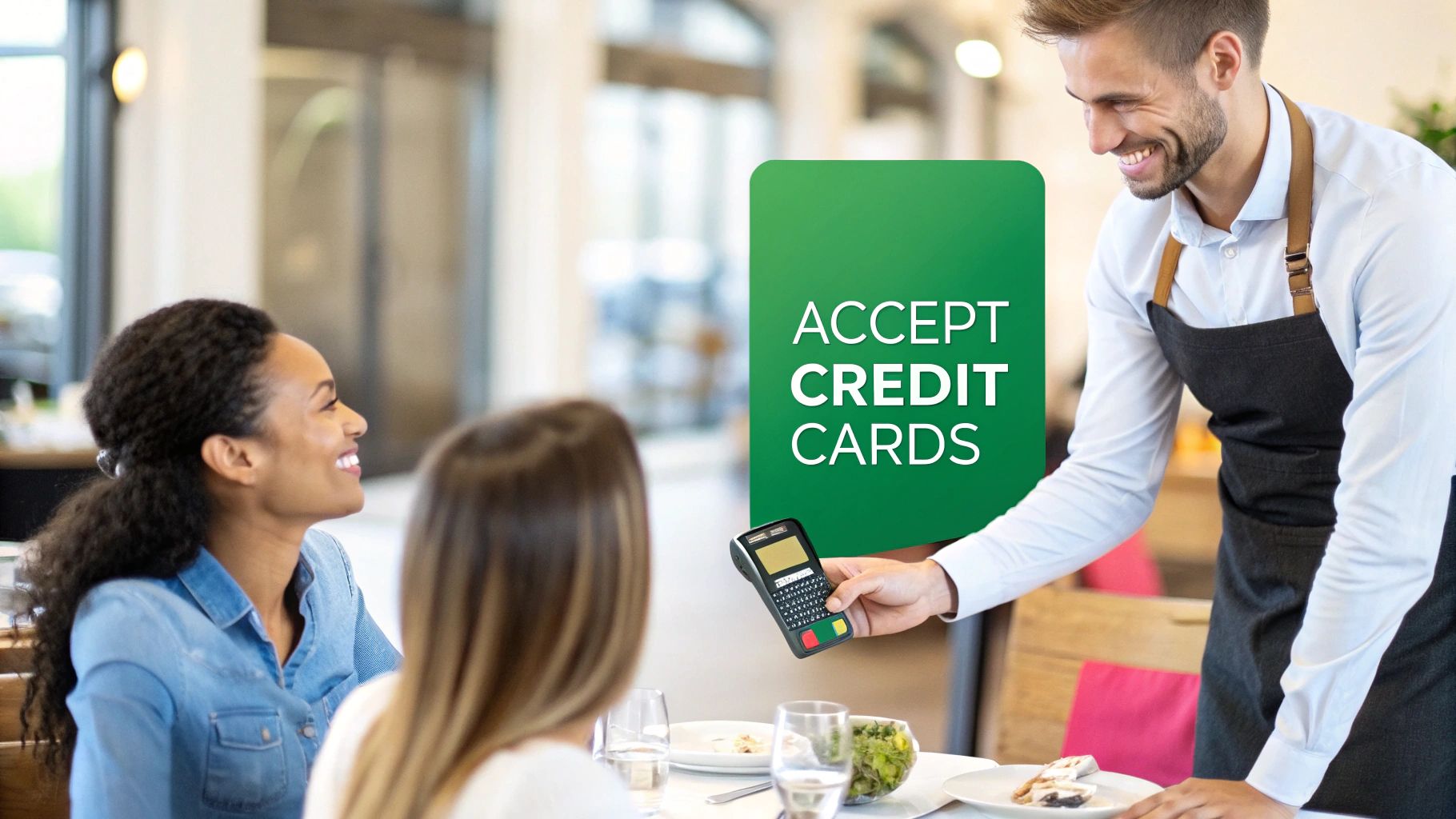
The way people pay has fundamentally changed. Customers now demand fast, secure, and easy payment options everywhere they go, and that expectation is only growing. It's not just about letting them swipe a card; it’s about creating a frictionless end to their dining experience.
Meeting Today's Customer Expectations
Think about it—your guests carry less cash than ever. They’re used to the speed of tapping a card or using mobile wallets like Apple Pay and Google Pay. Making them hunt for an ATM or fuss with exact change adds a layer of friction that can sour an otherwise fantastic meal. A modern payment system shows your guests you’re professional, up-to-date, and focused on their convenience.
This isn't just a hunch; it's a massive economic trend. The global market for credit card payments hit a mind-boggling USD 622.76 billion in 2024 and is expected to soar to USD 1,433.49 billion by 2034. This explosive growth, detailed in market analysis from Precedence Research, is exactly why having a system that securely accepts all payment types is no longer optional.
The Hidden Power of Integrated Payments
Beyond making customers happy, a truly integrated payment system is a game-changer for your operations. It’s a huge leap from a basic, standalone credit card terminal that only does one thing. When your payments are tied directly into your POS, every single transaction—every swipe, tap, and dip—feeds you valuable information.
A modern restaurant POS doesn't just process a payment; it turns that transaction into a powerful insight. It helps you spot sales trends, keep a tight grip on inventory, and make smarter, data-backed decisions that directly boost your bottom line.
Having an all-in-one platform like TackOn Table gives you a single, clear view of your entire business. You can instantly see which dishes are flying out of the kitchen, check in on staff performance, and manage inventory across multiple locations without juggling spreadsheets. This kind of simplicity and powerful multi-location control is a major benefit of modern café management software. It’s worth exploring the different TackOn Table solutions to see how our connected system can be tailored to your specific needs, whether you run a single bustling coffee shop or a growing restaurant group.
Ultimately, investing in a modern payment setup is a strategic move that pays off in several key ways. It helps you:
- Capture Every Possible Sale: You'll never have to turn a customer away simply because you can't take their preferred form of payment.
- Turn Tables Faster: With tools like our mobile POS terminals for pay-at-the-table service, you can cash out guests more quickly, which is crucial for seating more people during those busy rushes.
- Elevate the Guest Experience: Give diners the quick, secure, and seamless checkout they’ve come to expect.
Choosing the right system is the first and most important step toward building a more profitable and efficient restaurant.
Choosing Your Payment Processor and Hardware
Picking the right payment tools can feel like a huge decision, but it really comes down to finding a partner that’s transparent, reliable, and built for the unique rhythm of your restaurant. This is where you shift from simply accepting credit cards to actually using payments as a tool to help your business thrive.
First things first, let's look at the two main ways to get set up: a traditional merchant account or a payment service provider (PSP). A merchant account is a dedicated bank account just for your card payments, but getting one often involves a pretty lengthy application process. A PSP, on the other hand, bundles everything you need together—like TackOn Table does—which makes getting started much faster and way less complicated.
Decoding Payment Processing Fees
Nothing hits your bottom line quite like processing fees, so you absolutely need clarity here. Most processors use one of a few common pricing models. Knowing the difference will help you see exactly where your money is going and avoid nasty surprises down the road.
Comparing Payment Processing Models
This table breaks down the most common pricing structures to help you understand your credit card processing fees.
| Pricing Model | How It Works | Best For | TackOn Table Advantage |
|---|---|---|---|
| Flat-Rate | You pay a single, fixed percentage (and sometimes a small transaction fee) for every swipe, dip, or tap, regardless of the card type (e.g., Amex, Visa, rewards card). | Restaurants of all sizes seeking simplicity and predictable monthly costs. Excellent for budgeting. | We use a transparent flat-rate model. No complex statements, no hidden fees—just straightforward pricing. |
| Interchange-Plus | The processor passes the "wholesale" interchange fee from the card-issuing bank directly to you and adds a fixed markup on top. It's transparent but complex. | Very high-volume businesses that can negotiate a low markup and have staff to analyze fluctuating monthly statements. | By avoiding this model, we shield you from the fluctuating rates that make financial forecasting a headache. |
| Tiered | Transactions are grouped into different tiers (e.g., "qualified," "mid-qualified," "non-qualified"), each with a different rate. This model often hides high fees. | We generally don't recommend this for restaurants, as it's the least transparent and can be costly. | Our commitment to affordability and simplicity means we steer clear of confusing tiered pricing. |
As you can see, a clear, flat-rate structure, like the one we use at TackOn Table, is designed to eliminate surprises. It's one of the key reasons so many restaurateurs find us to be a breath of fresh air. You get straightforward costs without needing an accounting degree to decipher your statement each month. You can see how our transparent pricing stacks up and find a plan that fits your restaurant perfectly here: https://tackontable.com/pricing/
My takeaway from years in this business: The right pricing isn't just about finding the lowest number—it's about finding the greatest value. Predictable, transparent fees free you from worrying about hidden costs so you can focus on what you do best: creating amazing food and experiences for your guests.
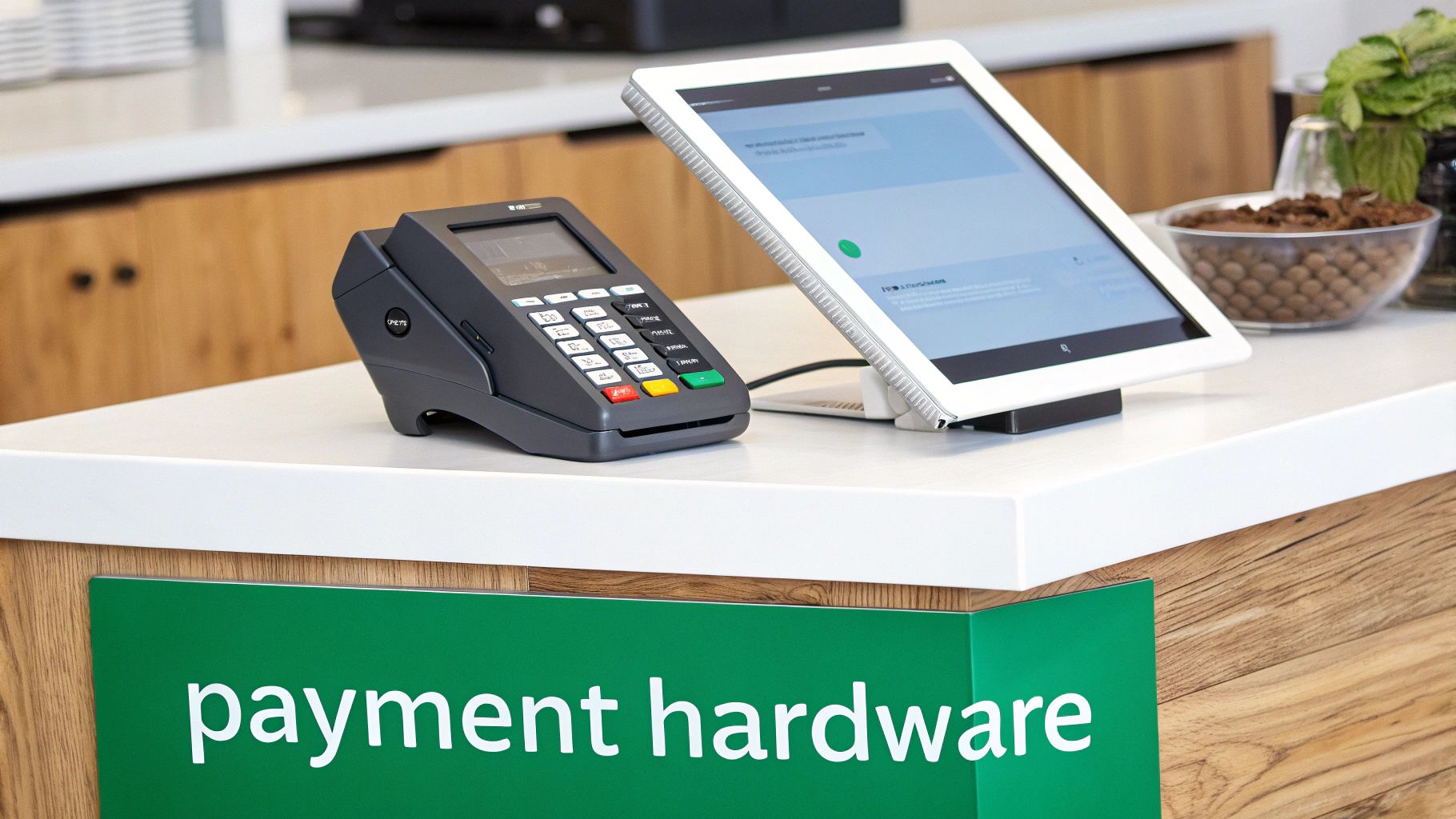
Finding the Right Restaurant POS Hardware
Once you've got a handle on the processing side, it's time to choose your hardware. Let's be honest, the days of a clunky terminal chained to the counter are long gone. Modern restaurant POS hardware is all about flexibility, speed, and durability—three things you can't live without in a busy kitchen or dining room.
What you need really depends on your restaurant’s flow:
- Countertop Terminals: These are still the go-to for cafes, pizzerias, and quick-service spots where customers line up to pay at a single location. They’re reliable workhorses.
- Mobile POS (mPOS) Systems: These handheld devices are total game-changers for full-service restaurants, breweries, and food trucks. They let your staff take orders and payments right at the table, on the patio, or curbside.
Picture a slammed Friday night. Instead of servers creating a bottleneck at a central terminal, they’re processing payments tableside with a TackOn Table mobile POS device. This does more than just speed up table turnover; it dramatically improves the customer experience.
For those of you who also sell online, integrating payments can feel like another puzzle. Once you've picked a processor for your restaurant, you'll need to get your online store connected. If you're on a major e-commerce platform, there's usually a well-paved path; for instance, here's a step-by-step guide on how to enable Shopify Payments to get your online channel up and running.
Look for an All-in-One Solution
The real magic happens when your payment processing and hardware are part of a single, unified system. An all-in-one platform means your payments, orders, inventory, and even customer data are all connected and speaking the same language.
This tight integration saves you from the massive headache of duct-taping different systems together that were never meant to work with one another. A modern system like TackOn Table can get you up and running in less than 30 minutes, giving you a professional-grade setup without the high costs or complexity of old-school legacy options. It’s all about choosing a partner that can grow with you.
Keeping Customer Data Safe: PCI Compliance and Fraud Protection
When you start taking credit cards, you’re suddenly in the data security business. You're not just handling payments; you're responsible for your customers' sensitive information. This isn't just a best practice—it's a critical part of running a modern restaurant. PCI compliance and solid fraud protection are the bedrock of a trustworthy payment system.
The Payment Card Industry Data Security Standard (PCI DSS) is the rulebook, created by the major card brands to keep cardholder data safe. Think of it as the baseline for security. If you don't follow these rules, you could be hit with massive fines, lose your ability to accept cards entirely, and—worst of all—destroy the trust you’ve built with your customers.
Thankfully, you don't have to become a cybersecurity expert overnight. Modern restaurant POS systems are designed to take most of this burden off your shoulders.
How a Modern POS Handles the Heavy Lifting of PCI DSS
Let's be honest: trying to achieve and maintain PCI compliance on your own is a nightmare. It’s a technical minefield of secure networks, data encryption, and regular system scans. For a restaurant owner who’s already juggling a dozen other things, it’s a distraction you simply can’t afford.
This is exactly where choosing an all-in-one platform like TackOn Table makes a world of difference. We handle the complex security work behind the scenes. Our entire system—from the software to the card readers—is built with PCI DSS and SOC 2 compliance at its foundation.
Instead of you trying to figure it all out, our platform automatically takes care of the critical stuff:
- End-to-End Encryption: The moment a customer taps, dips, or swipes their card on one of our mobile POS devices, their data is instantly encrypted. It travels through the system as unreadable code, completely shielded from anyone trying to intercept it.
- Tokenization: We never store raw credit card numbers on your system. Instead, that sensitive data is swapped out for a unique, secure "token." This token lets you do things like process refunds or handle repeat orders without ever exposing the actual card details.
Using a compliant, all-in-one system is like outsourcing your data security to a team of experts. It gives you incredible peace of mind, freeing you up to focus on what you do best: creating amazing experiences for your guests.
Smart Ways to Prevent and Manage Chargebacks
Even with top-notch security, you’re bound to run into a chargeback eventually. This is when a customer disputes a transaction with their bank, which then forcibly reverses the payment. While some are valid, many are cases of "friendly fraud" or simply a customer not recognizing the charge.
Being proactive is your best defense against losing revenue to disputes.
First, check your billing descriptor. This is the name that shows up on your customer’s credit card statement. Is it clear? Something like "TACKON TABLE CAFE NYC" is instantly recognizable, while a generic holding company name might confuse a customer and trigger a dispute.
Simple operational habits make a big difference, too. Always give customers a clear, itemized receipt and train staff to double-check orders, especially for takeout. For any online or phone orders, make sure you're using security tools like Address Verification Service (AVS) and requiring the CVV code. These small checks can stop a fraudulent transaction in its tracks.
When a chargeback does happen, you have to respond quickly with solid proof that the charge was legitimate. This means having things like signed receipts, order details, and any customer communications ready to go. The process of fighting a chargeback is called representment, and having a good strategy is key; you can learn more from resources like Disputely's Q4 Representment Campaign.
An integrated café management software makes this whole process much less painful. With TackOn Table, every bit of transaction data is organized in one place, so you can easily find the evidence you need to fight an unfair chargeback and protect your bottom line.
Ready to see how a secure, simple, and fully compliant POS can protect your business and streamline your operations?
Book a Personalized Demo Today
Integrating Payments with Your Restaurant POS System
Let’s be honest. True efficiency in a restaurant doesn't come from juggling a dozen different apps and devices that barely talk to each other. It comes from having a single, unified system where every part of your operation—from the front of the house to the back—is perfectly in sync.
Integrating your payment processing directly into your restaurant POS isn’t just about convenience. It’s the secret sauce for unlocking major operational wins and making smarter business decisions on the fly.
When your systems are siloed—a standalone card terminal over here, an ordering tablet over there, and sales reports you have to piece together by hand—you’re operating with blind spots. Information gets stuck, mistakes are inevitable, and you miss out on the very insights that could make you more profitable. An integrated system tears down those walls.
From a Single Tap to Powerful Business Insights
Picture this: a customer at your bistro pays their bill at the table using one of your server's mobile POS devices. In a disconnected setup, that's just a payment. But with a truly integrated platform like TackOn Table, that single tap sets off a powerful, behind-the-scenes chain reaction:
- Inventory Is Instantly Updated: The POS knows that the steak frites and Malbec they ordered are now gone. It automatically adjusts your live counts for beef, potatoes, and that specific wine. No more guesswork.
- Sales Reports Are Synced: That table's revenue is immediately logged in your daily sales report, broken down by menu item, server, and time of day. Your team doesn't have to spend a minute on manual entry at the end of a grueling shift.
- Staff Performance Is Tracked: You can see your server’s sales totals, average check size, and table turn times in real-time. This helps you spot your top performers and identify where a little extra coaching might be needed.
All of this happens instantly, without anyone lifting a finger. You're not just accepting a credit card; you're converting every single transaction into a valuable piece of business intelligence. This is exactly why so many operators are ditching clunky legacy systems for modern all-in-one platforms. To see how different options compare, check out our guide on how TackOn Table stacks up against Clover and Square.
By unifying payments with your core operations, you move from simply reacting to your business to proactively managing it. You gain the clarity needed to make smarter, faster decisions that directly impact your bottom line.
The All-in-One Advantage for Cafés, Food Trucks, and More
For a fast-paced café, a busy food truck, or a growing restaurant group, the benefits of integration are even bigger. An all-in-one system gives you a single command center to run every aspect of your business—a game-changer when things get hectic.
This unified approach means you can:
- Manage Multiple Locations Seamlessly: With TackOn Table's multi-location control, you can check sales data, push out menu updates, and manage staff across all your locations from one central dashboard. This ensures consistency and saves a ton of administrative headaches.
- Make Instant Menu Updates: Just sold the last of your daily special? A few taps can 86 that item across every terminal, your kitchen display system, and your online ordering site, preventing any customer disappointment.
- Spot Trends with Real-Time Analytics: Notice a sudden surge in oat milk lattes? Maybe it’s time to run a promotion or add a new seasonal flavor. Real-time data lets you jump on trends as they happen, not weeks after they've passed.
This kind of agility is vital for growth. The ability to scale your operations is baked right into the system, supported by transparent pricing that fits everyone from a brand-new startup to an established enterprise.
Consumer spending is strong, with payment volumes projected to grow from $787 billion in Q2 2021 to $1.18 trillion in Q1 2025. Platforms that can process these transactions with 40% greater speed while providing instant insights give you a serious competitive edge.
Ultimately, integrating your payments is more than a tech upgrade. It's a strategic move to build a smarter, more resilient, and more profitable restaurant.
Keeping Up with How Your Customers Pay
In the restaurant business, how you take a customer's money is a massive part of their overall experience. Let’s be honest, the old-school swipe terminal just doesn’t cut it anymore. Today's guests expect you to be ready for whatever they pull out of their pocket—whether it’s a card, a phone, or just a tap.
This isn't just about being tech-savvy; it's about being smart. Offering a variety of modern payment options is one of the easiest ways to speed up service and keep your lines moving. For a quick-service spot or a food truck, those few seconds saved on every transaction really add up.
The New Normal: Tap-to-Pay and Mobile Wallets
Think about your last few purchases. How often did you tap your card or phone? Contactless payments, which use NFC (Near Field Communication) technology, are practically the default now. They’re blazing fast, super secure, and include both physical tap-to-pay cards and mobile wallets like Apple Pay and Google Pay.
For a busy coffee shop, shaving seconds off each payment during the morning rush is a huge win. It means shorter lines, less frustrated customers, and ultimately, more sales. In a full-service restaurant, giving servers mobile POS devices to take these payments right at the table is a game-changer. No more running cards back and forth to a terminal—just faster service and quicker table turns.
The move away from cash is happening faster than you might think. We’re seeing consumers increasingly leave their cash at home, with forecasts showing it will account for just 46% of global payments in 2024, down from 50% the year before. You can dig into the full global payments report to see how these habits are evolving.
Handling Online Orders and "Card-Not-Present" Payments
Your restaurant isn't just a physical location anymore; it's an online brand. With takeout and delivery orders booming, you have to be set up to handle card-not-present (CNP) payments safely and smoothly. A CNP transaction is exactly what it sounds like—any payment where you don't physically have the customer's card, like an order from your website or over the phone.
This is where having a secure, integrated payment gateway is non-negotiable. Think of it as the digital bouncer for your online transactions, encrypting customer data and sending it off for approval. Skimping on this not only puts you at a much higher risk for fraud but also creates a frustrating, clunky checkout for anyone trying to order food from you online.
An all-in-one platform like TackOn Table builds this right in, connecting your online ordering directly to your in-house Restaurant POS. When someone orders from your website, the ticket prints straight to the kitchen, and the payment is handled by the exact same secure system you use for dine-in. This unified setup makes life so much easier, from balancing the books to keeping track of inventory.
Why You Need an All-in-One Platform as a Toast vs Clover Alternative
Juggling different systems for different payment types is a nightmare. One provider for your countertop terminal, another for your online store, and a third for your mobile readers? That's a surefire way to create operational chaos and lose track of what's actually happening in your business.
TackOn Table is designed as a powerful Toast vs Clover alternative that brings everything together with superior simplicity and affordability. Our all-in-one platform is built to handle every single way a customer might want to pay:
- EMV Chip Cards: The rock-solid standard for secure in-person payments.
- NFC Contactless: For lightning-fast taps from cards and mobile wallets.
- Online Payments: Fully integrated and secure for your website and delivery orders.
- Mobile Pay-at-the-Table: Let servers close out checks from anywhere with our handheld mobile POS.
This kind of flexibility means every transaction is smooth and secure, no matter if it happens at the counter, at the table, or on a customer's couch. When you bring all your payments under one roof, you get a clear, simple view of your entire business, whether you're running a multi-location enterprise or a cozy neighborhood spot.
Ready to see how simple it can be to accept every payment your customers prefer?
Start Your Free Trial Today
Your Action Plan for Launching Card Payments
Alright, let's pull all the pieces together. You’ve done the research, and now it's time to map out the final steps to get you from making a decision to running your very first card transaction. A smooth launch is critical—it sets the tone for your staff and ensures your customers have a great experience right from the start.
Getting up and running with a modern, all-in-one platform like TackOn Table is surprisingly fast. Gone are the days of tedious applications and technical nightmares. Our system can be activated and ready to go in under 30 minutes. Once you've picked a plan, we kick off the simple process of setting up your merchant account so you can start getting paid.
Configuring Your System and Training Your Team
When your hardware arrives—whether that’s a sharp-looking countertop terminal or a set of flexible mobile POS devices—the setup is usually pretty intuitive. But you shouldn't have to go it alone. The best providers offer hands-on onboarding, with a specialist walking you through everything from menu setup to user permissions and payment configurations.
With the tech handled, it’s time to focus on your people. Any new system is only as good as the team using it, but training doesn't need to be a long, drawn-out affair.
- Run Test Transactions: I always recommend creating a "test" menu item. Have every single team member practice taking an order, splitting a check, and running every kind of payment you'll accept—tap, chip, and even a swipe. It builds crucial muscle memory.
- Create Quick Guides: A simple, laminated one-page cheat sheet kept near each terminal is a lifesaver during a crazy dinner rush. It should cover common tasks like issuing a refund or adjusting tips.
- Role-Play Scenarios: Walk through what to do when a card is declined or a customer wants to use Google Pay. A little practice goes a long way in building confidence.
This diagram breaks down the flow for the payment methods your customers are already using every day.
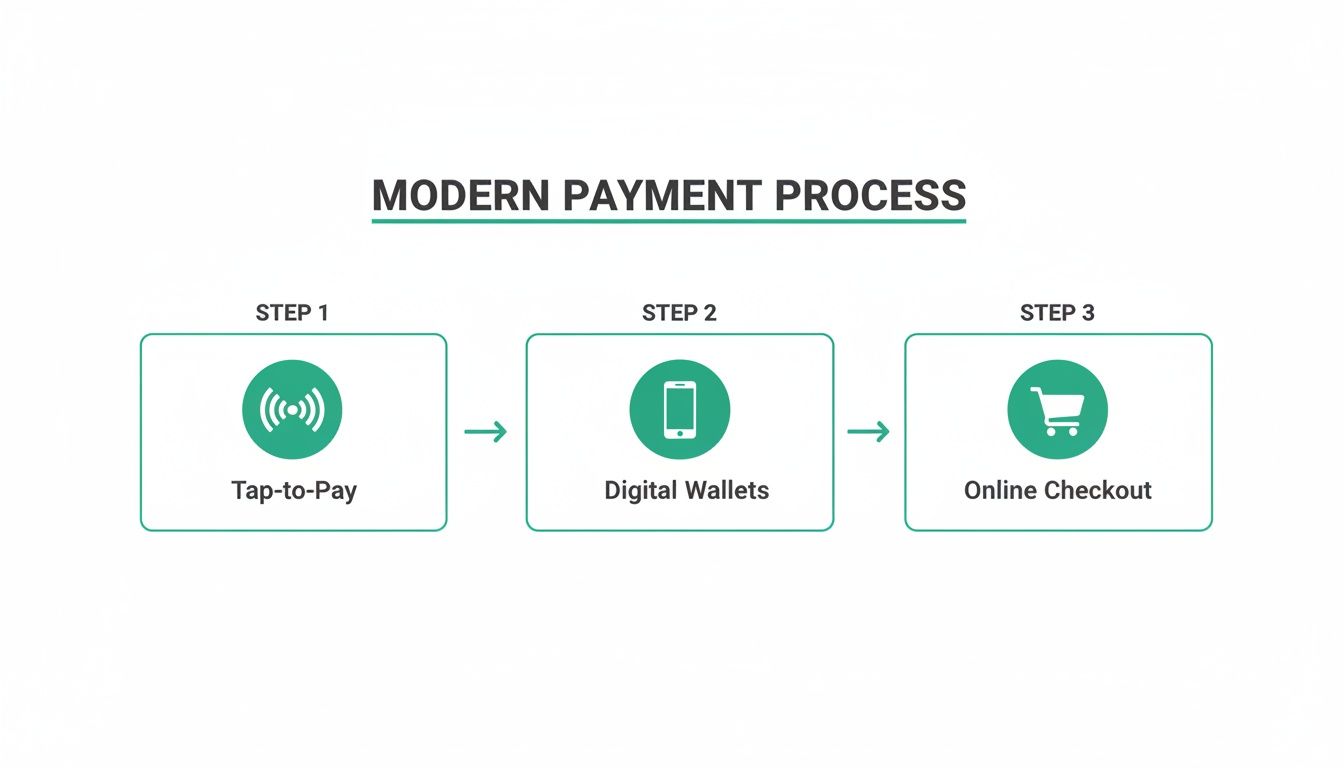
It’s a clear picture of the shift toward the faster, more secure options that any modern POS needs to handle without a hitch.
Pro Tip: Before you officially go live, run a few small, real transactions. Use your own credit card to buy a coffee or a soda. This is the ultimate final check to confirm that money is actually landing in your bank account and the entire system is working from end to end.
Getting started should be the easiest part of the process. A good partner gives you an adaptable system, but they also back it up with 24/7 support and a risk-free 30-day free trial. It's worth exploring how a simple setup paired with powerful multi-location control can genuinely make a difference in your operations.
Ready to make your launch a success?
Book Your Personalized Demo Now
FAQs: Accepting Credit Cards at Your Restaurant
If you're sorting through payment options, you're not alone. Most restaurant owners find themselves asking the same kinds of questions. Let's tackle some of the most common ones I hear all the time.
What’s This Actually Going to Cost Me?
You're right to focus on the cost. Typically, you'll see credit card processing fees fall somewhere between 1.5% and 3.5% of each transaction, often with a small flat fee tacked on.
What you end up paying really depends on your sales volume and the processor you choose. At TackOn Table, for instance, we use a transparent, flat-rate model built specifically for restaurants. Our goal is to give you predictable, affordable costs without any of those nasty hidden fees that can sneak up on you.
What's the Best Setup for a Food Truck?
For a food truck, it’s all about mobility and durability. A mobile POS (mPOS) system is your best friend here.
Think about it: you need something that can handle a rush, survive a bumpy ride, and keep going all day. The ideal solution is a lightweight handheld device with a built-in card reader and a battery that won’t die mid-service. With an adaptable system like TackOn Table, you can be up and running in less than 30 minutes, taking payments from anywhere your truck is parked.
Do I Really Need Different Systems for Online and In-Store Sales?
Absolutely not—in fact, you should actively avoid it! Juggling separate systems is a recipe for headaches with accounting, inventory tracking, and getting a clear picture of your sales.
An integrated platform brings everything under one roof. When you use a unified system like TackOn Table, your in-store, online, and pay-at-table orders all flow into a single dashboard. This gives you a real-time, comprehensive view of your entire operation, which makes running your business a whole lot simpler.
Ready to stop worrying about payments and start focusing on what you do best? TackOn Table offers an all-in-one system that’s affordable, adaptable, and surprisingly easy to get started with.