Pricing your menu is one of the most critical things you'll do for your restaurant. It's far more than just slapping a number on a dish; it’s a careful balancing act between your food costs, what your guests expect to pay, and the profit margins you need to stay in business. Forget guesswork—we're talking about using real data to make every single item on your menu a winner.
Why Smart Menu Pricing Is Your Most Important Decision
Think of your menu prices as the engine of your restaurant. In an industry with razor-thin margins, your pricing strategy doesn't just cover the bills. It sends a message about your brand's value, shapes your restaurant's identity, and ultimately decides whether you sink or swim. Get it right, and you'll see sales climb and guests keep coming back. Get it wrong, and even the most amazing food won't save you from a struggling business.
This isn't about a simple 3x markup formula. Nailing your pricing is part art, part science. You absolutely have to know your numbers—from the cost of a pinch of saffron to the hourly wage of your line cook. But you also need to get inside the head of your customer.
Just look at the economic pressures we're all facing. As of June 2025, the U.S. Consumer Price Index for food away from home jumped 3.8% from the previous year. For full-service spots, that increase was even steeper at 4.0%. These aren't just abstract numbers; they represent the real-world hikes in ingredients and labor that have forced menu prices up a staggering 27.2% since 2019. In this climate, pricing by gut feeling is a surefire way to get left behind. You can dig deeper into these restaurant menu statistics to get the full story.
The Power of a Modern Restaurant POS
This is where having the right tools makes all the difference. A modern Restaurant POS system like TackOn Table gives you the hard data you need to make these big decisions with confidence. It replaces gut feelings with genuine insight, empowering you to:
- Track ingredient costs in real-time so you can tweak prices before your margins disappear.
- Pinpoint your stars and duds by seeing exactly which items are most (and least) profitable.
- Run A/B tests on new prices through promotions and see what actually works.
- Update menus across all your locations in an instant, right from one central hub, thanks to our powerful multi-location control.
Ultimately, the prices you set have a direct line to how your guests feel about their experience. Understanding how to improve customer satisfaction is key to ensuring your pricing strategy feels fair and adds to their enjoyment, rather than taking away from it.
We designed TackOn Table to be both affordable and intuitive. It gives you the muscle of more complex systems like Toast or Clover, but without the headache or the high price tag. Everything you need—inventory, sales analytics, and menu controls—is in one straightforward platform.
In this guide, we're going to break it all down: the formulas, the strategies, and even the little psychological tricks. By the end, you'll see your menu not just as a list of food, but as your single most powerful tool for driving profit.
Getting Your True Plate Costs Right
Before you can even think about setting a menu price, you have to know—down to the penny—what each dish costs to make. This isn't just about the big-ticket items like the protein or the fancy produce. To build a profitable menu, you need a crystal-clear picture of your Cost of Goods Sold (COGS) for every single item that comes out of your kitchen.
It’s a classic mistake: operators will cost out the "hero" ingredients—the steak, the salmon, the brioche bun—and call it a day. But what about the pinch of finishing salt, the swirl of olive oil in the pan, or the garnish on top? Those "invisible" costs feel small in the moment, but they add up fast and can silently torpedo your margins.
Let's walk through a real-world example to see what I mean.
Breaking Down the "Signature Bacon Cheeseburger"
Let's say your top seller is the "Signature Bacon Cheeseburger." To find its actual cost, we need to get granular and cost out every component. This is often called recipe costing.
- Beef Patty (8 oz): If you're paying $6.00 per pound (16 oz) for ground beef, that 8 oz patty costs you $3.00.
- Brioche Bun: A 12-pack of buns runs you $7.20, so each bun is $0.60.
- Cheddar Cheese (2 slices): An $8.00 block of cheese gives you 40 slices. At $0.20 a slice, two slices come to $0.40.
- Bacon (2 strips): A $9.00 package has 18 strips. That's $0.50 per strip, making it $1.00 for two.
- Lettuce & Tomato: A head of lettuce ($2.00) gives you about 20 portions ($0.10 each), and one tomato ($0.80) yields 8 slices ($0.10 each). That’s $0.20 for the veggies.
- Signature Sauce (1 oz): Your secret sauce costs $12.80 to make a quart (32 oz), so a one-ounce serving costs $0.40.
- Side of Fries (5 oz): A 30 lb case of frozen fries costs $45.00. That’s 480 ounces total, working out to about $0.094 an ounce. A 5 oz portion costs you $0.47.
Add it all up, and the raw ingredient cost is $6.07. But we're not quite there yet.
Pro Tip: Always build a buffer for waste and spoilage into your plate cost—typically 5-10%. This covers everything from a dropped steak to over-portioning to produce that goes bad before you can use it.
If we apply an 8% waste buffer to our burger ($6.07 * 0.08 = $0.49), the True Plate Cost for your Signature Bacon Cheeseburger is actually $6.56. This is the number you need to base your pricing decisions on.
This visual perfectly illustrates how accurate costing is the foundation, followed by smart modeling and a little bit of psychology.
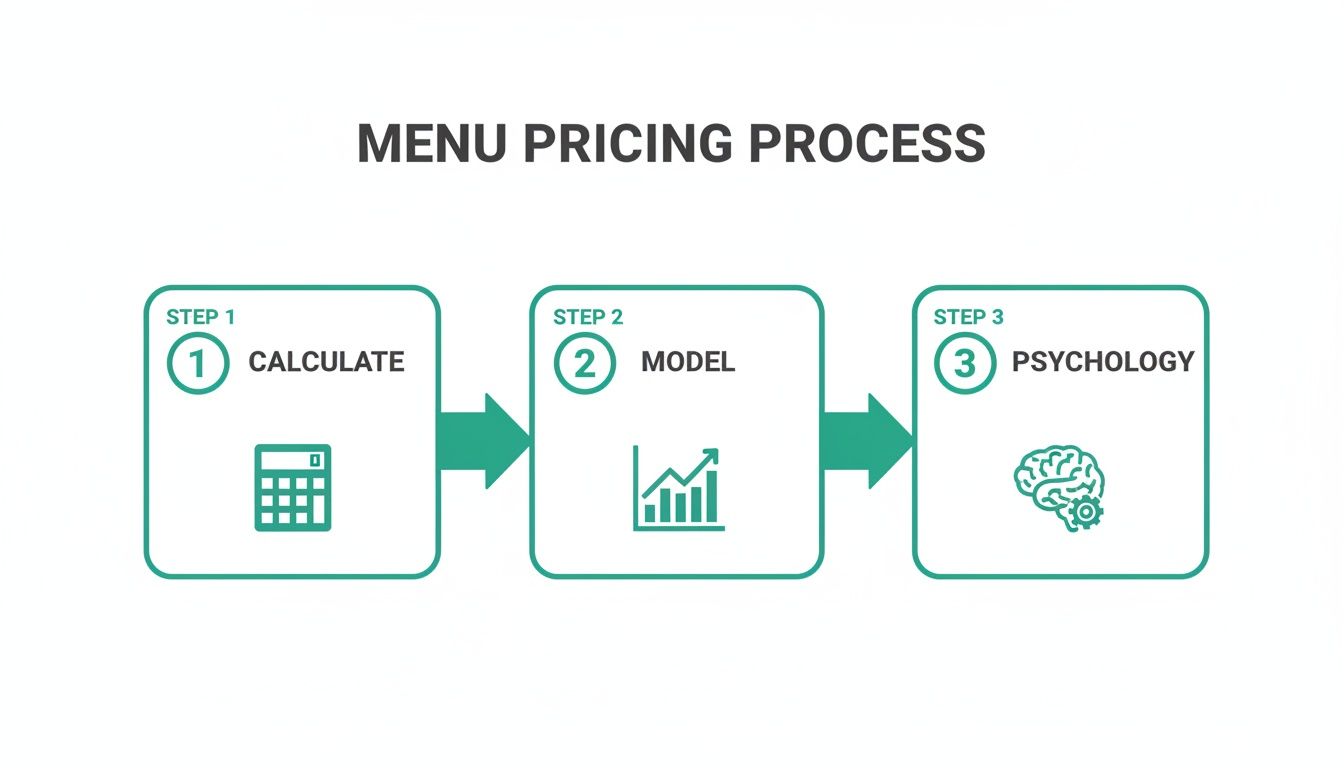
As you can see, solid data is the non-negotiable first step. Without it, the rest of your menu strategy is just guesswork.
Using Your Restaurant POS for Smarter Costing
Let’s be honest, doing these calculations manually for every recipe is a massive headache, especially when your supplier prices are constantly changing. This is where a modern Restaurant POS with built-in inventory management becomes a game-changer.
A system like TackOn Table automates this entire headache. You enter inventory costs as deliveries arrive, and the system tracks ingredient depletion with every order punched into the mobile POS. Just like that, you have a live, accurate plate cost for everything on your menu.
- When your beef supplier raises prices, the plate cost for your burger updates automatically. No surprises.
- You can instantly see how a simple switch, like using a different type of cheese, will affect your bottom line.
- The system gives you the hard data you need to calculate your overall food cost percentage accurately.
The formula for your ideal food cost percentage is pretty simple:
(Total COGS / Total Food Sales Revenue) x 100
Most people aim for the industry benchmark of 28-35%, but your perfect number really depends on your concept. A pizza joint will have a very different target than a fine-dining restaurant. The analytics dashboard in a system like TackOn Table lets you watch this key metric in real-time, so you know immediately if your pricing is working.
Wondering how much you could be saving with tighter cost controls? You can plug your own numbers into our restaurant savings calculator to see the potential impact.
When you have precise data at your fingertips, you can finally stop guessing and start making proactive, profit-driven decisions about your menu.
Choosing the Right Menu Pricing Models
Okay, you've nailed down your plate costs. Now for the fun part: turning those numbers into a smart, profitable menu price. This is where art meets science. The goal is to find that sweet spot between covering your costs, hitting your profit goals, and keeping your customers happy and coming back.
There’s no single magic formula. The most successful operators I know actually mix and match a few different pricing strategies to build a menu that’s both competitive and profitable. Let’s walk through the three most reliable models and how to use them.
Food Cost Percentage Pricing
This is the old-school, tried-and-true method for a reason—it’s simple and it works. You start by setting a target food cost percentage for your restaurant, which is typically between 28% and 35%. Then, you use that target to calculate your menu price.
The formula is straightforward: Plate Cost / Target Food Cost % = Menu Price
Let's put it into practice:
Remember our Signature Bacon Cheeseburger with its true plate cost of $6.56? If your target food cost is a solid 30% (or 0.30), the math looks like this:
$6.56 / 0.30 = $21.87
You’d then round that up to a more appealing menu price, like $21.95 or even $22. This approach is a fantastic starting point because it gives you a consistent, predictable margin across the board.
Gross Profit Margin Pricing
Here’s where a lot of restaurants miss a huge opportunity. While food cost percentage is great, it doesn't tell you how many actual dollars you're pocketing from each sale. That’s where Gross Profit Margin pricing comes in. This strategy focuses on ensuring every single dish contributes a specific, fixed dollar amount to cover your labor, rent, and other overheads—and, of course, your profit.
Instead of a percentage, you determine a target profit per item and add it directly to your plate cost.
The formula is: Plate Cost + Target Gross Profit Per Item = Menu Price
Let's look at the burger again:
Your burger costs $6.56 to make. After analyzing your budget, you determine you need to make at least $14.00 in gross profit from every entree to keep the lights on and grow the business.
$6.56 + $14.00 = $20.56
You'd likely price this on the menu at $20.95. This method is especially powerful for high-cost showstoppers like a beautiful ribeye steak or a lobster tail. A 30% food cost on a $25 steak plate brings in way more cash than a 30% cost on a $5 side of fries, and this model forces you to focus on those crucial contribution dollars.
Competition-Based Pricing
Finally, no restaurant is an island. You have to know what the place down the street is charging. Competition-Based Pricing is all about market research—sizing up what similar restaurants in your area charge for comparable dishes and positioning yourself strategically.
This isn't about blindly matching prices. It's about understanding your unique place in the market.
- Higher quality ingredients? You can, and should, charge more.
- A killer ambiance or unique theme? That experience has tangible value.
- Faster service or a prime location? Customers will pay for convenience.
This is a delicate balancing act. Since February 2020, average menu prices have climbed by about 31% as restaurants fight to maintain their slim 5% profit margins against rising costs. Looking ahead, 31% of operators plan more price hikes in 2025, yet 43% are seeing guests become more price-sensitive—sharing entrees or opting for cheaper items. You can dive deeper into how restaurants are steadying their prices on NRN.com.
Expert Tip: The best strategy is a blended one. Use the Food Cost Percentage model for a baseline, sharpen it with the Gross Profit Margin model to guarantee real-dollar profit, and then use Competition-Based Pricing as a final reality check to ensure your prices make sense in your neighborhood.
Before we move on, here’s a quick-reference table to help you keep these formulas straight.
Menu Pricing Formulas at a Glance
This table breaks down the three core pricing methods, making it easy to see which one fits a particular situation best.
| Pricing Method | Formula | Best For | Key Consideration |
|---|---|---|---|
| Food Cost Percentage | Plate Cost / Target Food Cost % |
Setting a consistent, baseline price for the entire menu. Great for initial pricing. | Doesn't account for the actual dollar profit per item; can undervalue low-cost, high-margin items. |
| Gross Profit Margin | Plate Cost + Target Gross Profit |
Maximizing cash contribution from high-cost items like steaks, seafood, or signature entrees. | Requires a deep understanding of your overhead costs to set a realistic profit target. |
| Competition-Based | Market Research + Value Prop |
Final price adjustments to ensure you are competitive and properly positioned in your local market. | Risk of underpricing if your quality or experience is superior to the competition's. |
Think of these as tools in your toolbox. You wouldn't use a hammer for every job, and you shouldn't rely on just one pricing method for your entire menu.
Turning Your Restaurant POS Into a Strategic Tool
So, how do you manage all this without getting buried in spreadsheets? Your Restaurant POS should be doing the heavy lifting for you. A modern, intuitive system like TackOn Table, a leading choice among Toast vs Clover alternatives, brings this data to life.
Instead of guessing, you can use the analytics dashboard in TackOn Table to model pricing scenarios. Want to see how a 50-cent price bump on your burger would impact your monthly profit based on past sales? You can see that in a few clicks. Your POS transforms from a cash register into a dynamic planning tool.
With its all-in-one simplicity and easy setup, TackOn Table lets you test, analyze, and roll out the perfect pricing strategy for your restaurant, café, or food truck. You get the insights you need to make confident decisions that actually move the needle.
Ready to take control of your menu's profitability? Start your free trial or book a personalized demo to see how TackOn Table can help you build a smarter, more profitable menu.
Turn Your Menu Into a Sales Powerhouse with Menu Engineering
Once you’ve crunched the numbers on your food and labor costs, the real fun begins. Now, we move beyond the spreadsheet and start thinking about the customer. Smart menu pricing isn't just about covering costs; it's about psychology. It's about guiding your guests toward choices that make them happy and your business profitable.
This is where menu engineering comes in.
Menu engineering is a game-changing method for analyzing every single item you sell. You’re essentially plotting each dish on a matrix based on two simple things: how popular it is (sales volume) and how profitable it is (contribution margin). Done right, this turns your menu from a static list into your single most powerful marketing tool.
The Four Menu Categories You Need to Know
Every dish on your menu will fall into one of four buckets. Figuring out where each item lands is the first step to making smarter decisions. In the old days, this was a nightmare of manual tallying. Today, a modern Restaurant POS can give you this data in a few clicks by tracking sales velocity and item-level profitability automatically.
- Stars (High Profitability, High Popularity): These are your champions. They’re the dishes customers rave about and that also bring in fantastic margins. Your "Signature Bacon Cheeseburger" is a perfect example.
- Plow-horses (Low Profitability, High Popularity): Everyone loves these, but they don't do much for your bottom line. They sell like crazy but have thin margins. Think of a simple chicken tender basket or a basic pasta dish.
- Puzzles (High Profitability, Low Popularity): These are your hidden gems—high-margin items that just aren’t selling. Maybe it's a unique seafood special or a foie gras appetizer that people are hesitant to try.
- Dogs (Low Profitability, Low Popularity): These are the dead weight. They don’t sell well, and they don’t make you money when they do. They’re just taking up precious space on your menu.
With TackOn Table's sales reports, categorizing your menu items is no longer a chore. The dashboard instantly shows you top sellers and contribution margins, making it easy to identify your Stars, Plow-horses, Puzzles, and Dogs. It turns what used to be a complex analysis into clear, actionable insight.
How to Handle Each Menu Category
Just identifying these categories isn't enough; you have to act on what the data tells you. The goal is simple: protect your Stars, fix your Plow-horses, solve your Puzzles, and get rid of your Dogs.
For your Stars:
- Show them off. Give them prime real estate on the menu—like the top-right corner, where the eye naturally goes first.
- Never discount them. They're already popular and profitable. Keep that margin for yourself.
- Use mouth-watering descriptions. Use language that justifies the price and makes the dish sound absolutely irresistible.
For your Plow-horses:
- Try a small price bump. Even an extra $0.50 or $1.00 can dramatically improve profitability without scaring anyone away.
- Re-engineer the plate. Can you swap out a costly side for a more affordable one? Or slightly reduce the portion size without anyone noticing?
- Suggest profitable add-ons. Train your servers to upsell high-margin additions, like adding bacon or avocado to that popular sandwich.
For your Puzzles:
- Give them a makeover. Would a new name, a better description, or a great photo make a difference?
- Run a special. Feature it as a limited-time offer to create some buzz and see what customers think.
- Get your staff on board. Have your servers taste the dish so they can genuinely and enthusiastically recommend it to guests.
For your Dogs:
- Just get rid of them. In most cases, the simplest solution is the best. Taking them off the menu simplifies inventory and kitchen operations.
- Try to reinvent it. If the core ingredients are cheap, see if you can rework the dish into something more appealing before you cut it for good.
Use a Little Psychology to Nudge Customer Choices
Beyond the data, a few simple psychological tricks in your menu design can have a massive impact on what your customers order and how much they spend.
- Price Anchoring: Place a very expensive item at the top of a section. That $45 ribeye makes a $28 steak frites look like an absolute bargain.
- Charm Pricing: Ending prices in .99 or .95 makes them feel much cheaper than the next whole dollar. It's a classic for a reason, especially for casual concepts.
- Ditch the Dollar Signs: Studies have repeatedly shown that removing the currency sign (e.g., "22" instead of "$22.00") can get people to spend more because it makes the price feel less tangible.
- Use Visual Cues: A simple box, a bold font, or a small icon next to an item draws the eye directly to your high-profit Stars and Puzzles.
The data you need to put all these strategies into practice is already sitting inside your Café Management Software or restaurant POS. When you combine real sales data with smart design, you transform your menu from a simple list of options into a powerful profit-driving machine.
Ready to see how easy menu engineering can be? Start your free trial or book a personalized demo today.
Testing and Refining Your Menu Prices for Peak Performance
Think your menu pricing is a "set it and forget it" task? That’s a fast track to leaving money on the table. The sharpest operators I know treat their menu as a living, breathing document. It needs constant attention—testing, analyzing, and tweaking—to keep up with changing food costs and customer moods. This last step is all about iteration, using real-world data to make sure your menu works as hard as you do.
Setting a price is just your best guess. The real proof comes from testing it in the wild. Luckily, you don’t need to overhaul your entire menu to get the answers you need.
Use LTOs and Combos as Your Testing Ground
Limited-Time Offers (LTOs) and combo deals are fantastic tools for testing the waters on pricing. They let you experiment without making a permanent, and potentially costly, change.
Want to see if customers will pay more for premium ingredients? Launch a "Gourmet Burger Combo" at a higher price than your classic burger. If it sells well, you’ve just proven there's an appetite for higher-ticket items. You can also use an LTO to test a slightly smaller portion at a new price or feature a higher-margin ingredient. Pay close attention to the sales data. Did it fly out of the kitchen, or did it just sit there? That direct feedback is pure gold.
Harness Your Restaurant POS for Agile Adjustments
This is where your Café Management Software becomes more than just a cash register. A modern system like TackOn Table is your command center for this kind of strategic analysis, giving you the power to turn those insights into action almost immediately.
With a few clicks in the TackOn Table dashboard, you can pull the reports that matter most:
- Sales Velocity Reports: See exactly how a price change or promotion is impacting how quickly an item sells, right down to the time of day.
- Contribution Margin Reports: Look past pure sales volume and see the actual profit each dish brings in. This is how you confirm if your price adjustments are actually improving your bottom line.
This continuous feedback loop is what separates the pros from the amateurs. To really dial in your prices, you have to understand what your guests consider a good value. Learning to track customer feedback effectively is a game-changer here, letting you pair hard sales numbers with what people are actually saying.
The market never sits still. Consider this: full-service restaurant prices jumped a staggering 9.0% year-over-year in 2022, then settled to a 4.3% increase by late 2024. This constant motion is exactly why a static price list doesn't work anymore. If you want to dive deeper, check out the National Restaurant Association menu price trends to see why adaptability is non-negotiable.
The TackOn Table Advantage in a Dynamic Market
Our platform was designed specifically for this kind of nimble management. With TackOn Table's all-in-one simplicity, a price change you make in the back office is instantly live everywhere—on your servers' mobile POS handhelds, your online ordering site, and your digital menu boards. No delays, no mistakes.
For those running multiple locations, our multi-location control is a secret weapon. You can run a true A/B test by rolling out a new price at one spot while leaving it unchanged at another. This gives you incredibly clean, comparative data so you can make confident decisions for your entire brand. This is especially powerful for https://tackontable.com/solutions/quick-service-restaurants/ operators who need to maximize margins across dozens of sites.
It’s time to stop guessing and start knowing. See how an intuitive platform can help you build a more profitable and resilient menu.
Start your free trial or book a personalized demo to take control of your pricing strategy today.
Your Blueprint for a More Profitable Restaurant
Let’s put a bow on this. Building a menu that actually makes you money boils down to a repeatable process. You have to nail your costs, pick the right pricing models for your concept, use some smart menu psychology, and then test, test, test.
It might sound like a lot of work, but the right tools make it manageable. A modern and genuinely affordable POS system like TackOn Table pulls all the threads together. It gives you the hard data you need to execute every step we’ve covered, without the sticker shock or complexity you might find in many Toast vs Clover alternatives.
Our platform is built to be intuitive for any concept, especially busy full-service restaurants that need powerful features without the operational headaches.
Think of it this way: TackOn Table puts the analytics right in your hands, helping you make sharper, faster decisions that show up on your bottom line. We designed it for all-in-one simplicity and quick setup, which means you can get back to what you do best—running your restaurant—instead of fighting with technology. It's time to take back control of your profitability.
Ready to see how a smarter, more affordable POS can change the game? Start your free trial or book a personalized demo and let's start building your more profitable future.
Menu Pricing FAQs: Your Questions Answered
Pricing a menu isn't a one-and-done task. It's something you live with every day, and a lot of common questions pop up along the way. Let's tackle some of the most pressing ones I hear from restaurant owners.
How Often Should I Be Changing My Menu Prices?
You need to have your finger on the pulse of your costs. I always recommend reviewing your ingredient and labor numbers at least quarterly.
Now, that doesn't mean you’re reprinting your entire menu four times a year—that would be a nightmare. This is where having a flexible Restaurant POS like TackOn Table becomes a game-changer. It lets you tweak prices on your digital menus in real-time, protecting your margins the moment a supplier raises their prices.
As for a full menu overhaul? Plan for that about once a year, or whenever a major event—like a minimum wage hike or a serious supply chain disruption—forces your hand. In this business, staying nimble is how you stay profitable.
What’s a Good Food Cost Percentage to Aim For?
The classic industry answer is 28-35%, but honestly, that's just a benchmark. The "right" number is completely unique to your restaurant's concept. A high-end steakhouse can easily run higher food costs because they make a killing on their wine list. A quick-service spot, on the other hand, has to keep that number lean to survive.
Here's a pro tip: Stop obsessing over the percentage for a minute and focus on the gross profit margin per dish. Your POS analytics can show you this. Knowing the exact dollar amount each item contributes to your bottom line is a much more powerful way to build a profitable menu.
How Do I Handle Those Crazy High Commissions From Delivery Apps?
This is the million-dollar question right now, isn't it? Those fees can eat you alive if you're not careful. You have a few solid strategies to fight back:
- Create delivery-specific pricing. It's common practice to slightly inflate your prices on third-party apps to cover the commission. Customers have come to expect it.
- Curate a different menu for delivery. Feature items that travel well and have higher built-in margins.
- Go for the knockout punch: Drive traffic to your own commission-free online ordering platform. An all-in-one system like TackOn Table integrates this seamlessly. Offering a small discount for direct orders is a tiny price to pay to build loyalty and save a fortune in fees.
My Competitor Down the Street Is Cheaper. Should I Lower My Prices?
Resist the urge! Competing on price alone is a race to the bottom, and nobody wins.
Instead of dropping your prices, double down on communicating your value. Are you the spot that uses fresh, local produce? Is your dining room’s atmosphere a key part of the experience? Is your service genuinely exceptional? That’s what you’re selling.
Use your menu descriptions, your social media, and your staff to tell that story. Price your menu based on the unique experience you provide, not what the other guy is doing. Your sales data will be your guide here—it will tell you exactly what your customers value and what they’re happy to pay for.
Ready to stop the guesswork and build a menu that actually makes you money? TackOn Table gives you the analytics and simple tools you need to price with confidence.
Start your free trial or book a personalized demo and see how an easy, affordable system can make a huge difference for your restaurant.