Running a successful food truck business comes down to three key pillars: creating a solid business plan, designing a delicious and efficient menu, and leveraging the right technology to streamline operations. Master these fundamentals, and you'll have a reliable roadmap for turning your culinary passion into a profitable mobile enterprise.
Your Blueprint for a Profitable Food truck
Starting a food truck is more than a passion for cooking—it's about building a lean, mobile, and profitable business. This guide is your blueprint for success, walking you through the essential steps from drafting a business plan and navigating local regulations to designing a menu people will chase across town for.
This is your roadmap, providing a clear view of the entire journey from your initial idea to your first sale.
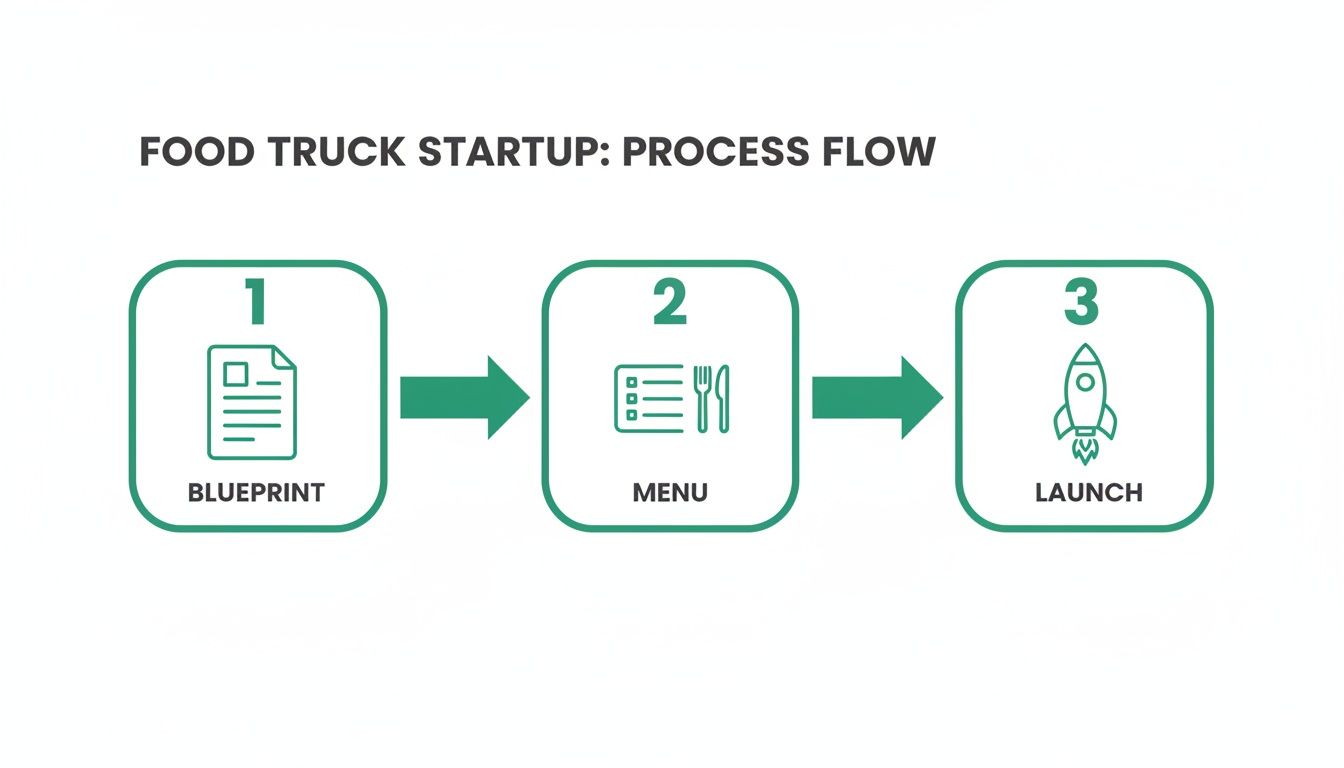
This simple progression drives home a critical point: a strong strategic plan and a well-designed menu are the foundations you absolutely need in place before you can successfully launch.
Why Food Trucks Are a Growing Opportunity
It's easy to see the appeal of food trucks. They offer a much lower-risk entry point into the restaurant world compared to the massive overhead of a traditional brick-and-mortar spot, and that accessibility has fueled some incredible growth.
The food truck industry has been on a tear, with the U.S. market growing at an impressive 13.2% compound annual rate between 2020 and 2025. It's on track to hit an estimated $2.8 billion in revenue. This boom reflects a real shift in how people want to eat—they want great, convenient options. The industry now includes around 92,257 businesses across the country, a number you can dig into deeper with the full market analysis from IBISWorld.
The key to tapping into this growth is efficiency. Every minute wasted on a clunky ordering system or slow payment processing is a lost sale. Your blueprint must include technology that keeps the line moving and customers happy.
The Role of Modern Restaurant POS Technology
In a business where every inch of space and every second counts, having the right tools isn't a luxury—it's essential. Modern Restaurant POS systems are built specifically for the fast-paced, tight-quarters environment of a food truck. With an all-in-one solution, you can forget about juggling a mess of different apps for payments, orders, and inventory; it becomes the central hub of your entire operation.
For instance, TackOn Table’s mobile POS lets your team take orders directly from the line on a handheld device, accept any payment type in seconds, and fire orders straight to the kitchen without missing a beat. This all-in-one simplicity is a game-changer for a business that's always on the move. You can explore the full suite of solutions to see how you can get your truck ready for prime time.
A simple, powerful system frees you up to focus on what you actually got into this business for: the food and the customer experience.
Food Truck Startup Checklist: Essential First Steps
Before you even think about firing up the grill, there are foundational steps you need to take. This checklist outlines the critical early-stage actions and gives you a ballpark idea of the costs involved to get you started on the right foot.
| Phase | Key Actions | Estimated Cost Range |
|---|---|---|
| Blueprint | Develop a comprehensive business plan, define your concept and brand, and research your target market. | $500 – $1,500 |
| Legal & Admin | Register your business, obtain an EIN, open a business bank account, and secure all necessary local licenses and permits. | $1,000 – $3,000 |
| The Truck | Purchase or lease a vehicle, then customize and equip it with all necessary kitchen and safety gear. | $50,000 – $150,000+ |
| Tech & Ops | Select and set up your POS system, payment processing, and basic inventory management tools. | $500 – $2,000 (plus fees) |
| Menu & Supply | Finalize your menu, calculate food costs, and establish relationships with reliable suppliers. | $2,000 – $5,000 (initial) |
Getting these initial pieces in place is non-negotiable. They form the bedrock of your business, ensuring you're legally compliant, operationally ready, and financially prepared for the road ahead.
Ready to see how simple and affordable your food truck operations can be? Book a personalized demo of TackOn Table today.
Untangling the Red Tape: Licenses, Permits, and Local Laws
Alright, you’ve got a killer concept and a solid business plan. Now comes the part that makes a lot of aspiring food truckers want to throw in the towel: the bureaucracy. Let's be honest, figuring out the legal side of things is probably the most intimidating part of this whole adventure. Get it wrong, and you could be facing hefty fines or even get shut down before you sell your first taco.
The first thing to understand is that there's no one-size-fits-all answer. The rules are hyper-local. What works in Austin won't fly in Los Angeles, and the requirements can change just by crossing a county line. Your first, and most important, call should be to your local city hall and the county health department. They are the gatekeepers and will give you the definitive checklist you need to follow.
First, You Need to Be a Real Business
Before you even think about food-specific permits, you have to officially exist as a legal business. This isn't just a formality; it's what protects your personal assets if things go sideways.
You've got a few common options for your business structure:
- Sole Proprietorship: Super easy to set up, but there's a big catch—it offers zero personal liability protection. This means your personal car or house could be at risk if the business is sued.
- Limited Liability Company (LLC): This is the go-to for most food truck owners. It creates a protective wall between your personal life and your business debts, which is a layer of security you really want.
- Partnership: Going into business with a friend or partner? A formal partnership agreement lays out all the rules and responsibilities from the start.
Once you’ve registered your business name and structure with the state, your next stop is the IRS website to get an Employer Identification Number (EIN). Think of it as a Social Security number for your business. You'll need it for everything—opening a bank account, paying taxes, and especially for hiring your first employee.
The Essential Food Truck Paperwork
With your business entity squared away, it’s time to chase down the permits that let you actually cook and sell food. The specific names might vary, but you’ll almost certainly need these in your arsenal.
- Business License: The basic ticket to operate any business in your city or county.
- Vehicle License: Your truck is a commercial vehicle, so it needs the proper registration and licensing.
- Food Handler's Permit: This is non-negotiable. You, and every single person on your truck who touches food, will need to pass a food safety course to get this certification.
- Health Department Permit: This is the big one. A health inspector will go through your truck with a fine-tooth comb, checking everything from your refrigerator temperatures to your three-compartment sink and hand-washing station.
- Seller's Permit: If you're charging customers, the government wants its cut. This permit allows you to collect and remit sales tax.
A word of advice from someone who's been there: these permits aren't a "one and done" deal. Most of them have to be renewed annually. Keep all your documents in a binder on the truck at all times. An organized operator is a compliant operator.
The Unwritten Rules: Zoning and Where to Park
Here’s a rookie mistake I see all the time: assuming you can park your shiny new truck anywhere and start selling. Big nope. Cities are very particular about where mobile food vendors can operate, and breaking these rules is a quick way to get a ticket and be told to move along.
Keep an eye out for common restrictions like:
- Proximity Rules: Many cities have rules to protect brick-and-mortar restaurants. For example, you might have to stay at least 200 feet away from the entrance of any establishment that sells similar food.
- Parking Time Limits: You can't just claim a spot for the entire day. Most public parking spaces have time limits, and they apply to you, too.
- Designated Zones: Some forward-thinking cities have created special "food truck zones" or require you to stick to approved events and private lots.
You'll have to do some digging on your city's website, likely in the municipal code section, or talk directly to the planning department. It feels like a hassle now, but doing this research upfront is what saves you from being forced to pack up and leave in the middle of a profitable lunch rush.
Tackling the legal stuff is a game of details and deadlines. Create a master checklist, set calendar reminders for renewals, and keep that binder updated. When you know your business is built on a solid legal foundation, you can finally stop worrying about the paperwork and start focusing on what really matters: the food and your customers.
Ready to simplify the rest of your operations? Start your free trial of TackOn Table and see how easy it is to manage orders, payments, and sales from day one.
Designing a Profitable Menu and Supply Chain
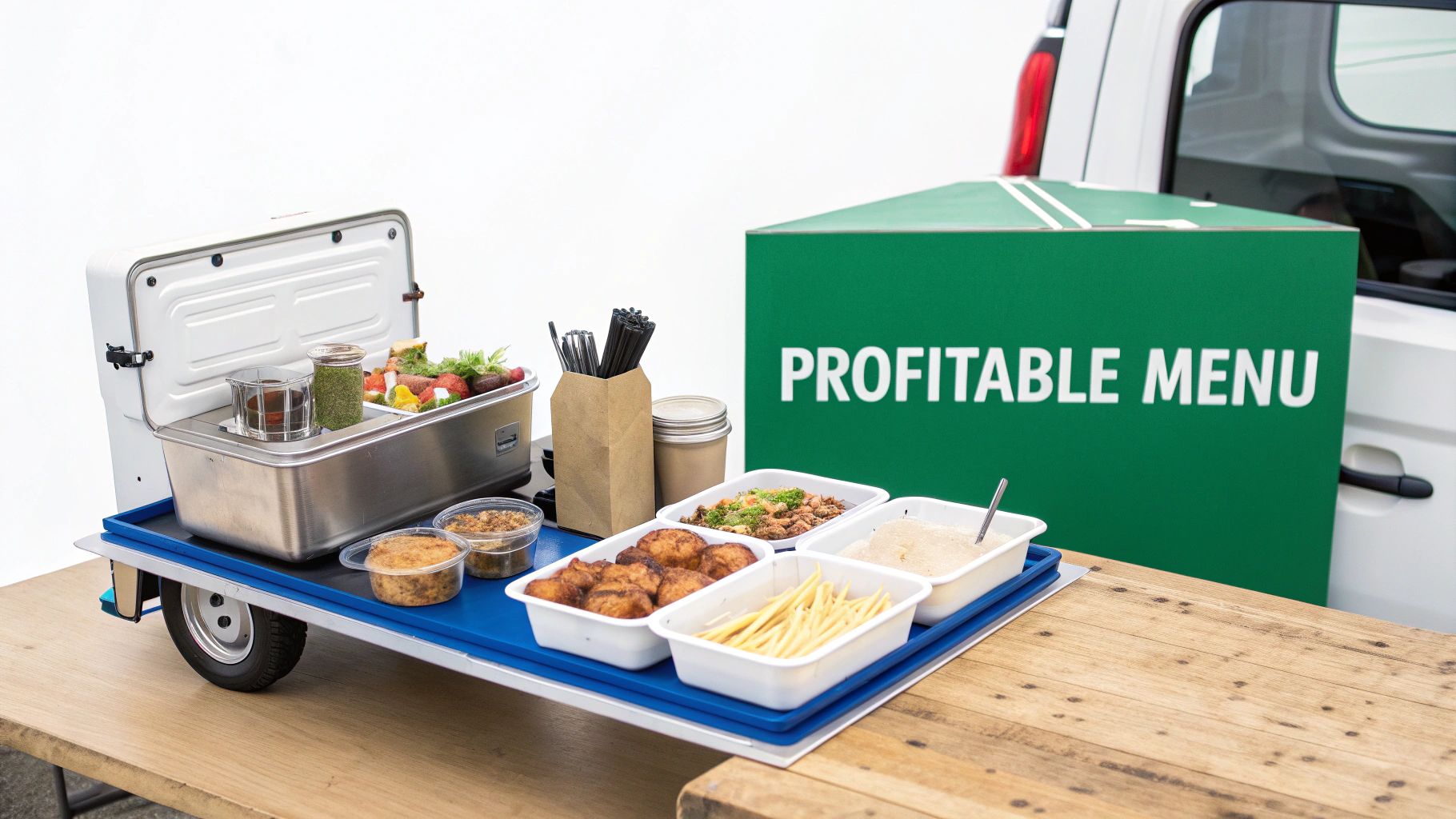
Your menu is your brand, and your supply chain is its backbone. Sure, a creative menu gets people to walk up to your window, but a profitable and efficient one is what actually keeps the lights on. This is where your culinary vision has to meet hard-nosed business strategy. You need to create dishes that are not just delicious but are actually practical to make in a tiny, mobile kitchen.
Think of your menu and supply chain as two sides of the same coin. Every single ingredient you choose has a direct impact on your prep time, your limited storage space, your food cost, and, ultimately, your bottom line. A well-designed menu cuts down on waste and speeds up service—two of the most critical ingredients for a successful food truck.
Engineering Your Menu for Speed and Profit
When you're working in a food truck, complexity is your worst enemy. A huge menu with a million different ingredients is a recipe for disaster. It kills your service speed, makes it more likely you'll run out of something important, and turns your supply chain into a nightmare. My advice? Pick a core concept and build a tight, focused menu around it.
The smartest thing you can do is cross-utilize ingredients. Can that awesome grilled chicken for your tacos also be the star of a salad or a wrap? Can you create one amazing sauce base that works for several different dishes? This approach simplifies everything—your inventory, your prep, and your supplier orders—while dramatically cutting down on food waste.
- Keep It Simple: I've found the sweet spot is 5-7 core menu items. This keeps your quality consistently high and your ticket times low.
- Know Your Costs: You absolutely must know the exact cost of every dish you serve. A solid benchmark is to keep your food cost between 28-35% of your menu price.
- Design for the Road: Focus on items that can be prepped in advance and then quickly finished to order. Food that travels well and is easy for customers to eat on their feet is always a winner.
Building a Bulletproof Supply Chain
Your suppliers aren't just vendors; they're your partners in this venture. Finding reliable folks who deliver quality products on schedule is completely non-negotiable. Don't just chase the lowest price—think about the consistency of their product and the reliability of their deliveries.
From my experience, a great supplier relationship is all about communication. Be upfront about your tiny storage space and the fact that you'll need smaller, more frequent deliveries. A good partner will work with you.
Managing inventory in a space the size of a closet takes serious discipline. You don't have a big walk-in cooler, so every inch of shelf space is prime real estate. This is where good technology becomes your best friend. Forget the old clipboard and manual counts; a modern Café Management Software or a restaurant-focused POS system can track your inventory in real-time.
Getting this right is more important than ever. The global food truck market is projected to grow from $4.04 billion in 2024 to $5.77 billion by 2029, largely driven by the demand for convenience and contactless payments. To grab your share of that growth, your operations have to be dialed in. You can dig into the food truck market growth report to see what trends are shaping the future of this industry.
Integrating Your Menu and Inventory with a Modern POS
This is where all the pieces come together. A system like TackOn Table can be the central nervous system of your entire operation, directly linking your menu to your inventory. When you ring up a burger on the mobile POS, the system automatically subtracts one bun, one patty, a slice of cheese, and some lettuce from your stock levels.
This kind of integration gives you a few massive advantages:
- Real-Time Stock Counts: You always know precisely what you have on the truck. This helps you avoid telling a customer you're "86'd" on your bestseller right in the middle of a busy lunch rush.
- Automated Ordering Suggestions: The system learns your sales patterns and can prompt you on what to reorder and when, saving you a ton of guesswork and preventing stockouts.
- Instant Menu Updates: Did a supplier short you on avocado? With a few taps, you can instantly pull the guacamole from your digital menu on all devices.
This level of control is a huge step up from many Toast vs Clover alternatives, which can sometimes be too complex or expensive for a food truck budget. TackOn Table was designed with the kind of simplicity and power that works perfectly in a mobile environment where you need tools that just get the job done without a fuss.
Ready to see how an integrated system can protect your profits and make your life easier?
Book a free demo of TackOn Table to see our inventory and menu management features in action.
Toast vs Clover Alternatives: Choosing the Best Food Truck POS System
In the food truck world, speed is everything. Every second your customer spends waiting for a clunky payment terminal or for you to scribble down an order is a second they might decide to walk away. Your point-of-sale (POS) system isn't just a cash register—it's the heart of your entire operation, and picking the right one is a make-or-break decision.
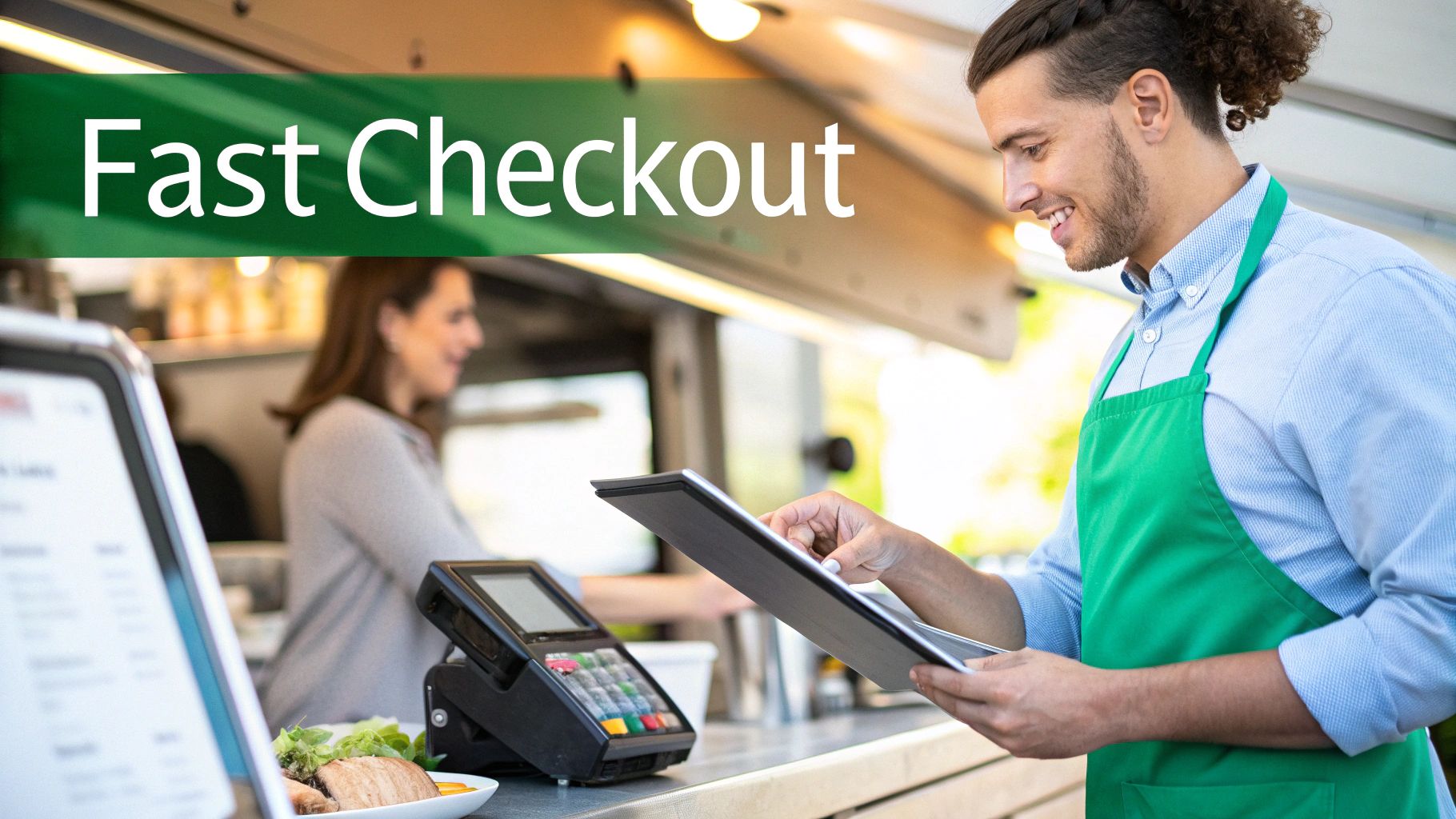
Forget the days of "cash only" signs and finicky credit card swipers. Today's customers expect a fast, smooth checkout. If your line is crawling because your tech can't keep up, you're not just creating a bad experience; you're actively losing sales. A modern, reliable Food Truck POS is built to crush those bottlenecks.
Why You Need a Truly Mobile POS
Your business is on wheels, so your technology has to be just as nimble. A true mobile POS system, like TackOn Table, is designed for exactly this kind of environment. It frees you from being stuck behind a counter and lets you run your business from anywhere.
Picture this: it's the peak of the lunch rush, and a long line is forming. Instead of watching people get discouraged and leave, a team member grabs a tablet and starts walking the line, taking orders and payments right there on the spot. This isn't just great service; it's a savvy business move that can double your serving capacity.
A great mobile POS should let you:
- Take Orders Anywhere: Bust lines by engaging customers while they wait.
- Accept Every Payment: Effortlessly process credit cards, tap-to-pay like Apple Pay, and other mobile wallets.
- Fire Orders Instantly: Send orders straight to your kitchen printer or KDS, cutting out the risk of handwritten mistakes.
This kind of agility is what separates struggling trucks from thriving ones.
TackOn Table vs. the Big Guys Like Toast and Clover
As you start looking, you'll run into giants like Toast and Clover. They offer powerful platforms, but they were largely built for sprawling, brick-and-mortar restaurants. That often means you're getting complex setups, long-term contracts, and a mountain of features you'll pay for but never actually use.
TackOn Table was built on a different idea: all-in-one simplicity. We give you the high-impact features you need without the bloat, making it a perfect fit for food truck owners who need something affordable and easy to master. You won't be juggling separate apps for payments, inventory, and sales reports—it's all right there in one place.
The best technology for a food truck is the kind you can set up in minutes and completely trust during your busiest hour. Complexity is the enemy of speed, and speed is everything.
Choosing Your Food Truck POS: TackOn Table vs Alternatives
A food truck is a lean machine. You don't have an IT department or hours to waste troubleshooting software. You just need it to work, period. That’s where a truly integrated, all-in-one solution pulls ahead.
Here's a quick look at how the options stack up when you're on the move.
| Feature | TackOn Table | Toast | Clover |
|---|---|---|---|
| Setup Time | Under 30 minutes, self-setup | Professional installation often needed | Can require third-party setup |
| Hardware | Works on common devices like iPads | Proprietary hardware with contracts | Proprietary hardware often required |
| Pricing Model | Transparent, no hidden fees | Complex tiers, long-term contracts | Can involve multiple processors & fees |
| Core Focus | Simplicity and speed for SMBs | Full-service restaurant enterprise | Retail & restaurant generalist |
This focus on simplicity and flexibility makes a huge difference. With TackOn Table, you get a quick setup you can handle yourself, the freedom to use hardware you might already have, and straightforward pricing without getting locked into a multi-year deal. For a deeper dive, check out our dedicated food truck POS solutions designed for vendors on the go.
The right tech partner lets you focus on your food and your customers, not on wrestling with software. Picking a simple, powerful, and affordable POS is a cornerstone of building a profitable food truck.
Finding Your Hungry Crowd: Location and Marketing Strategy
You could have the most amazing food in the city, but if your truck is parked on an empty street, you’ve just got an expensive hobby. A killer menu means nothing if no one can find you. This is where smart location scouting and day-to-day marketing become your two most important jobs. They work hand-in-hand to build a steady stream of customers.
The whole point of a mobile business is to go where the people are. But you can't just park and hope for the best—you need a plan.

The Art of Scouting the Perfect Spot
At its core, the food truck game is all about foot traffic. Your mission is to find places with a built-in audience that's a perfect match for what you're serving. Get a map out and start brainstorming your potential goldmines.
- Corporate Parks: These are an absolute goldmine for the weekday lunch rush. A single office building can mean hundreds of potential customers looking for something better than the sad desk salad.
- Breweries and Bars: So many spots that serve drinks don't have their own kitchens, and they're often desperate to partner with food trucks. It’s a classic win-win: they keep customers around longer, and you get direct access to their thirsty (and hungry) crowd.
- Festivals and Farmers Markets: Events like these are huge. You get crowds of people who showed up specifically to eat, drink, and spend money. Getting a spot can be competitive, but the payout is almost always worth the effort.
- Big Residential Areas: Don't sleep on large apartment complexes or dense neighborhoods, especially for dinner service. You can easily become the go-to weeknight treat for busy families and professionals.
Here's the real secret: test and track everything. Spend a day at a potential spot and just observe. How many people are walking by? When is the peak rush? Use the sales data from your Restaurant POS to see which locations deliver the highest average sales. That data is pure gold—it tells you exactly where to go back.
Marketing That Actually Works (and Doesn't Cost a Fortune)
For a food truck, marketing isn't about running pricey ads. It's about talking directly to your followers in real-time. Social media is your best friend here—no question. Platforms like Instagram, Facebook, and even TikTok are built for what you do: announcing your daily location, posting drool-worthy photos of your specials, and running flash promotions to get people to show up now.
Your social media bio should always list your location for the day. A simple morning post like, "Find us at 123 Main Street from 11 AM to 2 PM today!" is non-negotiable. This one simple habit turns your online followers into actual, paying customers.
Building Predictable Revenue with Partnerships
One of the best ways to smooth out the ups and downs of street vending is to lock in regular, scheduled gigs. Building relationships is a massive part of running a successful food truck business.
Start reaching out to local businesses and event organizers to build a more reliable schedule.
- Corporate Catering: Pitch a "Food Truck Friday" package to office managers in your area. This guarantees you a set amount of revenue and, just as importantly, introduces your food to hundreds of new people.
- Private Events: Market your truck for weddings, birthday parties, and graduation celebrations. These gigs command premium pricing and give you a captive audience ready to eat.
- Community Collaborations: Team up with a local blogger or influencer for a "takeover" day. A good word from them can send a huge wave of new customers right to your window.
These partnerships create a stable income base, making your daily walk-up sales the profitable cherry on top. The right tech makes it easy to manage this mix. For example, the features in TackOn Table's café management software are powerful enough to handle a single street-side taco sale and a massive catered event, all in the same simple system.
Unlike some Toast vs Clover alternatives that can feel bloated and overly complex for a mobile business, TackOn Table was built for simplicity and the need to adapt on the fly. Its all-in-one platform means you can manage your entire business—whether you're at a festival or a private party—without the headache.
Ready to build a predictable customer base? Book a personalized demo to see how our tools can help you lock in your best locations and market your truck effectively.
Managing Your Finances and Scaling for Growth
Profitability isn't a lucky break—it's the direct result of knowing your numbers inside and out. To really succeed in the food truck game, you have to get a little obsessed with the financials. We're talking about tracking every dollar that comes in, managing every cost that goes out, and understanding what the metrics are telling you about the health of your business. This is what separates the trucks that thrive from the ones that just scrape by.
Your POS system is your financial command center. A modern system like TackOn Table isn't just for taking orders; it’s packed with analytics that give you a clear, real-time view of your operation. In a few taps, you can see which menu items are your superstars, spot sales trends for different locations or days of the week, and keep an eye on how your labor costs stack up against your revenue. This isn't just trivia—it's the critical intel you need to make smarter, more profitable decisions on the fly.
Let Your Data Guide Your Decisions
Your sales data tells a story if you know how to read it. Are your spicy chicken sandwiches selling out by noon while the pulled pork languishes? That’s your cue to adjust prep levels and inventory orders. Noticing a consistent sales slump every Tuesday afternoon? That's your opportunity to experiment with a new parking spot or launch a targeted social media deal.
The earning potential for a truck that's dialed in is huge. Recent research into food truck revenue findings for 2025 shows that with smart cost management, operators are pulling in average annual revenues around $346,000. Even better, the top 25% are clearing $492,000 and beyond. A huge part of this comes down to tech, which can slash order errors by up to 95% and speed up your line by 40%. More efficiency means more customers served and more money in your pocket.
From One Truck to a Food Empire
Once you've got a handle on your finances and your truck is turning a consistent profit, it's natural to start thinking bigger. Scaling doesn't always mean jumping into a brick-and-mortar spot (though it can!). Growth can look like a lot of different things:
- Adding a second truck to hit more locations or work different types of events simultaneously.
- Building out a catering arm of your business for weddings, corporate gigs, and private parties.
- Creating a retail product, like bottling that secret-recipe BBQ sauce everyone raves about.
This is where your choice of technology becomes absolutely crucial. As your business gets more complex, you need a system that can grow with you without causing operational nightmares or a massive price hike. Features like TackOn Table’s multi-location control are a game-changer, letting you manage menus, track sales, and oversee staff across multiple trucks from one dashboard. That kind of built-in scalability is a major advantage over many popular Toast vs Clover alternatives.
You’re not just trying to survive out there; you're building a resilient and scalable food truck business. Having the right tools and a laser focus on your numbers is the foundation for making that happen.
Curious how much you could be saving with a more efficient and affordable system? Use our savings calculator to see the potential impact on your bottom line.
A profitable business starts with mastering today’s finances and having a clear plan for tomorrow's growth.
Take the first step toward that future. Book a demo of TackOn Table and see how our all-in-one platform can help you get there.
Frequently Asked Questions About Running a Food Truck Business
Let's tackle some of the burning questions I hear all the time from people just getting into the food truck game. Getting these right from the start can save you a lot of headaches down the road.
What’s the single biggest mistake new food truck owners make?
Hands down, it's underestimating the importance of operational workflow. Many new owners get so caught up in the menu and the truck wrap that they forget about the actual process of taking an order, processing a payment, and getting food out the window quickly. A clunky operation leads to long, frustrated lines and lost customers. The secret weapon here is a solid mobile POS system. A solution like TackOn Table, with its easy setup and all-in-one simplicity, is built to eliminate these bottlenecks.
How much cash do I really need to start a food truck?
There's no single magic number, but you should realistically budget between $50,000 and $175,000. This wide range covers everything from the truck itself and kitchen equipment to all the permits and initial inventory. A big piece of that budget you can control is your tech. Don't get locked into expensive, complex systems designed for brick-and-mortar restaurants. An affordable, adaptable platform like TackOn Table helps you protect that precious startup capital with transparent pricing and no long-term contracts, keeping your monthly overhead low.
How do I pick the right POS system for a business on wheels?
For a food truck, the best Restaurant POS needs to be three things: simple, tough, and completely mobile. You’re not in a building with stable Wi-Fi, so you need a cloud-based system that runs smoothly on a tablet or phone using cellular data. Crucially, it must accept every way people want to pay—think tap-to-pay, Apple Pay, and Google Pay. You should also be able to update your menu on the fly and see your sales in real-time. This is exactly the fast-paced environment TackOn Table was designed for, giving you the power and simplicity a mobile business demands.
Ready to equip your food truck with a system that’s actually built for speed and simplicity? TackOn Table gives you the essential features you need, without the bloat you’d find in traditional Toast vs Clover alternatives.
Start your free trial today and discover just how easy it can be to manage your business on the go.