
So, you're ready to start a food truck. Before you even think about firing up the grill, you need a solid blueprint. This is where the real work begins: nailing down your unique concept, writing a bulletproof business plan, and figuring out how you’ll pay for it all.
This isn't just paperwork; it’s the foundation that turns a passion for food into a real, profitable business that's ready to hit the road.
Your Blueprint for Food Truck Success
Launching a food truck is so much more than just cooking great food. It's about building a business from the ground up, and that process starts long before you ever serve your first customer. A strategic plan is your roadmap, guiding every single decision you'll make. This is the stage where you transform that brilliant idea into something tangible and, importantly, fundable.
The timing couldn't be better. The food truck industry is booming, expected to grow from roughly USD 5.8 billion in 2025 to a massive USD 10.9 billion by 2035. What’s really interesting is that no single company owns more than a 5% market share. It’s a wide-open field, perfect for a passionate entrepreneur to make their mark. Most successful owners I've seen go for customized or medium-sized trucks, which make up about 80% of the market, striking that perfect balance between kitchen space and mobility.
This diagram breaks down the essential first steps for getting your food truck idea off the ground and into reality.
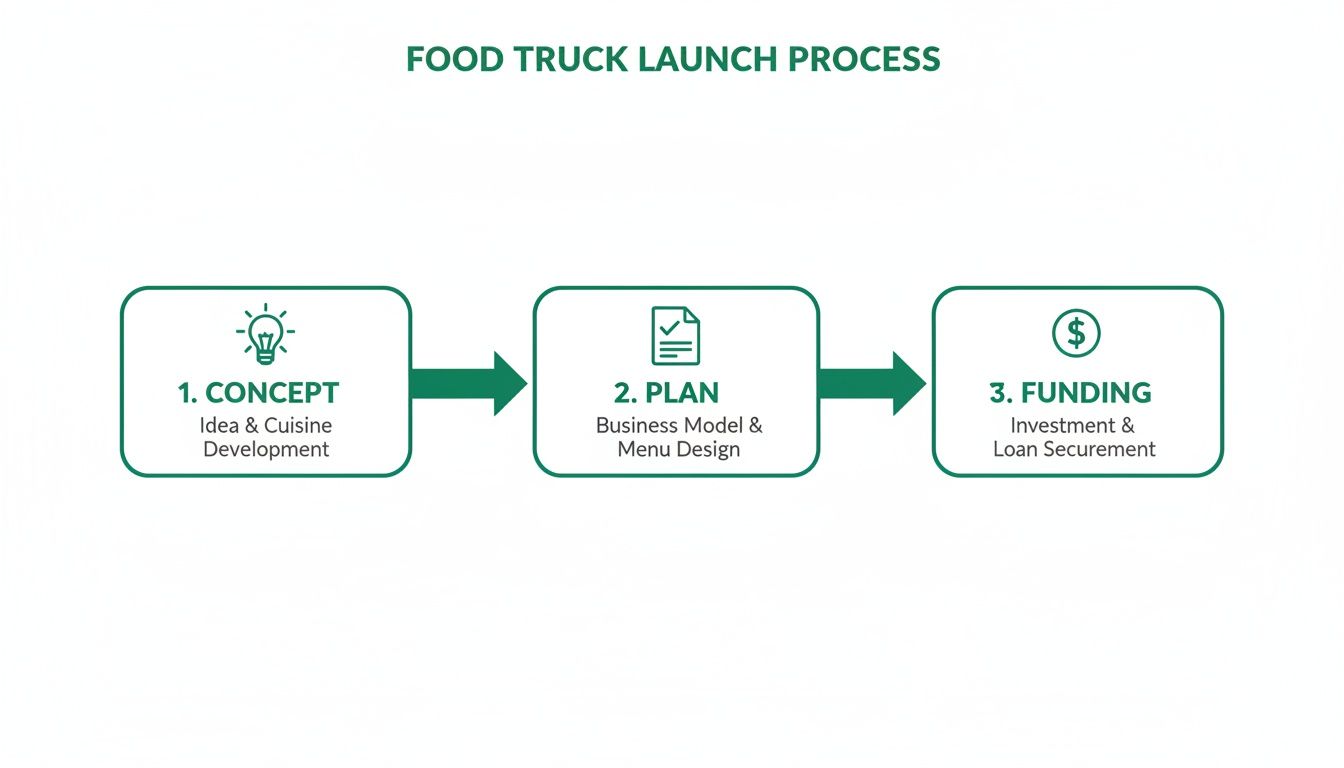
As you can see, a killer concept, a detailed plan, and the right funding are the three pillars that will hold up your entire venture.
Nail Down Your Business Plan and Concept
I can’t stress this enough: your business plan is the single most important document you’ll create. It forces you to get honest about every part of the operation, anticipate roadblocks, and set clear, achievable goals. The first real step toward success is putting together a winning food truck business plan that clearly lays out your vision.
Your plan needs to cover a few key areas:
- The Big Idea: What makes your food truck special? Define your niche—are you doing gourmet grilled cheese, authentic Filipino street food, or a mobile espresso bar? Know exactly who you're trying to feed.
- Market Research: Who are you up against? Where are you going to park? Spend time scouting local regulations, popular festival sites, and bustling office parks to find your prime locations.
- The Numbers: This is where you map out your startup costs, day-to-day expenses, and what you realistically expect to earn. Don't be overly optimistic—be thorough.
Getting a Handle on Your Finances
Let’s talk money. Budgeting with accuracy is non-negotiable. Your initial investment will cover the truck itself, outfitting the kitchen, stocking your first round of inventory, paying for licenses, and creating your brand. All in, these one-time costs can run anywhere from $50,000 to over $175,000, depending on whether you buy new or used and how fancy you get.
Here’s a quick look at where that initial investment might go. These are just estimates, but they give you a realistic starting point for your own budget.
Initial Food Truck Startup Cost Breakdown (Estimates)
| Expense Category | Low-End Estimate (USD) | High-End Estimate (USD) |
|---|---|---|
| Food Truck (Used vs. New) | $25,000 | $100,000 |
| Kitchen Equipment & Installation | $10,000 | $50,000 |
| Licenses, Permits & Legal Fees | $1,000 | $5,000 |
| Initial Food & Supply Inventory | $2,000 | $5,000 |
| POS System & Technology | $500 | $2,500 |
| Branding & Marketing (wrap, website) | $1,500 | $7,500 |
| Contingency Fund (Unexpected Costs) | $5,000 | $10,000 |
This table should help you see how the costs break down, but remember that your numbers will be unique to your specific concept and location.
Your business plan isn't just a roadmap for you—it’s your pitch. A well-researched financial section is what convinces banks or investors that you're a serious entrepreneur who understands the bottom line.
Of course, the spending doesn't stop there. You'll have ongoing costs for ingredients, fuel, insurance, marketing, and the technology that keeps you running. In a business with tight margins, choosing an affordable and reliable system is crucial. A modern, all-in-one platform like TackOn Table gives you the control you need without breaking the bank. Its transparent pricing and easy setup ensure you're not bogged down by surprise fees or complicated hardware, a clear advantage for any new business.
Building this strong financial foundation from day one is what will set you up for long-term profitability and maybe even a fleet of trucks down the line.
Navigating Food Truck Licenses and Legal Requirements
Let's talk about the least glamorous part of launching a food truck: the paperwork. It’s tempting to brush this aside and focus on perfecting your signature dish, but getting the legal side buttoned up is absolutely non-negotiable. One missed form or misunderstood city ordinance can bring your dream to a screeching halt with fines or even a full shutdown before you’ve served a single customer.
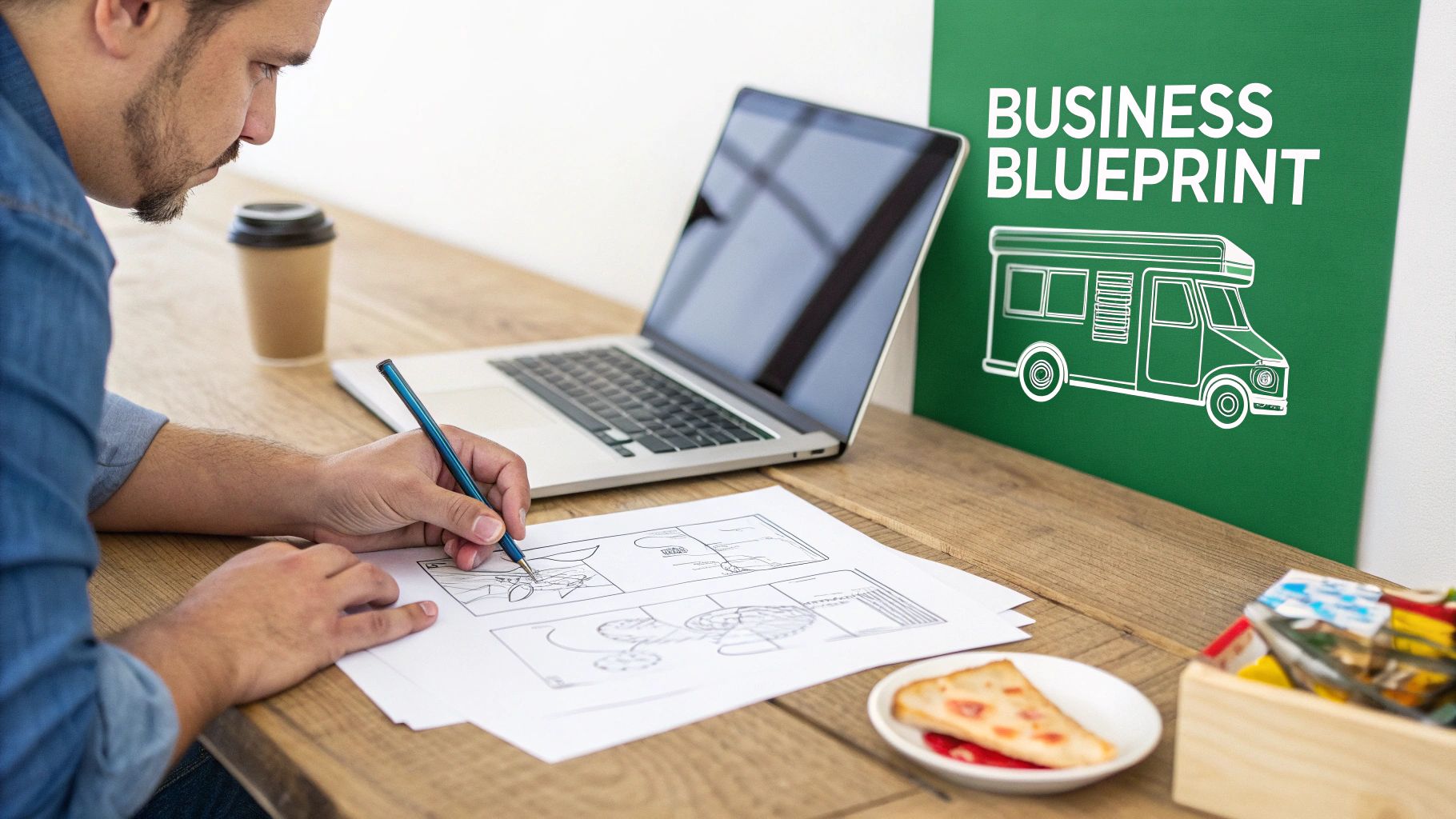
Think of all this legal stuff as the frame and foundation for your truck. A solid legal structure ensures everything else can run smoothly, protecting you, your future team, and your customers. The requirements can feel like a maze because they vary wildly from one city to the next, but they generally fall into a few key categories.
Your Essential Permit and License Checklist
Before you can legally fire up the grill, you’ll need a whole folder of official documents. Your first stop should be your local city and county government websites—they are the final word on what’s required in your area. Most places will demand some version of these:
- Business License: This is your basic ticket to operate in a specific city or county. It gets your business on the local government’s radar for tax purposes.
- Employer Identification Number (EIN): Planning to hire help? You'll need an EIN from the IRS. It’s basically a Social Security number for your business and is essential for payroll.
- Health Department Permit: This is a big one. A health inspector will comb through your truck to make sure it meets all safety and sanitation codes—from the number of sinks to refrigerator temperatures—before they give you the green light.
- Food Handler’s Permits: Every single person on your truck who touches food needs their own permit. This usually involves taking a short course on food safety and passing a test.
- Mobile Food Vending License: This is the specific permit that lets you operate as a mobile vendor. It often comes with a whole set of rules about where you can park, your hours, and how long you can stay in one spot.
Depending on where you are, you might also need permits from the fire department, special zoning permits, or licenses for specific events. Never assume. Make a checklist and get direct confirmation for every single item.
Pro Tip: Many cities require food trucks to partner with a licensed commercial kitchen, often called a commissary. This is your home base for prepping food, storing extra supplies, dumping greywater, and filling up with fresh water. You’ll often need to show proof of a commissary agreement before you can even get your health permit, so lock this down early.
Protecting Your Investment with the Right Insurance
Insurance isn't just a good idea—it's mandatory. It’s what stands between your business and financial disaster if something unexpected happens. A single customer slip-and-fall or a small kitchen fire can lead to a lawsuit that could wipe you out. The average claim for a food truck incident can easily sail past $6,000, an expense most startups simply can't absorb.
You need more than just one policy; you need a few layers of protection.
Key Insurance Policies for Food Trucks
| Insurance Type | What It Covers | Why You Need It |
|---|---|---|
| General Liability | Protects against claims of injury or property damage from your business operations. | This is your core coverage for customer accidents. Think food poisoning claims or someone tripping over a sign. |
| Commercial Auto | Covers your truck itself and any accidents that happen while you're on the road. | Your personal auto policy will not cover a vehicle used for business. This is non-negotiable. |
| Workers' Comp | Provides benefits to employees for any work-related injuries or illnesses. | In most states, this is legally required the moment you hire your first employee. |
| Property Insurance | Covers the expensive gear inside your truck, like your grills, fryers, and POS system. | This protects the essential tools of your trade from theft, fire, or other damage. |
Working your way through this legal landscape takes patience and a good organizational system. If you tackle these requirements step-by-step, you’ll build a resilient, compliant business that’s truly ready for the road ahead.
Ready to build a business that runs as smoothly as it’s legally protected? Discover how TackOn Table’s all-in-one system can simplify your operations. Book a personalized demo to see it in action.
Choosing and Outfitting Your Mobile Kitchen
Your truck isn't just a vehicle—it's your entire business on wheels. This is the heart of your operation, the place where the magic happens and where you'll spend most of your time. Every single choice, from the truck itself to the placement of the fryer, will either make your life easier or create daily headaches. A smart setup is the secret to a smooth, profitable workflow.
The first major fork in the road is deciding whether to buy a brand-new, custom-built truck or a more accessible used one. A new truck is a dream—perfectly tailored to your concept and backed by warranties—but it comes with a hefty price tag. A used truck can slash your startup costs, but it might hide mechanical gremlins or a kitchen layout that fights you every step of the way.
You’re jumping into a booming market, by the way. The global food truck industry is set to explode, growing from $4.33 billion in 2025 to $5.77 billion by 2029. Here in the US, revenue is expected to climb to $2.8 billion in 2025, which shows just how much people love unique, on-the-go food.
New Versus Used Food Trucks
The choice between a shiny new truck and a seasoned veteran really boils down to budget versus customization. There’s no right or wrong answer here; it’s all about what makes sense for your financial situation and your specific menu.
-
New Trucks: Think of these as a blank canvas. You get to collaborate with a builder to craft a kitchen where every piece of equipment is exactly where you need it for an efficient workflow. Plus, everything is under warranty, so you can avoid the nightmare of a major breakdown in your first year. The trade-off is the cost, which can easily soar past $100,000.
-
Used Trucks: The big draw here is the lower price, often landing somewhere between $30,000 and $70,000. But you’re inheriting someone else’s dream, which means the layout might be all wrong for your concept, forcing you into awkward workarounds. Always, always get a trusted mechanic to give it a top-to-bottom inspection before you sign anything.
Whichever route you take, don't get so caught up in the kitchen that you forget about the vehicle itself. A pristine kitchen is useless if the engine gives out on the way to a sold-out festival.
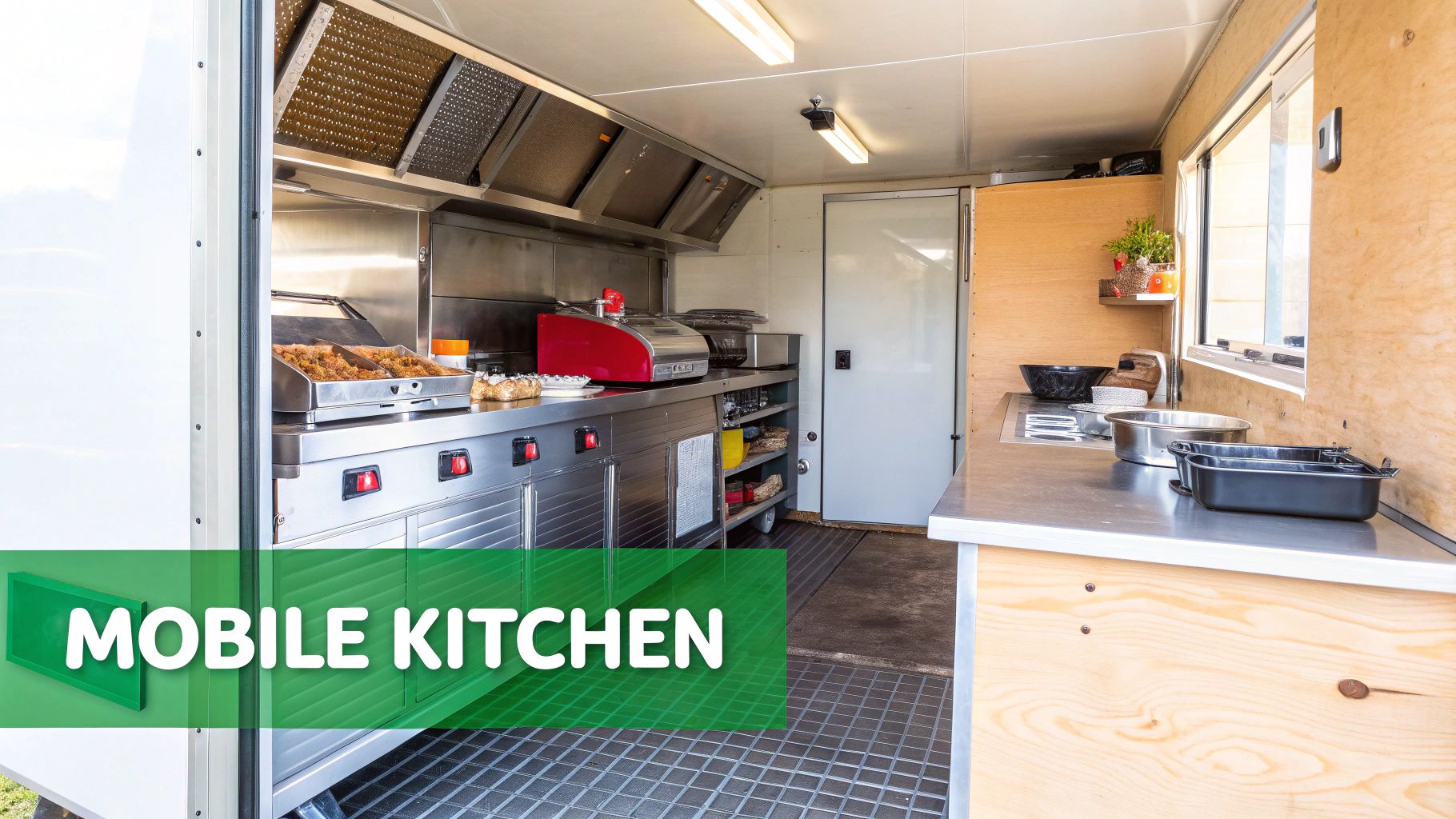
Equipping Your Kitchen for Maximum Efficiency
Once you've secured your truck, the real fun begins—outfitting the kitchen. In a food truck, space is the ultimate luxury, so every piece of equipment has to earn its keep. An ultimate commercial kitchen equipment checklist can be a lifesaver here, making sure you don't forget something critical.
Let your menu be your guide. A gourmet burger truck needs a high-quality griddle and deep fryer, while a mobile coffee bar needs an espresso machine and grinders. Whatever you buy, make sure it’s commercial-grade stainless steel—it’s built to last and a breeze to clean.
Your kitchen layout should be all about flow. You want to minimize the number of steps it takes to get an order from the ticket printer to the customer's hands. Shaving just a few seconds off each order can mean hundreds of dollars in extra sales during a hectic lunch rush.
Beyond the shiny cooking gear, your truck’s core infrastructure is what keeps the whole operation running. This is non-negotiable stuff:
- Power: You’ll need a robust generator or battery bank that can handle your entire kitchen running at full blast without skipping a beat.
- Plumbing: Health codes are very specific here. You’ll typically need a three-compartment sink for washing, a separate handwashing sink, a freshwater tank, and a greywater tank.
- Ventilation: A commercial-grade hood and an up-to-code fire suppression system aren't just suggested—they’re required by law and are absolutely critical for keeping everyone safe.
Every square inch of your truck needs to serve a purpose. Pouring your effort into designing a smart, efficient kitchen from the start is one of the best investments you'll ever make.
Ready to manage your new mobile kitchen with a system built for speed and simplicity? TackOn Table’s mobile POS is the perfect all-in-one solution for food truck owners. Start your free trial today and see how easy it can be.
Crafting a Menu That Sells (and Makes a Profit)
Your menu is the heart of your food truck. It’s more than just a list of what you sell—it's your culinary identity, your production line, and your profit engine all rolled into one. Getting it right is a careful balancing act between amazing food, smart business, and the realities of a kitchen on wheels.
The biggest mistake I see new owners make is trying to do too much. A sprawling menu is a recipe for disaster in a tight space. It leads to slow service, a mountain of wasted ingredients, and a brand that feels confusing. The sweet spot is a focused list of 5-8 core items you can execute flawlessly, even during a crazy lunch rush.
A tight menu means you master every dish, your ticket times are lightning-fast, and managing inventory doesn't become a full-time job. Remember, in the food truck game, speed is money. Shaving seconds off each order means more customers served and more cash in the register.
Nailing Your Food Costs and Pricing
You can't be profitable if you don't know your numbers, and the most important one is your food cost percentage. This tells you exactly how much of a menu item's price is eaten up by the ingredients. For most food trucks, you want to aim for a healthy 28% to 35%.
To figure this out, you have to cost out every single recipe. I mean everything—down to the pinch of salt and the drizzle of oil. Add up the cost of every component to find your cost per serving.
Once you have that magic number, the pricing formula is straightforward:
Price = Cost Per Serving / Your Target Food Cost Percentage
Let's say your signature tacos cost $3.50 in raw ingredients to make. If you’re targeting a 30% food cost, you need to price them at $11.67 or more ($3.50 / 0.30). This simple math ensures every sale is actually building your business, not just covering ingredients.
Smart Menu Design for a Mobile Kitchen
With your prices locked in, you can start thinking like a marketer. Menu engineering is all about psychology—gently guiding customers toward the items that are both popular and highly profitable.
Here are a few tricks of the trade that really work:
- Sell with Words: Don't just list "spicy mayo." Call it "Smoky Chipotle Aioli." It sounds incredible and justifies a premium price.
- Master the Upsell: "Want to add bacon or avocado to that?" These small add-ons cost you pennies but can boost your average sale significantly.
- Create Value with Combos: Bundling an entrée, a side, and a drink for a single price feels like a great deal for the customer and encourages them to spend more than they might have otherwise.
The Right Tech and the Right Partners
Juggling costs, prices, sales, and inventory on a clipboard is a nightmare. This is where a modern Restaurant POS becomes your best friend. It’s the command center for your entire operation, doing way more than just taking payments.
A system like TackOn Table, for example, gives you a real-time dashboard of what’s selling. It can automatically track your inventory, so you never run out of your best-selling item during the busiest hour of the day. For food truck owners who need powerful features without the headache of complex systems, it's a fantastic Toast vs Clover alternative.
Just as crucial are your suppliers. Forging strong relationships with them is non-negotiable. You need partners who deliver consistent quality at a predictable price. A good supplier will also give you a heads-up on market changes or seasonal deals, helping you stay ahead of price hikes and keep your menu profitable.
Ready to take control of your menu and inventory? See how TackOn Table simplifies food truck management. Book a demo today and discover a smarter way to run your business.
Picking the Right Tech: Your Food Truck's Restaurant POS System
In the tight, fast-paced world of a food truck, your technology can either be your secret weapon or your biggest headache. Your Point of Sale (POS) system is the command center for your entire operation. Think of it as much more than a cash register; it’s what keeps orders firing, payments flying, and vital business data right where you need it.
A clunky, slow system will only frustrate customers and cause chaos during a lunch rush. On the other hand, a modern, mobile-first POS lets you take orders down the line on a tablet, accept any payment method in a flash, and keep service moving at the speed of hungry. That kind of efficiency is a game-changer when every second counts.
What to Look For in a Food Truck POS
When you start comparing options, it's easy to get sidetracked by features built for a massive sit-down restaurant. Your needs are different. You need a system that’s nimble, reliable, and built for the real-world challenges of a mobile business.
Here are the features you absolutely can't compromise on:
- Go Mobile, Go Wireless: This is non-negotiable. Your system has to run on a handheld device like a tablet and connect reliably over cellular data. You can't be chained to a bulky terminal inside the truck.
- Lightning-Fast Payments: It needs to handle everything—credit, debit, and especially contactless payments like Apple Pay and Google Pay. People just expect to tap and go now.
- So Simple, Anyone Can Use It: Your crew should be able to pick it up in minutes, not hours. An intuitive interface means fewer mistakes and a line that never stops moving.
- Real-Time Sales Data: You need to know what's flying off the menu right now. Good analytics help you make smart calls on the fly, like prepping more of your best-seller before you run out mid-service.
A food truck POS isn’t just about ringing up sales. It’s about making your entire workflow smoother, from the moment a customer steps up to the window to the second you hand them their food. The right tech gives you the freedom to focus on what you do best—making incredible food—not wrestling with clunky software.
A Modern Take: TackOn Table as a Top Toast vs Clover Alternative
For a long time, systems from companies like Toast and Clover were the default choice, but they were often designed with brick-and-mortar restaurants in mind. This can mean complicated setups, expensive proprietary hardware, and a bunch of features you’ll pay for but never actually use. For a food truck owner, a simpler, more affordable solution is almost always the smarter move.
This is exactly where a system like TackOn Table comes in. It’s a powerful Toast vs Clover alternative that gives you all the essential features—menu management, sales reports, and even inventory tracking—in a dead-simple package that runs on an iPad. It's the definition of all-in-one simplicity, built from the ground up for modern food businesses like yours.
Let's break down how a modern system stacks up against the old guard.
Comparing Food Truck POS Systems
| Feature | TackOn Table | Traditional Competitors (Toast/Clover) |
|---|---|---|
| Hardware | Use your own iPad; no proprietary hardware needed | Often requires expensive, proprietary terminals |
| Setup Time | Get up and running in under 30 minutes | Can require professional installation and hours of setup |
| Pricing Model | Simple, transparent pricing with no hidden fees | Often involves complex contracts and processing fees |
| Ease of Use | Extremely intuitive, minimal training required | Can have a steep learning curve with complex features |
| Flexibility | Designed for mobile and multi-location management | Can be rigid and better suited for a fixed location |
As you can see, the focus is on getting you started quickly and affordably, without locking you into a complex ecosystem that wasn't built for you.
Why Simplicity and Cost Matter Most
Startup costs are the biggest hurdle when you're figuring out how to start a food truck. A system with a clear, honest price and no long-term contracts lifts a massive weight off your shoulders. The real advantage of TackOn Table lies in its affordability and adaptability, letting you get started without sinking thousands into hardware.
The easy setup is just as important. Getting a system like TackOn Table running in less than 30 minutes means you're spending your valuable time serving customers, not on the phone with tech support. And as you grow, the multi-location control makes it incredibly easy to manage a second truck or even open a small storefront, all from one place.
The global food truck industry is booming, projected to grow at a 6.4% CAGR, and a smart investment can often pay for itself in just 2-4 years. But that success relies on efficiency. As you can learn from these booming food truck market trends, the right technology is at the heart of it all.
Choosing your tech is one of the most critical decisions you'll make. A powerful, intuitive, and affordable POS is the engine that will drive your food truck's success. To see exactly how our platform is built for businesses on wheels, check out our guide on POS solutions for food trucks.
Ready to see how an all-in-one system can change your game? Book a personalized demo and discover how simple and powerful your food truck POS can be.
Getting the Word Out and Building a Fan Base
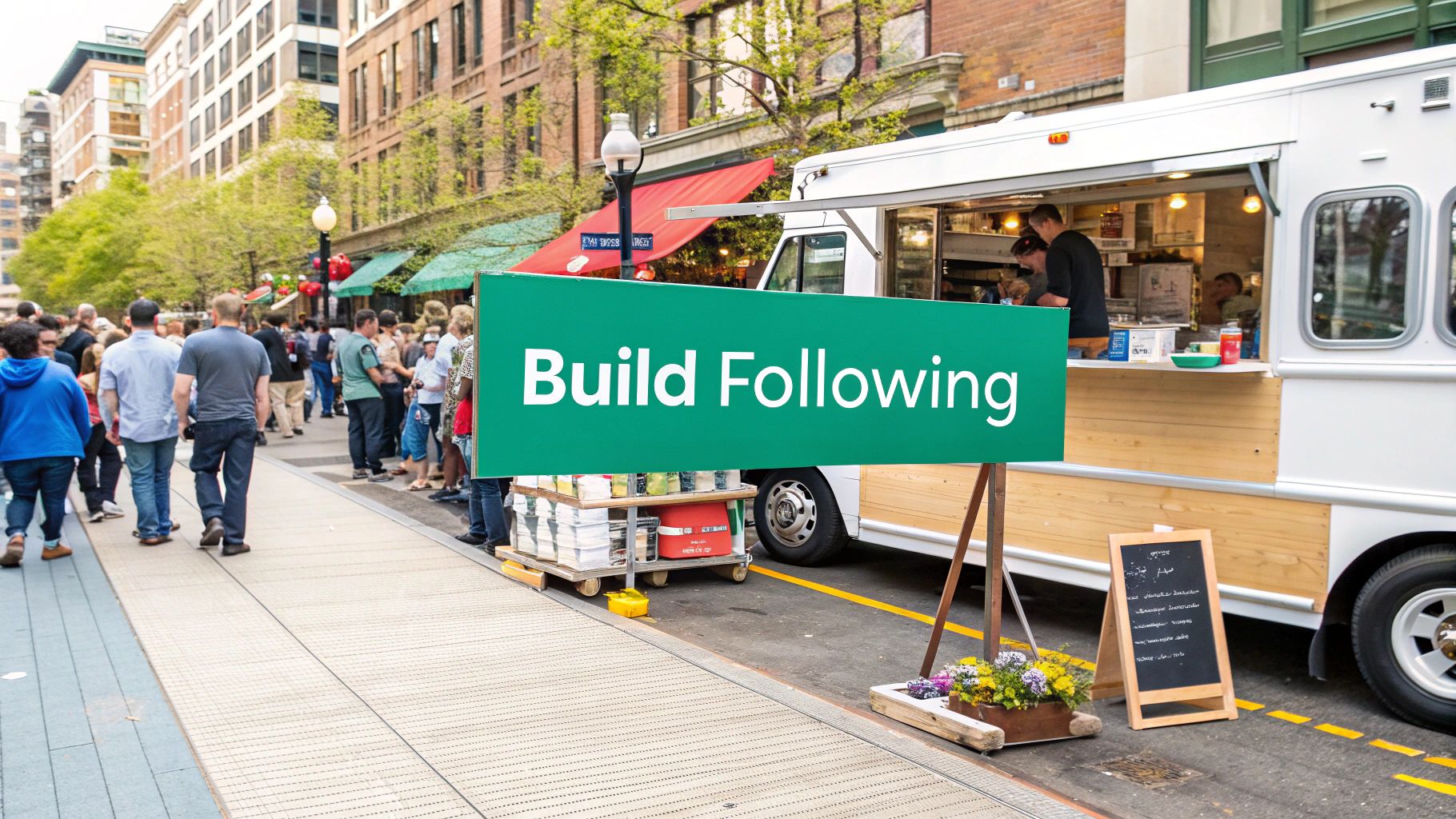
Making killer food is the heart of your business, but it won't matter if no one knows where to find you. The real challenge is cutting through the noise, getting people to your window for the first time, and then turning them into regulars who actively hunt you down. This is where smart, consistent marketing comes in. It's about creating a buzz that keeps your line long and builds a genuine community around your food.
It all begins with a solid brand identity. Think of your truck’s wrap as a giant, rolling billboard. It needs to be eye-catching, easy to read, and tell people what you're all about in a single glance. That visual style—your logo, your colors—should be everywhere: on your packaging, your social media, your website. A cohesive look tells people you’re a professional who means business.
Put Social Media to Work
For a food truck, social media isn't optional—it's your lifeline. Platforms like Instagram and Facebook are how you talk directly to your customers. It's where you'll announce your daily location, make people drool over your specials, and show off your brand's personality. Don't skimp here; high-quality, mouth-watering photos are an absolute must.
Your most important post, every single day, is your location announcement. Get into a routine of posting it at the same time each morning so your followers know when to check. Use a great photo or a quick video, and always tag the specific location or any business you’re partnering with, like the brewery or office park where you've set up shop.
My Two Cents: Don't just post and walk away. Use Instagram Stories and Facebook Live to show what's happening right now. A quick clip of a daily special coming off the grill, a poll asking followers what new menu item they'd rather see, or a live shot of a happy lunch rush—this kind of in-the-moment content makes people feel connected and creates a real sense of urgency.
Smart Marketing That Won’t Break the Bank
You don’t need a huge budget to make a name for yourself. Some of the most powerful marketing tactics are built on old-fashioned hustle, community connections, and clever partnerships. Your goal is simple: get your food into as many new mouths as possible.
Here are a few tried-and-true tactics that deliver results:
- Team Up with Local Breweries & Wineries: This is a classic win-win. They have the thirsty customers, but often no kitchen. You have the amazing food. You help them keep patrons on-site longer, and they provide a built-in crowd for you.
- Hit the Farmers' Markets and Festivals: These events are goldmines. You get access to a concentrated audience of people who are already out and looking for great local food. Scour local event calendars to find opportunities.
- Connect with Local Food Bloggers: A single positive post from a respected local food writer or influencer can create a stampede to your truck. Reach out, invite them for a meal on the house, and let your food speak for itself.
Your Secret Weapon: A Flawless Customer Experience
At the end of the day, your very best marketing tool is an incredible customer experience. When the service is quick, the staff is friendly, and the whole process is seamless, people remember. They come back, they tell their friends, and they post rave reviews online. This is where your behind-the-scenes tech becomes a silent but powerful part of your marketing.
Nothing kills the vibe of a great meal like a clunky payment system or a frustratingly long wait. A modern Restaurant POS like TackOn Table makes sure that last interaction is just as good as the first bite. Its mobile POS features let you bust lines by taking orders quickly, and the easy setup means you're up and running without a headache.
This all-in-one simplicity takes the operational stress off your shoulders, so you can focus on what you do best: making amazing food and connecting with your customers. When the tech just works, you have more time and energy to build the loyal community that will keep your business thriving.
Ready to provide a customer experience that keeps them coming back?
Book a demo today to see how TackOn Table can help you build your following.
Got Questions About Starting a Food Truck? We’ve Got Answers.
Jumping into the food truck world is exciting, but it definitely comes with a lot of questions. Let's break down some of the most common things new owners ask.
What's the Real-World Cost to Start a Food Truck?
There's no single price tag, but you should probably budget somewhere between $50,000 and $175,000. The truck itself is your biggest line item. You might find an older, used truck for around $25,000-$40,000, but a shiny new one, fully customized, can easily top $150,000.
Don't forget the other big expenses:
- Kitchen Gear: Depending on what you're cooking, this can set you back anywhere from $10,000 to $50,000.
- Licenses & Permits: This can range from $500 to $5,000 based on your city and state regulations.
- POS System: The good news is you can avoid a huge upfront cost here. Modern systems like TackOn Table use a subscription model, which is much easier on the wallet than old-school hardware.
What are the Must-Have Permits?
Navigating the red tape can feel overwhelming, but it boils down to a few key documents. The exact requirements change from city to city, but you'll almost certainly need:
- A standard Business License
- An Employer Identification Number (EIN)
- A Food Handler's Permit for every single person on your team
On top of that, you'll need a Health Department Permit to prove your truck is up to code, plus a Mobile Food Vending License to operate legally. Your first call should always be to your local city and county health departments—they have the final say.
The secret to a profitable food truck menu? Find a niche that people love, but make sure your cost of goods sold (COGS) stays under 30-35% of your menu price. Nailing that balance is everything.
What's the Most Profitable Food to Sell?
Profitability is a magic mix of low food costs, high customer demand, and how fast you can get the food out the window. Time-tested concepts like gourmet tacos, specialty burgers, creative grilled cheese, and pizza by the slice are always big winners.
These items are built on inexpensive core ingredients. From there, you can offer premium toppings and add-ons that boost the price—and your profit margin—without much extra work.
How Do I Pick the Right Restaurant POS?
For a food truck, your Restaurant POS needs to be three things: mobile, dependable, and simple. You're looking for something with rock-solid wireless connectivity, a battery that won't die mid-rush, and the ability to take any payment that comes your way, especially contactless.
This is where a system like TackOn Table really shines. It's an all-in-one solution that runs right on a tablet. You get built-in inventory management to see what you're running low on, plus sales data that helps you figure out what's selling and what's not. It's the kind of straightforward, affordable system that makes it a great Toast vs Clover alternative. If you want to dig deeper, you can check out our full list of frequently asked questions.
Ready to give your new food truck a POS that’s built for the hustle? TackOn Table is an intuitive, all-in-one system designed to make taking orders, processing payments, and managing inventory feel effortless. Book a personalized demo and see just how easy it is to get up and running.