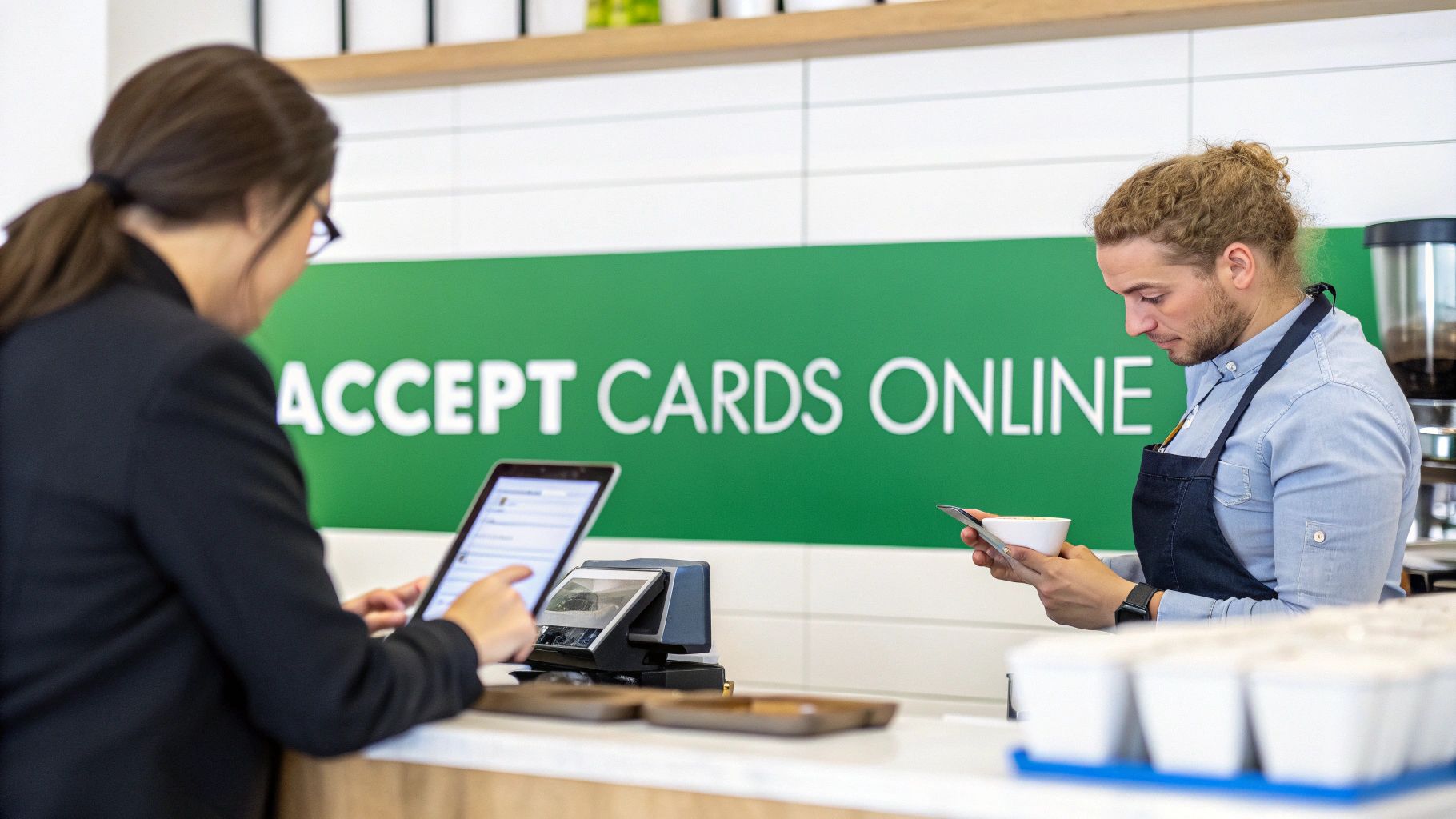
Let's face it, if you're running a restaurant, café, or food truck and not accepting credit cards online, you're leaving money on the table. It's that simple. Setting up online credit card processing for your small business isn't just a "nice to have" anymore; it's the critical link between your fantastic food and your customers' wallets.
Why Your Restaurant Absolutely Needs Online Credit Card Processing
In the food world, cash has been dethroned. The modern diner expects to pay with a card, whether they're ordering delivery from their couch, picking up curbside, or sitting at one of your tables. For any food business—from a bustling cafe to a roaming food truck or a full-service restaurant—accepting cards is fundamental to growth.
Think about it from a customer's perspective. They find your menu online, get excited, and build a big order for their office lunch. They get to the checkout page, ready to pay, only to find you don't accept cards online. What happens next? They close the tab, find a competitor who does, and you've lost that sale—and maybe their future business, too. This isn't just a bad dream; it's a real, preventable loss of revenue.
Capturing Every Sale in a Digital-First World
The move to digital payments isn't a fad; it's a tidal wave. E-commerce sales have rocketed to over $300 billion per quarter, a staggering increase from just $100 billion in late 2019. This data, highlighted by the Small Business Payments Alliance, screams opportunity. By embracing seamless online payments, you're tapping directly into this massive market and extending your reach far beyond the customers who happen to walk by your door.
This is where a modern, integrated system like TackOn Table becomes your most valuable player. It’s not just about getting the transaction approved. Our all-in-one platform ties your whole operation together.
- No More Juggling: It brings your online orders, in-house dining, and phone-in payments into one unified system. Reconciliation just got a whole lot easier.
- Quicker Turns: Our mobile POS devices let your servers take orders and payments right at the table. This means faster service, happier guests, and more table turnovers on a busy night.
- Fewer Headaches: Automating payments gets rid of the manual entry errors that always seem to pop up and cause nightmares when you're closing out the books.
To really see the difference, let's break down how modernizing your payment system changes the game.
How Modern Payments Impact Your Restaurant Operations
A quick comparison of how different payment methods directly affect your restaurant's revenue and daily workflow, highlighting the clear advantages of an integrated system.
| Payment Method | Impact on Sales | Effect on Operations | Best For |
|---|---|---|---|
| Cash-Only | Limits sales to walk-ins with cash; loses online/phone orders. | Simple, but invites theft, requires bank runs, and is slow. | Very small, niche operations with low volume. |
| Standalone Terminal | Captures in-person card sales but misses online opportunities. | Creates separate reporting, requiring manual reconciliation. | Basic in-person transactions without online integration. |
| Integrated Restaurant POS | Maximizes sales across all channels (online, in-person, mobile). | Automates reporting, reduces errors, and speeds up service. | Any modern restaurant, café, or food truck wanting efficiency and growth. |
The right system isn't just about taking money. It’s about building a smooth, reliable experience that keeps customers coming back while making life easier for you and your staff.
The takeaway is clear: The right payment system isn't just about taking money. It's about creating a frictionless experience that encourages repeat business, simplifies your operations, and unlocks new revenue streams you couldn't access before.
Ready to stop losing sales and start streamlining your operations? Book a Demo with TackOn Table and see how easy it is to get started.
Choosing the Right Restaurant POS Payment Partner
Diving into the world of online credit card processing can feel overwhelming. You're hit with terms like processors, gateways, and all-in-one systems, and honestly, it’s tough to figure out where to even start.
Let’s break it down with a simple restaurant analogy. Your payment gateway is like your front-of-house host—it securely takes the customer's payment information. The payment processor is your kitchen staff—they're in the back, making sure the funds are approved and the transaction goes through smoothly.

You could hire your "host" and "kitchen" from different companies, trying to piece everything together yourself. Or, you can find a partner that provides an all-in-one solution. For a busy food business, this choice makes a world of difference in your day-to-day operations.
Why an All-in-One Café Management Software Just Makes Sense
Think about a growing café. You might be juggling one vendor for your in-store terminal, another for your online ordering site, and maybe a third for invoicing. This isn't just complicated; it creates operational chaos. You're stuck doing manual reconciliation, staring at disjointed reports, and never getting a true picture of your business's health. The market is full of options, and when you start looking, you'll see just how many choices are out there, like specialized services such as Debit Success NZ.
Now, picture a food truck that needs to be fast and flexible. A clunky, multi-part payment system is a non-starter. You need a simple, mobile POS that just works, letting you take a payment from anywhere without a second thought. This is exactly where a unified platform like TackOn Table changes the game.
We designed TackOn Table to get rid of this exact headache. Our system combines the gateway, processor, and your POS into one seamless platform. That means one login, one dashboard, and one transparent bill—no more juggling multiple vendors.
Moving to integrated digital payments isn't just a trend; it's a fundamental shift. The global payment processing market has already hit $61.1 billion, and 79% of small businesses now accept electronic payments. For a coffee shop or a multi-location franchise, a reliable, cloud-based POS is no longer a luxury—it's essential. On average, small businesses see an 8% lift in sales just by starting to accept online payments. That’s a whole new revenue stream waiting for you.
A Smarter Toast vs Clover Alternative
Too many restaurant owners feel trapped by big, complex systems like Toast or Clover. They often rope you into long-term contracts with confusing pricing, and you're forced to buy hardware that locks you into their ecosystem for years.
TackOn Table was built to be the exact opposite: simple, affordable, and adaptable.
- Easy Setup: We'll get you up and running in minutes, not days. Our guided onboarding means you can start taking payments almost immediately.
- Multi-Location Control: Manage menus, update pricing, and handle staffing across all your locations from a single, intuitive dashboard.
- All-in-One Simplicity: From online orders to tableside payments, everything is connected. Your data syncs in real-time, giving you a clear, honest view of your business's performance.
Curious how we really stack up? Take a look at our direct TackOn Table vs. Clover and Square restaurant POS comparison.
Ready to simplify your payments and grow your business with a partner that actually gets it?
Start Your Free Trial with TackOn Table Today
Understanding Payment Processing Fees Without the Headache
Nothing eats into your restaurant's profits faster than hidden fees and confusing payment processing statements. If you want to protect your margins, you have to get a handle on how processors charge you. The first step is to really understand the common pricing models out there so you can pick a partner who offers clarity, not just complexity.
Most processors will pitch you on one of three main structures. Each one calculates your cost per transaction differently, and that difference can have a huge impact on your bottom line, especially when you're a small business trying to grow.
The Three Main Pricing Models Explained
Let's break these models down. Imagine you just sold a $25 dinner special. Here’s a look at how each structure would calculate your cost for that single transaction:
- Interchange-Plus: This is often seen as the most transparent model. It passes the direct cost from the card network (like Visa or Mastercard), known as "interchange," straight to you. The processor then adds their own fixed markup on top. It's honest, but it can be a real headache to track since every single card type—from a debit card to a fancy rewards credit card—has a different interchange rate.
- Tiered: This model attempts to simplify things by grouping hundreds of different interchange rates into a few buckets, usually labeled Qualified, Mid-Qualified, and Non-Qualified. It sounds simple, but the catch is that the processor decides which tier a transaction falls into. More often than not, they get routed to the more expensive tiers, making your costs unpredictable.
- Flat-Rate: This is as simple as it gets. You pay one consistent percentage plus a small fixed fee for every single transaction, no matter what kind of card your customer uses. It’s predictable, incredibly easy to budget for, and a lifesaver for businesses that value simplicity over scrutinizing every line item on a statement.
For a busy restaurant owner, a flat-rate model is a game-changer. You don't have time to decode a 20-page statement every month. With a flat rate, you always know exactly what you'll pay, letting you focus on your food and your customers, not on deciphering fees.
To help you visualize which model might be the right fit, here’s a quick comparison.
Comparing Common Payment Processing Fee Structures
This table demystifies the three main pricing models, helping you decide which fee structure best aligns with your restaurant's sales volume and average check size.
| Pricing Model | How It Works | Best For | Potential Pitfalls |
|---|---|---|---|
| Flat-Rate | A single, fixed percentage + a small fee per transaction for all card types. (e.g., 2.9% + $0.30) | Startups, small businesses, restaurants with lower average tickets, and owners who prioritize simplicity and predictable costs. | Can be more expensive for high-volume businesses with very large average transactions. |
| Interchange-Plus | Passes the direct "interchange" cost from the card network to you, plus a fixed processor markup. (e.g., Interchange + 0.30% + $0.15) | High-volume businesses with large average transaction sizes that have the resources to analyze complex monthly statements. | Statements are incredibly complex and hard to reconcile. The final cost fluctuates with every card type used. |
| Tiered | Groups various interchange rates into 2-3 "tiers" (e.g., Qualified, Mid-Qualified, Non-Qualified). | Very rarely the best option for merchants. Often appears simple but hides higher costs. | Lack of transparency; processors can downgrade transactions to more expensive tiers, making costs unpredictable and high. |
Ultimately, choosing the right model comes down to what you value most: absolute transparency, simplicity, or potentially lower rates at the cost of complexity.
Red Flags and Hidden Costs to Watch For
Beyond the main transaction fee, some processors love to tack on extra charges that can quickly inflate your bill. When you're shopping around, it's critical to look for providers that offer transparent pricing structures to sidestep these nasty surprises.
Keep an eye out for these common red flags:
- Monthly Minimums: Penalties for not hitting a certain processing volume.
- PCI Compliance Fees: An extra charge for security standards that should really be included in the service.
- Early Termination Fees (ETFs): A massive penalty for leaving a long-term contract before it's up.
- Statement Fees: A small but irritating charge just for sending you a monthly bill.
These little "junk fees" can add up fast, turning a seemingly great rate into a very expensive one. A partner you can trust will be completely upfront about every potential cost from day one.
At TackOn Table, we're all about radical simplicity and fairness. We use a crystal-clear, flat-rate pricing model with zero hidden fees, no long-term contracts, and absolutely no surprises. You get one predictable rate for all card types, so you can manage your budget and protect your profits without worry. Feel free to explore our straightforward approach and find out more about our pricing at https://tackontable.com/pricing/.
Ready to switch to a payment partner that values transparency as much as you do?
Book a Demo with TackOn Table and see how our simple, all-in-one system can work for you.
The Advantage of an Integrated Restaurant POS System
Picture a Friday night dinner rush. Your servers are scrambling, taking orders on notepads, running to a fixed terminal to punch them in, then fumbling with a separate card reader at the table. It's a clunky, disjointed process that slows down service, frustrates your staff, and opens the door to costly mistakes. Sound familiar?
That’s the operational headache a disconnected payment system creates. The solution is to integrate your payment processing directly into your restaurant's Point of Sale (POS) system. Instead of juggling different devices and software, everything works together in one smooth, efficient flow.
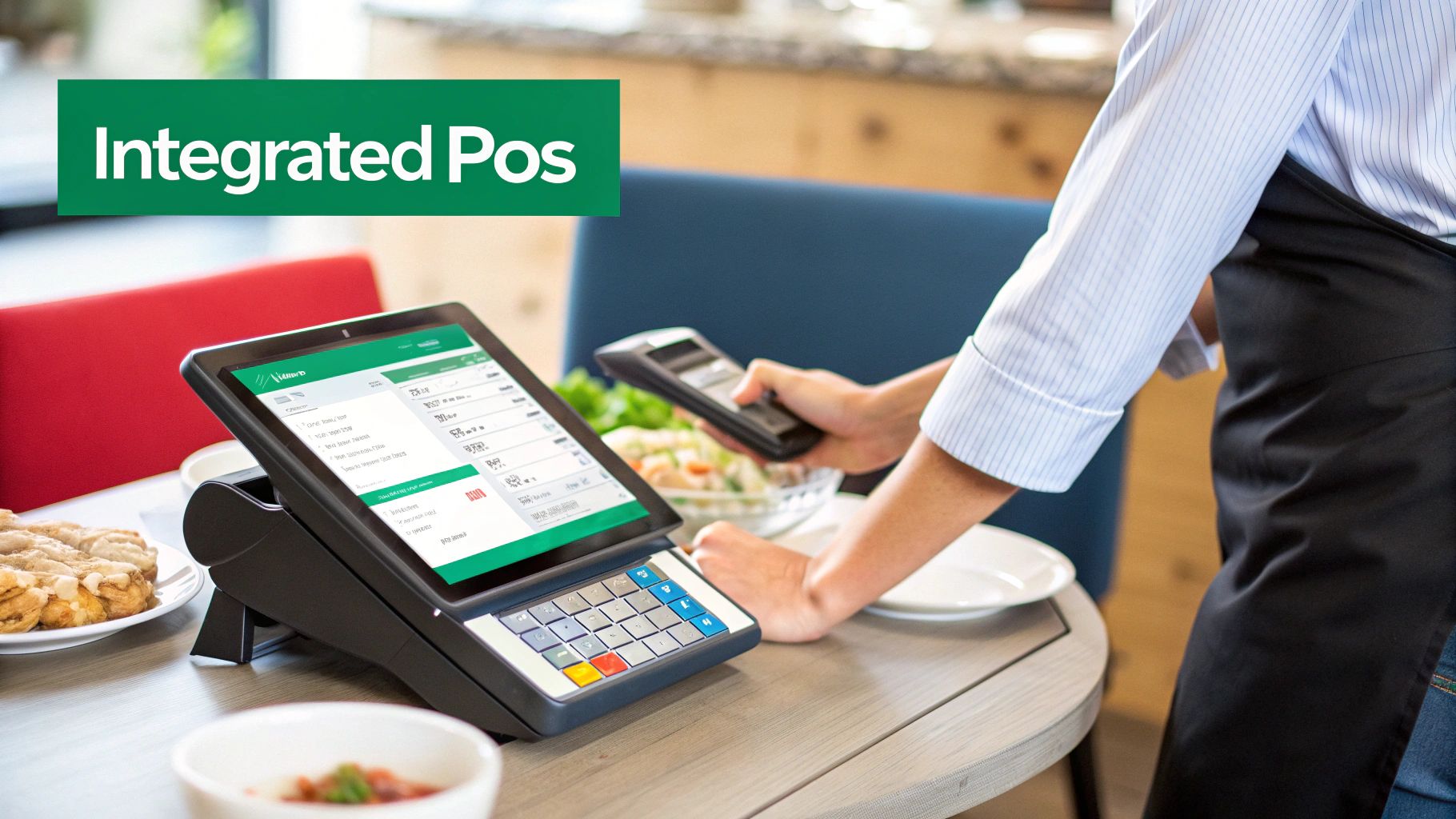
Why a Unified System Is a Game-Changer for Restaurants
When your systems are truly all-in-one, like with TackOn Table, that chaotic juggling act disappears. Our mobile POS lets your team take orders and process payments right at the table, all on a single handheld device.
This approach pays off immediately in very practical ways:
- Instant Order Syncing: An online order placed through your website pops up in the kitchen display system (KDS) instantly. No more delays or missed tickets.
- Real-Time Menu Management: Have to 86 the salmon? Update it once, and it’s immediately gone from your online menu and every terminal in the house.
- Centralized Reporting: All your sales data, whether from dine-in, takeout, or online orders, feeds into a single dashboard. You get a clear, complete picture of your business performance without having to patch reports together.
This isn't just about making life easier for your staff; it's about what your customers now expect. Let's be real, 75% of consumers prefer paying with a card, and 55% will actually choose where to shop based on whether their favorite payment option is accepted. You can dig into these payment trends yourself, but the takeaway is clear: frictionless payments are no longer a nice-to-have, they're critical.
We've seen it firsthand with our clients. By integrating their payments, they're not just adding new hardware. They're investing in a faster, more accurate way to run their business. On average, they see up to 40% faster order processing and 95% fewer errors.
The TackOn Table Advantage: A Smarter Toast vs Clover Alternative
A lot of restaurant owners feel trapped by big, clunky, and expensive systems. That’s why we built TackOn Table to be a powerful but straightforward Toast vs Clover alternative. We focus on affordability and flexibility, giving you an all-in-one system without locking you into rigid contracts or forcing you to buy confusing hardware bundles.
With TackOn Table, everything is designed to work together seamlessly from the moment you turn it on. Your team gets to focus on what they do best—creating a great experience for your guests—instead of fighting with their technology. That simplicity is what truly unlocks efficiency and helps your hospitality shine.
Ready to see how an integrated system could transform your restaurant?
Keeping Your Customers' Data Safe: A No-Nonsense Guide to PCI Compliance
Let's talk about something that makes a lot of restaurant owners nervous: PCI Compliance. It sounds technical and intimidating, but it doesn't have to be. Think of it less as a complex rulebook and more as a promise to your customers that you're handling their payment information with care.
At the end of the day, protecting customer data is just as crucial as the quality of your food. The good news is that you don't need to become a cybersecurity guru to get it right. It's all about creating a secure bubble for every transaction, whether it happens on your website, a tableside tablet, or at the front counter.
What PCI Compliance Really Means for Your Restaurant
For a busy spot like a cafe or food truck, security boils down to a few core practices. The official PCI standards (Payment Card Industry Data Security Standard) are long, but what they ask of you is actually quite straightforward.
- Use the Right Gear: Stick with payment hardware and software that is already certified as PCI compliant. This is non-negotiable.
- Lock Down Your Network: Your Wi-Fi network is a doorway for data. Make sure it’s password-protected and secure to keep intruders out. A separate, private network for your POS system is always a smart move.
- Don't Hoard Sensitive Info: Your system should never store sensitive card details like the full card number or the three-digit CVV code after a transaction is authorized. Modern systems are designed to prevent this automatically.
The real secret? You’re not supposed to handle this alone. Your technology partners should be doing the heavy lifting for you.
Honestly, the single best thing you can do for your peace of mind is to choose a modern, all-in-one POS platform. When security and compliance are built-in from the start, you're not just buying a tool—you're offloading enormous technical and financial risk.
How an Integrated POS Makes Security Effortless
Trying to piece together different systems—one for online orders, another for in-person payments—is a recipe for security headaches. You're left constantly wondering if every single component is up to date and secure.
This is exactly why we built TackOn Table the way we did. An integrated solution gives you confidence right out of the box. We manage the security complexities so you can get back to what you do best: running your business.
Our platform is designed with robust, built-in security features tailored for food service. A key feature is end-to-end encryption, which essentially scrambles card data the instant it’s swiped, tapped, or entered online. That makes the information completely useless to anyone who might try to intercept it.
As a PCI DSS compliant service provider, using TackOn Table automatically helps you meet your own compliance requirements. You're not just buying a payment terminal; you're adopting a secure ecosystem where every transaction is protected. That’s the kind of peace of mind that lets you sleep at night.
Ready to run your restaurant knowing every payment is secure?
Start Your Free Trial with TackOn Table Today
Your Go-Live Checklist for a Smooth Payment Launch
You've done the hard work of picking a payment partner, and now it's time for the exciting part: going live. Making the switch from your old system—or from being cash-only—can feel like a huge step, but a smooth launch all comes down to planning. A simple checklist ensures you don't miss a single detail, setting you up for a flawless first day.
The first thing on your list should be activating your merchant account and getting it hooked into your POS system. This is where an all-in-one platform like TackOn Table really shines, since the payment processing is already built-in. You’re not left waiting on a third-party bank or struggling with a technical setup. Our easy setup means we can guide you through it and get you ready to go in minutes.
Final Checks Before You Flip the Switch
Before you tell your customers you’re ready for their cards, take a moment to run through a few final checks. These are the little things that often get overlooked but make a massive difference in preventing those dreaded day-one headaches.
- Run Test Transactions: This is non-negotiable. Don't wait for a paying customer to be your guinea pig. Grab your personal debit card, a credit card, and even a digital wallet like Apple Pay to process a few small, real transactions. This is the only way to be 100% sure everything is talking to each other correctly.
- Train Your Team: A quick 15-minute huddle can save you hours of confusion later. Walk your staff through the new process on the mobile POS, showing them exactly how to take different payment types and, just as importantly, how to process a refund. A team that feels confident gives your customers a much better experience.
- Confirm Your Batch Time: Just ask a simple question: "When will my daily sales be batched and deposited?" Knowing your deposit schedule from the get-go is critical for managing your cash flow.
The security behind every single transaction is simple but powerful. This is what's happening behind the scenes to keep you and your customers safe.
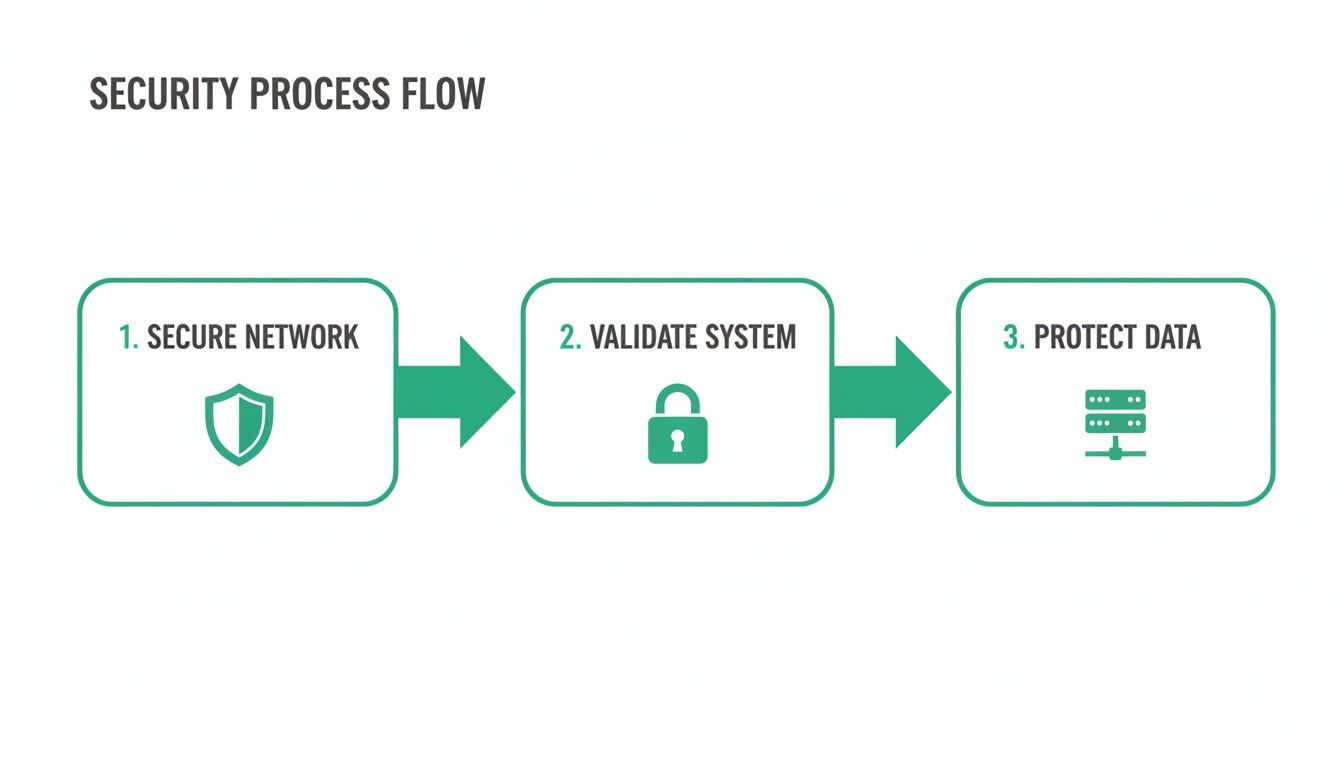
This entire process—securing the network, validating the transaction, and protecting the data—is baked right into an integrated system. With TackOn Table, you don't have to think about it; this security framework is just part of the package, giving you peace of mind without any extra effort on your part.
Ready for a launch without the stress? Book a Demo and see just how easy we make it.
FAQs for Restaurant & Café Credit Card Processing
Let's tackle some of the most common questions I hear from restaurant, cafe, and food truck owners when they're figuring out how to handle credit card payments. Getting this right from the start can save you a lot of headaches down the road.
How Fast Can I Get Set Up to Take Credit Cards Online?
Believe it or not, you can get up and running surprisingly quickly.
With an all-in-one system like TackOn Table, where the payment processing is already built-in, you could be approved and taking orders in as little as 30 minutes. Our easy setup sidesteps the whole drawn-out process of applying for a separate merchant account, which is a huge time-saver.
What’s the Cheapest Way for a Food Truck to Take Cards?
When you’re on the move, simplicity is your best friend. For a food truck, a flat-rate pricing model is almost always the most predictable and budget-friendly choice.
Look for an integrated mobile POS system that offers this kind of straightforward pricing. This way, all the different fees are rolled into a single, transparent percentage and a small per-transaction cost. TackOn Table's affordability and simplicity mean no more trying to decode complicated statements or getting blindsided by hidden charges.
Do I Really Need Different Payment Systems for My Website and My Counter?
Definitely not—and you shouldn't have to. A modern, unified platform is designed to handle all your sales channels through one integrated system.
This means your website orders, QR code payments at the table, and the tap-to-pay transactions at your counter all flow into the same place. TackOn Table provides true all-in-one simplicity, which makes your accounting a breeze and gives you a clear, complete picture of how your business is doing from every angle.
Ready to see how TackOn Table can pull all your payments and operations together into one simple system built just for restaurants?