Let's be honest, restaurant inventory management software is just a fancy term for a tool that stops you from guessing. It’s a system designed to give you a real-time, accurate picture of your stock, what you're ordering, and what you’re selling. It’s the difference between flying blind and having proactive, data-driven control over your food costs—which are almost always your biggest expense.
For any restaurant, café, or food truck owner, getting a handle on inventory is non-negotiable. With an all-in-one system like TackOn Table, you get the simplicity and power you need to protect your bottom line, cut down on waste, and run a smarter, more profitable business.
Why Manual Inventory Is Silently Costing Your Restaurant
Picture this: it’s the end of a slammed Friday night. You should be celebrating a win, but instead, you're hunched over a clipboard and a messy spreadsheet in the back office, trying to figure out what you have left. If that sounds familiar, you're not alone. But this old-school approach is a silent killer for restaurant profits.
Relying on pen-and-paper counts is more than just inefficient; it's a broken process that springs financial leaks in three crucial areas of your business.
The True Cost of Guesswork
When you don't have real-time data, every single purchasing decision is a roll of the dice. Manual tracking almost always pushes you toward one of two expensive mistakes: ordering way too much or not ordering nearly enough.
Over-ordering perishable ingredients based on a "gut feeling" is like pre-planning your food waste. On the flip side, running out of the star ingredient for your best-selling dish means lost revenue and unhappy customers who might not come back. It's a lose-lose situation. In fact, a huge chunk of restaurant food waste comes directly from not knowing what you have on the shelves. This is exactly what a modern Restaurant POS with built-in inventory tracking is designed to fix, by tying every sale directly to your stock levels.
This disconnect also makes it nearly impossible to figure out your true Cost of Goods Sold (COGS). You might think a dish is a cash cow, but without tracking every ingredient that goes into it, you’re just flying blind.
Manual inventory isn't just about counting what you have; it's about not knowing what you're losing. Every inaccurate count, spoiled ingredient, or missed sale erodes your profit margin without you ever seeing it happen.
Wasted Hours and Inaccurate Data
The most glaring cost of doing inventory by hand is the time it eats up. Your staff—or you—are burning hours every week counting boxes, updating spreadsheets, and punching in numbers. That's time and money that could be invested in training your team, perfecting a new menu item, or actually engaging with your guests. Those labor costs add up fast.
And let's not forget about human error. It only takes one small miscount or a single typo to derail your entire purchasing plan, trapping you in that frustrating cycle of waste and stockouts.
An all-in-one system like TackOn Table turns this whole mess into a smooth, almost automatic process. When you have a mobile POS that updates your inventory with every single order, you finally get the clarity you need to transform your stockroom from a cost center into a profit driver. With its simple setup and ability to manage multiple locations, it’s a smart, scalable tool for any cafe, food truck, or restaurant ready to work smarter.
Ready to stop guessing and start controlling your profits? See how an integrated system can make a real difference.
Book Your Free Demo Today!
The Financial Impact of an Integrated Restaurant POS
Saving time is great, but let's be honest—in the restaurant business, the real measure of any tool is how much money it puts back in your pocket. An integrated system does exactly that. It doesn't just tidy up your storeroom; it gives you a death grip on your single biggest expense: food costs. The financial impact isn't gradual; it’s immediate and it's big.
This all starts by truly understanding your Cost of Goods Sold (COGS), not as a monthly estimate, but as a live, breathing number. When your inventory management is built right into your POS, every sale instantly and automatically deducts the precise ingredients from your stock.
Sell a burger? The system subtracts one bun, 150 grams of ground beef, two slices of cheese, and even the pickle spear. This isn’t just counting; it's real-time financial accounting happening with every tap on the screen.
From Ingredient Tracking to True Profit Margins
Picture a busy pub on a Friday night. Without an integrated system, the manager knows they sold 200 of their signature burgers, but they're basically guessing at the real profit margin. They’re relying on a once-a-week stock count that completely misses the small variations—a cook being a little heavy-handed with the fries, a crate of tomatoes spoiling a day early, or a surprise price hike from the beef supplier.
Now, imagine that same manager using a unified system like TackOn Table. The moment that 200th burger is rung up, they can see its exact cost down to the penny. This is a game-changer. Suddenly, they know which menu items are cash cows and which are secretly bleeding them dry. That clarity gives you the power to make sharp, data-backed decisions on pricing, specials, and purchasing that directly fatten your bottom line.
Preventing Spoilage with Data-Driven Purchasing
Over-ordering is like setting cash on fire. An integrated platform stops this by turning your own sales history into smart purchasing advice. You no longer have to cross your fingers and guess how many avocados you'll need for the weekend rush.
The software crunches the numbers from past trends and checks your current stock levels to suggest exactly what to order and when. This stops you from tying up precious cash in inventory that might just end up in the bin.
An integrated system turns every sale into a data point. This data eliminates the guesswork in purchasing, reducing food waste and ensuring your capital is invested in inventory that sells, not spoils.
This isn't just for big chains. Whether you're a small coffee shop looking for simple Café Management Software or a multi-location group, the goal is identical: buy what you need, right when you need it.
The infographic below breaks down the three main ways old-school inventory methods drain your bank account, shining a light on the hidden costs you might not even realize you're paying.
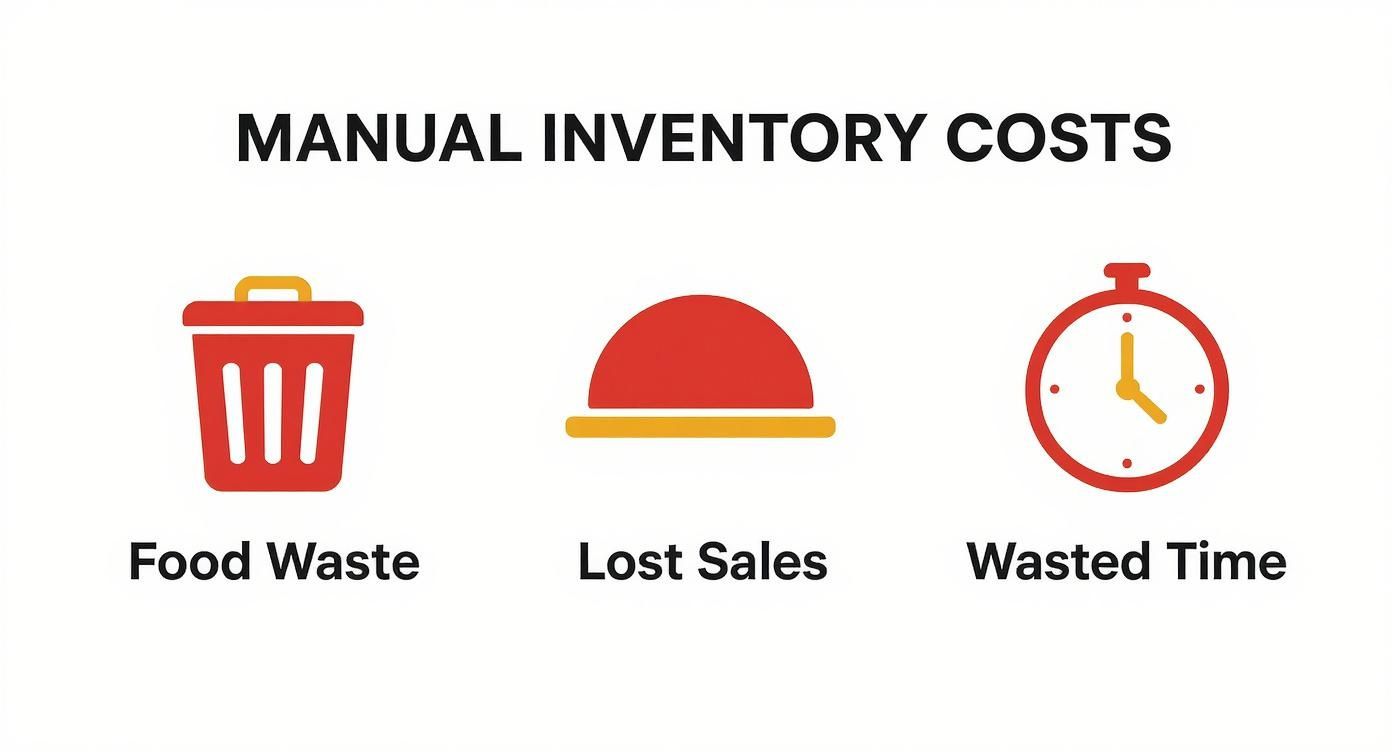
As you can see, these aren't just little leaks. They're major financial drains that an integrated system is built to plug for good.
Comparing Financial Outcomes: Integrated vs. Manual Systems
The difference in financial health between a restaurant running on spreadsheets and one with a modern, all-in-one system is stark. One operates with blind spots and guesswork, while the other makes decisions based on precision and real-time data.
Let's look at a head-to-head comparison of the financial impact.
Financial Impact of Integrated vs. Manual Inventory Systems
| Financial Metric | Manual/Separate Systems | Integrated System (like TackOn Table) |
|---|---|---|
| Food Cost (COGS) | High and variable (typically 28-35%+); prone to theft, waste, and over-portioning. | Controlled and predictable (can lower to 25-30%); accurate tracking minimizes waste and variance. |
| Profit Margins | Inaccurate and often lower than expected due to hidden costs and imprecise menu pricing. | Clear and optimized; data-driven pricing and cost control lead to higher, more reliable margins. |
| Inventory Waste | Significant financial loss from spoilage and over-prepping, often 4-10% of food purchased. | Minimal waste; smart purchasing suggestions based on sales data prevent over-ordering. |
| Labor Costs | High due to time-consuming manual counts, ordering, and data entry across multiple systems. | Reduced; automation of inventory tracking and ordering frees up staff for revenue-generating tasks. |
| Cash Flow | Constrained; capital is tied up in excess, slow-moving, or perishable stock. | Improved; optimized stock levels mean cash is available for growth, marketing, or emergencies. |
In the end, the numbers speak for themselves. An integrated approach isn't just about convenience; it's a strategic financial decision that directly contributes to a healthier, more profitable restaurant.
The All-in-One Advantage
Many well-known POS systems treat inventory management like an expensive afterthought. You often have to pay for a premium add-on or a clunky third-party integration that creates more problems than it solves.
At TackOn Table, we build these critical financial tools right into the core platform from the start. You get the insights you need on day one, with no hidden fees or integration headaches.
It’s no surprise the global market for restaurant inventory management software has ballooned to around $2.5 billion. Owners everywhere are realizing they need these tools. With a projected Compound Annual Growth Rate (CAGR) of 15% through 2033, the entire industry is moving toward unified solutions that just work better.
Curious how much your restaurant could actually be saving? Plug your numbers into our savings calculator and see the direct financial impact for yourself.
What to Look For: The Must-Have Features in Modern Inventory Software
Choosing the right inventory software can feel overwhelming. Every company promises the moon, and it's easy to get lost in a sea of technical jargon. So, let's cut through the noise and focus on what actually matters for your day-to-day operations. It’s not about finding the system with the most bells and whistles; it's about getting the core functions right that solve your biggest headaches.
Forget the marketing fluff. Here are the features that transform a simple counting tool into a genuine profit-driving machine.
Real-Time, Ingredient-Level Tracking
This is the bedrock of any good system. It needs to track inventory at the most detailed level. That means it doesn't just know you sold a "Classic Burger." It knows you used one bun, 150 grams of ground beef, two slices of cheese, and three pickles. When your software is tied directly to your POS, every single sale automatically deducts those specific ingredients from your stock in real time.
Why is this so critical? It's the only way to get a truly accurate Cost of Goods Sold (COGS), which is the key to understanding your real profit margins. You move from messy end-of-month guesswork to crystal-clear daily financial insight.
Automated Low-Stock Alerts
Running out of a key ingredient during the dinner rush is a restaurateur's nightmare. It tanks morale, costs you sales, and can damage your reputation. Modern software helps you sidestep this disaster by letting you set "par levels"—the minimum amount of stock you need for every item.
When an ingredient dips below that threshold, the system automatically pings you with an alert via email or a mobile notification. It’s a proactive heads-up, giving you plenty of time to place a supplier order before you're in a bind. This simple feature brings an enormous amount of peace of mind.
Recipe and Menu Costing
How much does it really cost to make your signature dish? A good recipe costing tool gives you the answer, right down to the penny. By linking each menu item to its ingredients and their current purchase prices, the software instantly calculates the exact cost and profit margin on everything you sell.
This gives you the power to:
- Price Your Menu Intelligently: Stop guessing and start pricing based on hard data to ensure every dish is profitable.
- Find Your Winners and Losers: Pinpoint which dishes are your true moneymakers and which ones are secretly draining your profits.
- Engineer a More Profitable Menu: Strategically feature your high-margin items to gently guide customers toward your most lucrative choices.
This kind of detailed insight is no longer a luxury; it's the standard. The global market for this type of software was recently valued at USD 4.55 billion, marking a 15.2% increase year-over-year. That growth tells you one thing: operators are relying on these platforms to stay competitive.
An effective inventory system doesn't just count what you have; it tells you what each item is worth. By connecting ingredients to sales, it transforms raw data into actionable financial intelligence that drives better business decisions.
Mobile POS and On-the-Go Management
If your business isn't stuck in one place—think food trucks, pop-up cafes, or catering gigs—a mobile POS with integrated inventory is non-negotiable. Picture yourself running a food truck at a packed festival. You need a handheld device that can take orders, process payments, and deplete inventory from anywhere.
This is where a unified solution like TackOn Table shines. It offers a powerful but lightweight mobile POS that puts your entire operation in the palm of your hand. You can check stock levels, update menu availability on the fly (automatically 86-ing sold-out items), and watch your sales data roll in, all without stepping away from the service window.
For any modern restaurant or mobile vendor, an all-in-one system that combines these features without any hassle is the way to go. TackOn Table was built with this in mind, putting all these powerful tools into one intuitive and affordable platform. You shouldn't have to wrestle with complicated add-ons or pay extra for the features you need to succeed.
How to Simplify Multi-Location Inventory Control
Growing from one successful spot to a multi-location brand is a huge achievement. But the manual systems that got you here will almost certainly break as you expand. What was once a manageable spreadsheet is now a tangled web of separate inventory lists, inconsistent recipes, and a disjointed view of your business’s health.
Suddenly, you’re trying to conduct an orchestra where every musician is playing from a different sheet of music. One of your cafes is overstocked on oat milk, creating waste, while another runs out during the morning rush, costing you sales. This chaos doesn't just hit your profit margins; it erodes the consistent customer experience you’ve worked so hard to build.
The answer isn’t more spreadsheets or frantic phone calls between managers. It’s a single source of truth—a cloud-based platform that brings all your locations under one digital roof.
Centralized Control From a Single Dashboard
Let's imagine a local coffee shop, "The Daily Grind," opening its second location. At first, the owner tries to manage both with separate systems. The result? Constant headaches. They had no easy way to see which location was more profitable, check real-time stock levels, or ensure baristas at both shops were making lattes the exact same way.
Switching to an all-in-one Café Management Software like TackOn Table was a game-changer. The owner got a master dashboard giving them a bird's-eye view of the entire operation, all in real-time.
With a unified system, they could finally:
- View Consolidated Reports: Instantly pull up total sales, see top-selling items, and check profit margins across all locations. They could also drill down to see how a single branch was performing.
- Standardize Menus and Recipes: A single click could push a menu update, a price change, or a new recipe to every location. This guaranteed every customer got the same great coffee, no matter which "Daily Grind" they visited.
- Monitor Inventory Across the Board: No more phone tag. They could check stock levels for any ingredient at any location, all from one screen.
A centralized inventory system does more than just count stock; it creates operational consistency. It ensures that your brand promise is delivered uniformly, whether a customer visits your flagship store or your newest location.
Streamlining Operations and Reducing Waste
One of the biggest wins of a unified platform is smarter resource management. For "The Daily Grind," this meant finally seeing that their downtown shop was always overstocked on almond milk, while their suburban branch kept running out.
A system like TackOn Table makes stock transfers dead simple. The owner could now easily log a transfer of the excess almond milk from one store to the other, slashing waste and preventing lost sales. That kind of visibility is just not possible with disconnected systems.
This blend of simplicity and power makes TackOn Table a compelling Toast vs Clover Alternative for growing businesses. You get a scalable, intuitive solution built for ambitious owners, without the complexity or cost of enterprise-level software. Plus, the easy setup and mobile POS features mean you can get a new location up and running fast, without needing expensive technicians or suffering through long downtimes.
Ready to take control of your growing business and manage all your locations with ease?
Start Your Free Trial and Simplify Your Operations
Your Step-by-Step System Implementation Plan
The idea of ripping out a core system and starting fresh can sound daunting. We get it. But moving to a modern restaurant inventory management software isn't like the old days of week-long downtimes and expensive IT consultants. Today’s best platforms are designed to get you up and running quickly, so you can start seeing the benefits right away.
Think of it less as a massive tech overhaul and more as a clear, logical process. Here’s a simple four-stage plan to guide you through a smooth and successful rollout.
Stage 1: Establish Your Core Data
First things first, you need to build the foundation. This means getting all of your essential data into the new system. It's like teaching a new employee the basics of your operation—they need the right information before they can start helping out.
This involves plugging in a few key details:
- Suppliers List: Who do you buy from? Get all your vendor names and contact information loaded in.
- Ingredient Catalog: List every single thing you purchase. We're talking flour, tomatoes, coffee beans, and even cleaning supplies. If you buy it, it goes on the list.
- Recipe Cards: This is where the magic happens. You’ll digitize your recipes, linking every ingredient to the exact menu item. This is the key to tracking your food costs and automatically depleting stock.
With a system like TackOn Table, you're not stuck with mind-numbing manual entry. You can often import everything from a simple spreadsheet, which makes the initial easy setup much faster than you’d expect.
Stage 2: Perform a Baseline Stock Count
Okay, your data is in. Now it’s time to draw a line in the sand. You need to do one last, comprehensive physical count of every single item you have in stock. This gives you a crystal-clear starting point, ensuring the numbers in your software match what's actually sitting on your shelves.
This initial count is the most important one you'll do. It calibrates the entire system, ensuring every sale, purchase, and transfer is tracked against an accurate starting inventory, giving you reliable data from the very first day.
Don't rush this part. Getting this baseline right is what makes all the future data and reporting so powerful.
Stage 3: Train Your Team on New Workflows
Great technology is only effective if your team knows how to use it. The next step is getting everyone comfortable with the new, simpler ways of doing things. For your front-of-house crew, it might just be learning to use the new mobile POS to punch in orders. For your BOH team and managers, it’ll be learning the new process for receiving deliveries or doing quick spot-checks on inventory.
The beauty of an all-in-one solution like TackOn Table is that training is incredibly straightforward. You aren’t teaching people three different systems for sales, inventory, and ordering. It’s one clean, intuitive interface that everyone can quickly get the hang of.
Stage 4: Go Live and Monitor
Data loaded, baseline set, team trained—you’re ready for launch. "Going live" simply means you start running your entire operation through the new system. From the moment you open, every sale, order, and delivery is tracked.
For the first few days, just keep an eye on things. You’ll start to see how sales automatically reduce your ingredient counts in real-time. You'll notice low-stock alerts popping up to guide your next purchase order. This is the moment you officially shift from reactive guesswork to proactive, data-driven management. It's no wonder the restaurant management software market is projected to hit USD 14.70 billion by 2030—operators everywhere are seeing the value. Discover more insights about restaurant tech trends on grandviewresearch.com.
Upgrading your restaurant’s tech is an achievable project that pays for itself in no time.
Ready to see how simple a new system can be? Explore how TackOn Table can transform your operations.
Book Your Free Demo Today
Finding the Best Toast vs Clover Alternatives
Choosing a technology partner is one of the biggest decisions you'll make for your restaurant. After you've nailed down the features you need and how to get started, the final choice comes down to what fits your reality—your budget, your team, and where you want to go. For a lot of independent restaurants, cafes, and food trucks, the industry giants just aren't the right answer.
Systems like Toast and Clover may be household names, but they often come with a reputation for being overly complicated, loaded with hidden fees, and built on inflexible, long-term contracts. So many owners get stuck with clunky interfaces that need hours of training or find themselves paying for enterprise-level features they will never touch. This is exactly where a more modern, straightforward solution can make all the difference.
Why Simplicity and Transparency Matter
The best restaurant inventory management software should feel like a relief, not another chore. It needs to be an intuitive tool that starts saving you time and money from the moment you turn it on. When you're weighing your options, the decision really boils down to a few core things.
- Seamless Integration: Your POS and inventory have to speak the same language, instantly. A true all-in-one system gets rid of the constant headache of trying to sync separate platforms.
- Intuitive Design: The software should be so easy that a brand-new hire can pick it up in a single shift, with a clean layout and logical steps.
- Scalability: Your system needs to grow with you, whether that means opening a second location or diving into online ordering.
- Transparent Pricing: You have a right to know exactly what you’re paying for, without nasty surprises or mandatory hardware leases popping up on your bill.
Platforms built on these principles give you a clear advantage. Instead of trapping you in a complicated ecosystem, they give you the flexibility and control to run your business your way.
TackOn Table: A Smarter Choice for Modern Restaurants
This is where TackOn Table really shines as a powerful Toast vs Clover alternative. We built our platform from the ground up to solve the real-world problems we saw independent operators wrestling with every day. We believe powerful technology should be accessible, affordable, and flexible enough to fit your unique business.
Our strength is in our all-in-one simplicity. TackOn Table combines a mobile POS, inventory control, and multi-location management into one seamless, user-friendly platform. We don't charge you for expensive add-ons to get the core features you need. Everything, from ingredient-level tracking to low-stock alerts, is included right out of the box. Our easy setup means you can be up and running in a few hours, not weeks, without waiting around for a technician.
For a detailed look at how our features and pricing compare, check out our complete breakdown of TackOn Table vs. Toast. We’re focused on giving you a solution that’s both incredibly capable and refreshingly simple, so you get the tools to manage your inventory like a pro without the enterprise-level price tag.
You’ve worked too hard building your business to let your technology work against you. It should be your most reliable employee.
Ready to see how a simpler, more affordable system can change the way you operate?
Book a Demo and Discover the Difference
FAQs About Restaurant Inventory Management Software
Diving into inventory management software can feel like a big step, so it’s natural to have a few questions. We’ve tackled some of the most common ones we hear from restaurant owners to give you the clarity you need to move forward.
How Much Food Waste Can This Software Realistically Cut Down?
You'd be surprised. A solid inventory system can slash food waste by 5-15%, sometimes even more. Think about it: by knowing exactly what you're selling and when, you stop over-ordering those delicate, perishable items that always seem to spoil before you can use them.
It goes deeper than just ordering, though. Recipe costing features shine a light on waste from things like over-portioning. Suddenly, you're making purchasing decisions based on hard data, not just a hunch, which directly pads your bottom line and keeps good food out of the bin.
I Run a Small Cafe. Is This Going to Be a Nightmare to Set Up?
Not at all. The days of needing an IT squad to install software are long gone. Modern, mobile-friendly systems like TackOn Table are built for easy setup. The whole process is usually as simple as uploading your menus, ingredients, and supplier lists from a basic spreadsheet.
Because it's an all-in-one system with the POS built right in, you get to skip the headache of trying to make different pieces of software talk to each other. This means you can be up and running in a matter of hours, not weeks, letting you get back to what you do best—serving your customers.
How Exactly Does an Integrated System Make My Restaurant More Profitable?
It’s a three-pronged attack on inefficiency. First, it calculates your Cost of Goods Sold (COGS) with pinpoint accuracy by tracking every single ingredient. This insight is gold, letting you price your menu items for the best possible margin.
Second, the automated low-stock alerts mean you never run out of a best-selling dish during a dinner rush and miss out on sales. Third, you get crystal-clear reports showing which menu items are your money-makers and which are duds, so you can engineer your menu for maximum profit.
An integrated system turns guesswork into financial strategy. It provides the clarity needed to plug hidden profit leaks, optimize menu pricing, and ensure every sale contributes effectively to your bottom line.
Can I Use One System to Manage Multiple Locations?
Absolutely. In fact, this is one of the biggest strengths of modern cloud-based software. A platform like TackOn Table gives you a single, centralized dashboard where you can see real-time inventory levels, sales data, and performance reports across all of your restaurants.
This multi-location control is a game-changer for growth. It lets you standardize recipes and procedures, manage supplier contracts from one place, and even transfer stock between your branches when one runs low. It simplifies scaling, making your expansion smoother and more predictable. As a flexible Toast vs Clover alternative, it delivers powerful tools without the hefty enterprise price tag.
You've poured everything into building your business. Your technology shouldn't be another obstacle—it should be your most dependable partner. It’s time to stop wrestling with clunky software and see how a simple, powerful, and affordable all-in-one system can truly support your operations.
Ready to stop guessing and start knowing? The team at TackOn Table can show you how.
Book a Demo Today
See how TackOn Table works for your restaurant. Same-day call →