
Of all the numbers you track in your restaurant, your labor cost percentage is one of the most revealing. It’s a direct pulse check on your operational health, telling you precisely what slice of your revenue goes toward paying your team. As a rule of thumb, a healthy labor cost sits somewhere between 25% and 35% of your gross sales, though this sweet spot can vary depending on your restaurant's style.
What Is Restaurant Labor Cost Percentage?
Think of your labor cost percentage not as just another expense, but as a financial compass for your business. It’s a clear, unfiltered look at how efficiently you’re managing your single greatest asset—and one of your biggest costs—your people. Whether you run a bustling diner, a quiet café, or a food truck on the go, getting this number right is make-or-break for long-term success.

A common pitfall for operators is tunnel vision, focusing only on hourly wages or fixed salaries. But your total labor cost is a much bigger, more complex beast. Overlooking the "hidden" costs can mask significant drains on your profitability, giving you a false sense of security.
The True Cost of Your Team
To get a real, accurate picture of what you're spending on labor, you have to look beyond the paycheck. A complete calculation includes every single dollar that goes into employing your staff.
Here’s what you need to be tracking:
- Wages and Salaries: This is the straightforward part—the hourly pay for your kitchen and front-of-house crew, plus any fixed salaries for your managers.
- Payroll Taxes: Don't forget the mandatory stuff. This includes your share of Social Security, Medicare, and unemployment taxes.
- Benefits and Insurance: Health insurance premiums, workers' compensation, paid time off, and any other perks you offer add up quickly.
- Overtime and Bonuses: Any hours paid at time-and-a-half or performance bonuses need to be factored in. They can easily push your costs up if not managed carefully.
Once you start seeing the full picture of your labor expenses, you stop just tracking payroll. You start strategically managing a huge investment in your business: your team.
Why This Metric Matters for Your Restaurant
Keeping a close eye on your labor cost percentage isn't just about accounting; it's about smart management. It gives you the clarity to make better decisions on everything from your weekly schedule and menu pricing to your overall staffing strategy. Without a firm handle on this number, you’re flying blind and likely leaving money on the table.
This is where a modern Restaurant POS can be a game-changer, taking the guesswork out of the equation. For example, a platform like TackOn Table integrates everything into one place, giving you a live, accurate view of your labor costs as they happen. Its straightforward setup and mobile POS let you check this vital metric from anywhere, turning what used to be a mess of data into simple, actionable information. It’s this kind of agility and affordability that makes it a powerful and accessible option for owners searching for simpler Toast vs Clover alternatives.
Instead of waiting for a P&L statement at the end of the month, you can make adjustments on the fly to protect your profit margins. That kind of proactive control is exactly what builds a resilient and successful restaurant.
How to Calculate Your Labor Cost Percentage
Ready to roll up your sleeves and get into the numbers? Figuring out your labor cost percentage is one of the most powerful things you can do to understand your restaurant's financial health. It's a straightforward calculation that tells you exactly how much of your revenue is going toward paying your team.
The formula itself is refreshingly simple:
(Total Labor Cost / Total Revenue) x 100 = Labor Cost Percentage
This little equation turns a pile of abstract expenses into a single, clean metric. It answers the critical question: for every dollar you earn, how many cents are spent on labor?
A Quick Word on "Total Labor Cost"
This is where many operators make their first mistake. Total Labor Cost isn't just the hourly wages you pay. That's only part of the story.
To get an accurate picture, you need to include all the "fully burdened" costs associated with your staff. This means adding up:
- Gross wages and salaries
- Overtime pay
- Payroll taxes (FICA, unemployment)
- Workers' compensation insurance
- Health insurance and other benefits
- Paid time off (PTO) and sick leave
Using only gross wages will give you a dangerously low and misleading number. You have to account for everything to know your true labor cost.
The Formula in Action: Real-World Examples
The real power of this metric comes from applying it consistently across different timeframes. Let's look at a few common scenarios.
To make it even clearer, here’s a table showing how the formula works in different restaurant settings and over various periods.
| Timeframe | Total Labor Cost | Total Revenue | Labor Cost Percentage Calculation |
|---|---|---|---|
| By the Shift | $140 | $700 | ($140 / $700) x 100 = 20% |
| By the Day | $1,200 | $4,500 | ($1,200 / $4,500) x 100 = 26.7% |
| By the Week | $8,500 | $30,000 | ($8,500 / $30,000) x 100 = 28.3% |
| By the Month | $40,000 | $120,000 | ($40,000 / $120,000) x 100 = 33.3% |
As you can see, you can zoom in on a single busy morning shift or zoom out to get a bird's-eye view of an entire month. A high percentage on a slow Tuesday might tell you to adjust the schedule, while a healthy monthly average confirms your overall staffing strategy is on track.
Stop Doing Manual Math
Let's be honest, crunching these numbers by hand is a tedious and error-prone chore. This is exactly why modern, all-in-one restaurant management platforms are no longer a luxury—they're a necessity.
A system like TackOn Table takes the guesswork out of the equation. It automatically pulls your sales data from the POS and syncs it with your employee time punches from the scheduler.
Instead of getting lost in spreadsheets, you see your labor cost percentage updated in real-time, right on your dashboard. This means you can spot a shift heading into overtime and make a change before it blows your budget.
Curious what that could mean for your bottom line? You can explore our savings calculator to get a tangible idea of how much time and money an integrated system can put back in your pocket. Having this control doesn't have to be complicated or expensive; it's about having the right information at your fingertips when you need it most.
Benchmarking Your Labor Cost Performance
So, you’ve calculated your restaurant's labor cost percentage. That's the first step. The real question is, "Is my number any good?"
The answer isn't a simple yes or no. The ideal target shifts dramatically depending on your business model, from a bustling cafe to a high-end dining room. This is where benchmarking comes in—it gives you the context to know if you're on track or if there’s a leak in your payroll bucket.
Think of it this way: knowing the industry standards helps you understand if you're operating like a well-oiled machine or if there’s some serious room for improvement. It turns a simple number into a powerful performance indicator.
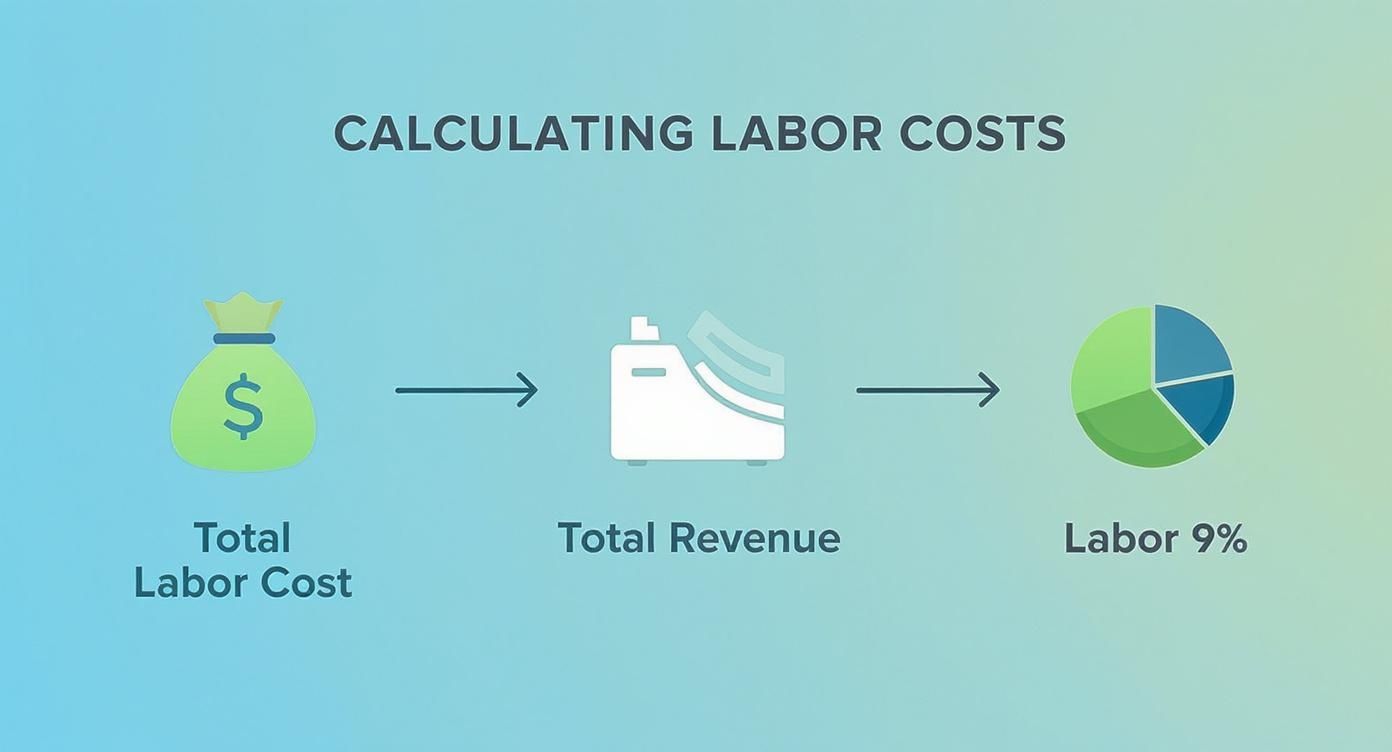
This visual breaks down the two key inputs—Total Labor Cost and Total Revenue—that determine your final percentage. It’s a great reminder of where to focus your efforts.
Typical Labor Cost Percentages by Restaurant Type
Comparing your numbers to the right category is everything. A fine-dining spot with a sommelier and multiple servers per table will naturally have higher labor needs than a quick-service burrito joint.
According to data from industry analysts like Barmetrix and MAJC.ai, here’s a rough guide to what you can expect:
- Quick-Service & Fast-Casual: These models are built for speed and efficiency, typically aiming for a restaurant labor cost percentage between 25% and 30%.
- Full-Service Restaurants: With more complex service, these establishments often land between 35% and 40%.
- Bars & Pubs: These often enjoy lower labor costs, usually falling between 18% and 24%.
- Fine Dining: The focus on high-touch service can push labor costs even higher, sometimes well past 35%.
These ranges aren’t rigid rules, but they give you a solid starting point. You can dig into more data on these restaurant labor costs to see exactly where you stand.
A "good" labor cost percentage isn't about hitting the lowest possible number. It's about finding the sweet spot where you are staffed perfectly to deliver amazing service without letting payroll eat into your profits.
Using a Restaurant POS to Track Performance
Constantly running these numbers and checking them against benchmarks can feel like a full-time job in itself. This is where a modern Restaurant POS becomes your secret weapon.
Systems like TackOn Table turn your sales terminal into a strategic dashboard. With real-time sales and labor data flowing in, you can see how your performance stacks up against industry standards right now, not at the end of the month when it's too late.
This kind of immediate insight is invaluable. TackOn Table’s all-in-one simplicity and easy setup mean you can stop guessing and start making smart, data-backed decisions. By providing this level of clarity at an affordable price, it’s a powerful Toast vs Clover alternative for operators who need results without the headache.
Ready to see how your labor costs really compare and find opportunities to improve?
Start Your Free Trial or Book a Live Demo
How to Actually Lower Your Labor Costs
Knowing your labor cost percentage is step one. But the real magic happens when you start actively managing it. This isn't about slashing hours and running your team into the ground. It’s about working smarter, using real data to match your staffing levels perfectly with your customer flow.
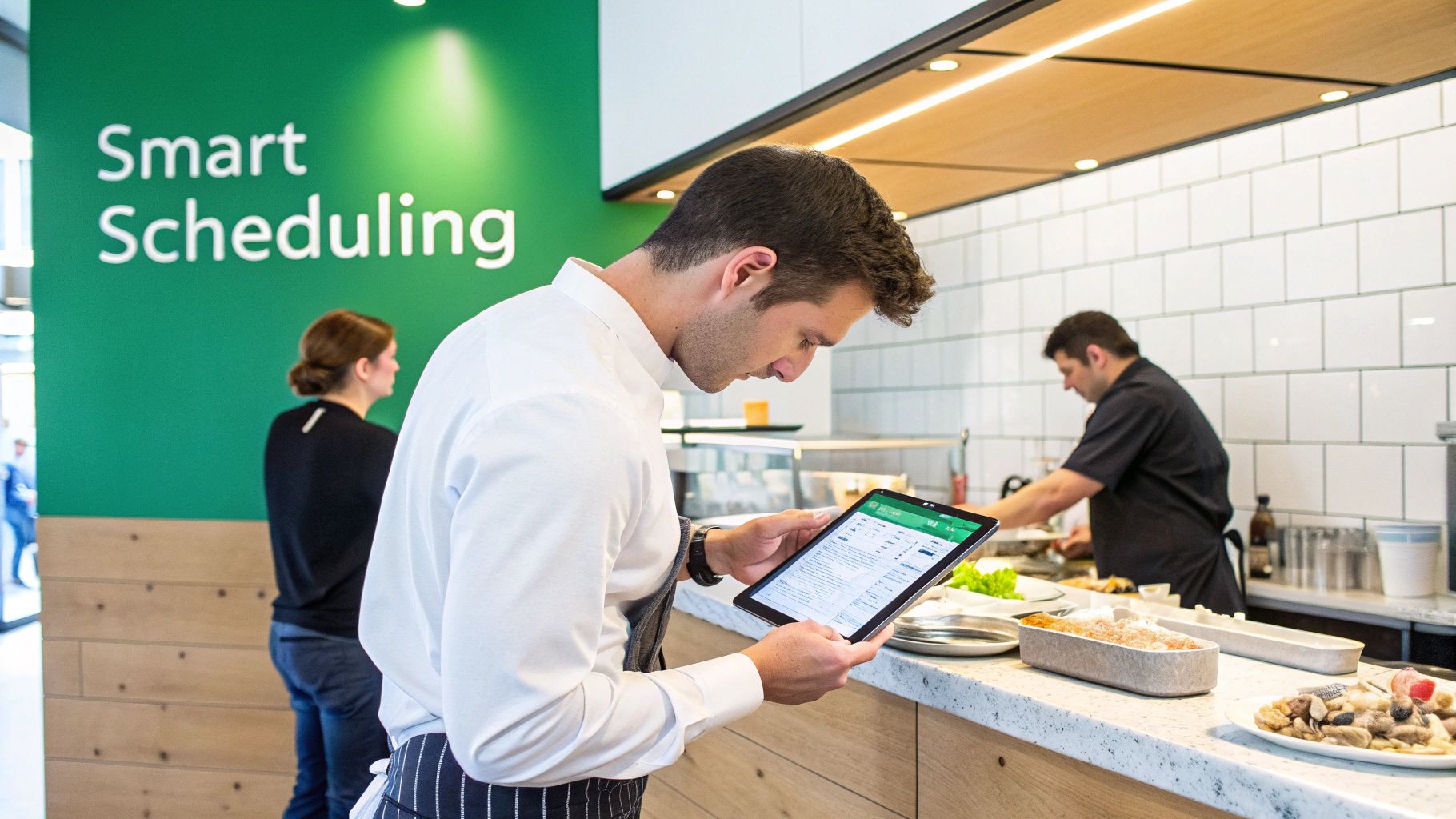
This is where the numbers on a spreadsheet turn into actual profit. You take what your business is telling you through its data and turn it into smart decisions that directly boost your bottom line. Let's dig into some of the most effective, battle-tested methods you can start using right away.
Master Your Schedule with Data
Smart scheduling is easily the most powerful tool in your arsenal for controlling labor costs. It means you stop copying and pasting last week’s schedule and start building one based on what you expect to sell. Modern Restaurant POS systems are goldmines for this, giving you historical sales data broken down by the hour, day, and week.
Use that data to find your actual peaks and valleys. If your sales reports show a consistent ghost town between 2 PM and 4 PM every weekday, you can schedule one fewer person for that block. That single change prevents overstaffing that slowly bleeds your profits. A platform like TackOn Table surfaces these analytics in a clean, straightforward way, letting you make decisions based on facts, not guesswork.
This isn’t just a local problem; operators everywhere are focused on this. A healthy restaurant labor cost percentage typically falls between 20% and 30%. But it’s a constant battle—recent industry data shows that for 83% of restaurant operators, labor cost is one of their top three biggest headaches. You can dive deeper into these trends by checking out the full 2025 restaurant workforce report.
Build a Versatile Team with Cross-Training
Another killer strategy is cross-training your employees. When your host can also jump in and bag takeout orders, or a line cook can seamlessly slide over to the fry station, you’ve built a flexible, efficient, and much more resilient team. That kind of agility is priceless.
Think about it: a server calls out sick right before the dinner rush. Instead of frantically calling people or letting a section get slammed, a cross-trained busser can step up and start taking tables. Service quality stays high, and you avoid paying for last-minute, on-call staff. Plus, it's a huge morale booster, giving your team new skills and a path for growth.
The most resilient restaurants are staffed by teams, not just individuals with narrow job descriptions. Cross-training transforms your workforce into a multi-skilled unit capable of adapting to any challenge.
Optimize Your Menu to Save Time
Your menu can be a secret source of high labor costs. Overly complex dishes that require tons of prep time demand more (and often more skilled) hands in the kitchen, inflating your back-of-house payroll. This is where menu engineering becomes your best friend.
Take a hard look at your menu and identify the most time-consuming dishes. Can a garnish be simplified? Can a sauce be batched in advance? Could you switch to a high-quality pre-prepped ingredient? Even tiny adjustments add up to massive labor savings over time, all without sacrificing the quality your guests come for. TackOn Table’s sales reports can pinpoint which high-labor items are also low-profit—making them obvious candidates to be reworked or removed.
By putting these strategies to work—and backing them up with data from a smart management platform—you can get a real handle on your restaurant labor cost percentage and build a much more resilient and profitable business.
Ready to see how an all-in-one system can simplify your labor management?
Start Your Free Trial or Book a Live Demo
Turn Your POS into Your Labor Cost Command Center
Think of your restaurant's POS system. Is it just a high-tech cash register, or is it the command center for your entire operation? When it comes to managing labor—one of your biggest and most volatile expenses—it absolutely needs to be the latter. Shifting from constantly putting out fires to proactively managing your staff is the key to protecting your profits.
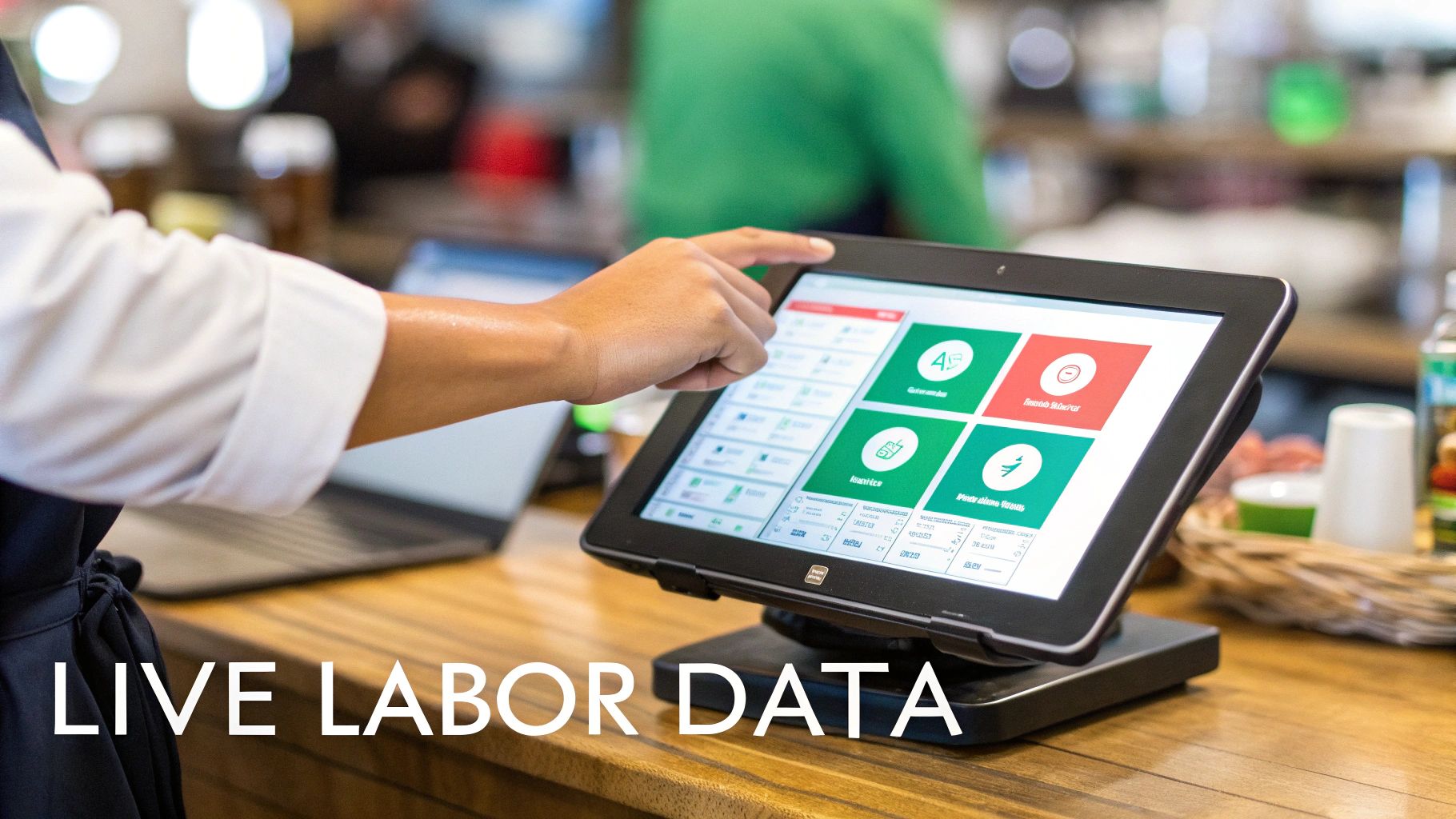
This isn't just a "nice-to-have" anymore. Labor expenses are on a steady climb across the industry. The median cost for full-service restaurants has hit 36.5% of sales, with limited-service spots not far behind at 31.7%. If you're curious about the bigger picture, you can review the full restaurant labor cost analysis to see just how much things have changed.
Get a Live Look at Your Labor Costs
Imagine pulling out your phone during the Friday night rush and seeing your exact labor-to-sales ratio in real-time. That’s not science fiction; it’s what a truly integrated system like TackOn Table delivers. Our platform gives you a live dashboard, so you know precisely how your payroll is tracking against sales, whether it’s a slammed Saturday or a sleepy Tuesday afternoon.
This isn't about looking in the rearview mirror. It's about making smarter decisions, right now. This kind of immediate visibility allows you to:
- Adjust Staffing on the Fly: If sales are unexpectedly slow, you can confidently send a team member home early, knowing you're protecting that shift's profit margin.
- Stop Overtime Before It Starts: Get automatic alerts when someone is about to hit overtime. This gives you a chance to adjust before it blows up your weekly budget.
- Empower Your Managers: With multi-location views, your managers can keep a close eye on their store's performance from anywhere, without being chained to the back-office computer.
A modern POS gives you the power of foresight. Instead of discovering a payroll blowout at the end of the week, you can see it coming and steer clear, protecting your profitability one shift at a time.
Make Payroll and Reporting Painless
Beyond the in-the-moment decisions, let's talk about one of the most tedious administrative jobs: running payroll. An all-in-one system connects your employee timeclock directly to your reporting tools, effectively automating the entire process.
With TackOn Table, you can pull accurate, ready-to-go payroll reports in just a few clicks. This completely gets rid of the painstaking task of manually copying hours from timesheets into a spreadsheet, which is where costly human errors always seem to creep in. We designed it for simplicity and easy setup, so you get all this power without the headaches or high costs of overly complex systems.
This integrated approach is why many owners looking for smarter Toast vs Clover alternatives find a great fit with TackOn Table. For a head-to-head breakdown, you can explore our guide on TackOn Table vs Toast. By bringing all your operations under one roof, you can finally make proactive labor management an accessible reality for your restaurant.
Ready to see how an all-in-one system can transform your labor management?
Start Your Free Trial or Book a Live Demo
Common Questions About Labor Cost Control
When you start digging into your restaurant's labor cost percentage, a lot of practical, "on-the-floor" questions pop up. Let's tackle some of the most common ones we hear from operators and connect them back to the strategies we've been talking about.
What Is Prime Cost and How Does Labor Affect It?
Think of prime cost as the combination of your two biggest controllable expenses: your total cost of goods sold (COGS) and your total labor costs. It's the core cost of running your restaurant day-to-day. The gold standard in the industry is to keep this number under 65% of your total sales.
Since labor is a massive piece of that pie, getting a handle on your labor cost percentage is essential for keeping your prime cost where it needs to be. This is where an integrated system really shines. For instance, a platform like TackOn Table lets you see both your inventory and labor costs in one place, giving you a live, honest look at your prime cost at any given moment.
How Often Should I Calculate My Labor Cost Percentage?
Good question. While looking at it weekly or monthly is fine for your accountant, the operators who are really crushing it are looking at this number far more often. I'm talking daily, or even shift-by-shift. This is what allows you to make quick adjustments based on what's actually happening in your restaurant right now.
It’s all about stopping a small leak before it becomes a flood. Instead of waiting until the end of the month to find out you overspent, you can see it happening and fix it. Modern Café Management Software makes this easy with real-time dashboards that turn live data into immediate, actionable decisions.
The goal is to move from reactive accounting to proactive management. Real-time labor tracking gives you the power to protect your profits today, not just review them next month.
Do I Include Salaried Employees in My Labor Cost?
Yes, one hundred percent. For your labor cost percentage to be accurate, your "total labor cost" has to include every single dollar you spend on your people. This means adding up hourly wages, manager salaries, bonuses, overtime, payroll taxes, and benefits like insurance or paid time off.
If you leave anything out, you'll get a number that looks better than it is, which can give you a false sense of security. Comprehensive management platforms are designed to pull all these different variables together automatically for precise reporting you can actually trust. For a deeper dive on what to include, you can check out our full list of frequently asked questions about restaurant operations.
Can Technology Cut Labor Costs Without Cutting Staff?
Absolutely. The point of great technology isn't to replace your team—it's to make them more powerful. Take Mobile POS systems, for example. When servers can take orders and payments right at the table, they turn tables faster and cover more ground without feeling rushed.
Suddenly, one server can comfortably handle more guests, which boosts your revenue potential without sacrificing the quality of service. Add in smart scheduling tools that help you avoid having too many people on the clock during a slow Tuesday lunch, and you see how it all works together. Technology optimizes your workflow so you can get more from the team you already have, driving sales up while holding labor costs steady.
Controlling your restaurant's labor cost percentage is a big job, but the right tools make it manageable. TackOn Table delivers the real-time data, smart scheduling insights, and all-in-one simplicity you need to turn labor from a constant headache into a strategic advantage.
Ready to see how easy it can be to take control of your profits? Start Your Free Trial or Book a Live Demo to discover the difference.
See how TackOn Table works for your restaurant. Same-day call →