

The restaurant industry is evolving at an unprecedented pace, and staying competitive means embracing the future of hospitality. Gone are the days of handwritten tickets and clunky cash registers. Today, the most successful quick-service restaurants, cozy cafés, bustling food trucks, and multi-location enterprises are powered by smart, integrated restaurant management software. This isn't just about keeping up; it's about getting ahead.
Key restaurant technology trends are reshaping everything from how customers order to how kitchens operate, creating opportunities for greater efficiency, higher profits, and unparalleled customer loyalty. Adopting these advancements is no longer a luxury for large chains; it’s a critical strategy for survival and growth for businesses of all sizes. The right tools can streamline operations, reduce waste, and build a stronger connection with your guests, directly impacting your bottom line.
In this comprehensive guide, we'll break down the 10 most impactful trends you need to know. We’ll explore how platforms like TackOn Table—a simple, all-in-one alternative to complex systems like Toast or Clover—make it affordable and easy to adopt these innovations. With unique features like a mobile POS, effortless setup, and multi-location control, we provide a unified solution for restaurants, cafés, and food trucks. This article offers actionable insights into implementing technologies such as AI-powered personalization, kitchen automation, and advanced data analytics. Whether you're looking to speed up service or gain deeper insights from your sales data, this is your roadmap to building a more resilient and profitable restaurant.
1. AI-Powered Ordering and Personalization
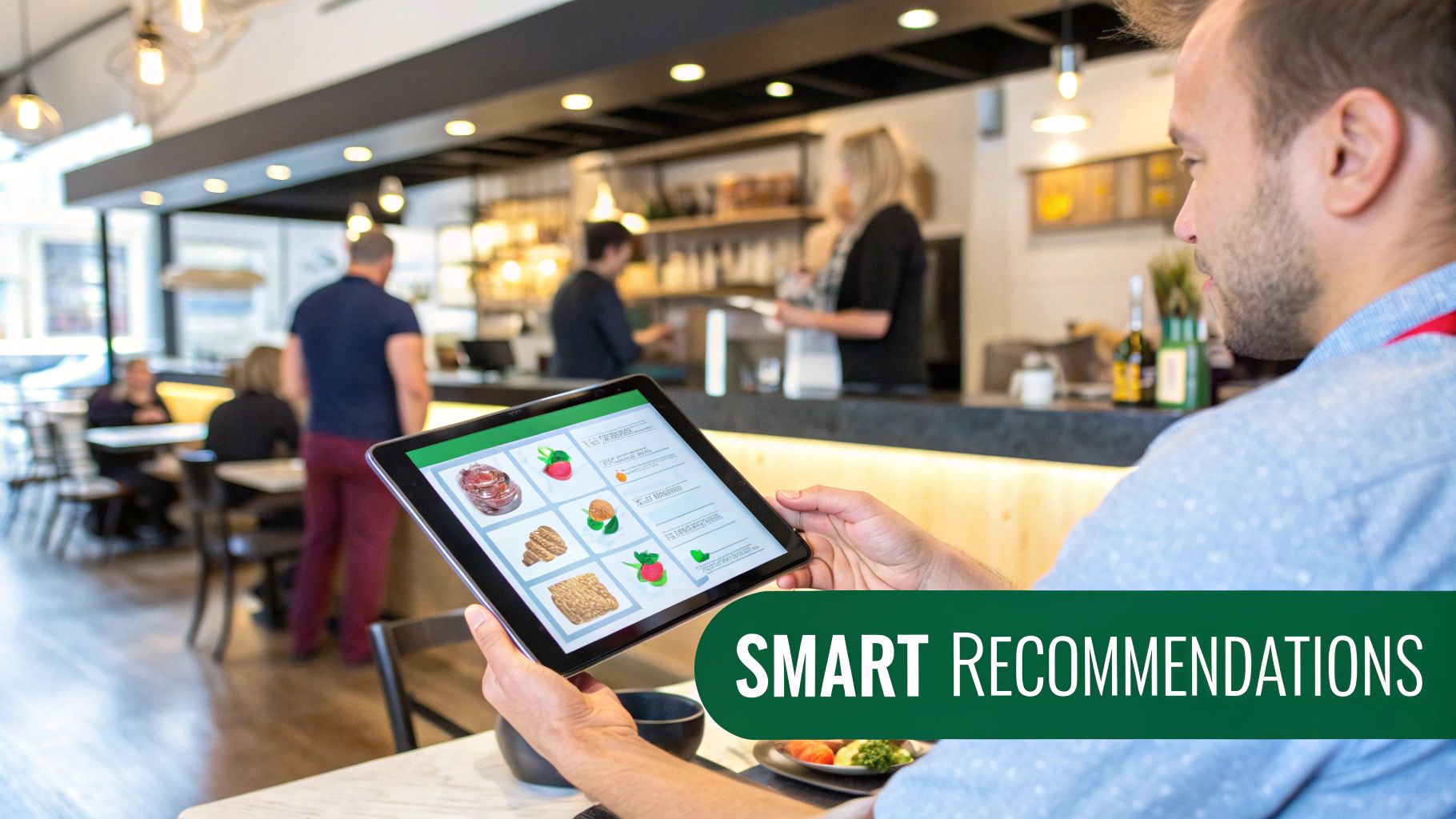
Artificial intelligence has officially moved from futuristic concept to a practical, revenue-driving tool in the restaurant industry. AI-powered ordering uses machine learning to analyze vast amounts of data, including a customer's past orders, the time of day, current weather, and popular menu pairings. This data is then used to generate hyper-personalized recommendations and upsell suggestions directly on your POS, mobile app, or digital menu boards.
This intelligent approach transforms a standard transaction into a curated guest experience. It predicts what a customer might enjoy, introduces them to new menu items they are likely to love, and streamlines the ordering process. For restaurant owners, this translates directly into higher average check sizes and increased customer loyalty, making it a crucial component of modern restaurant technology trends. An integrated system like TackOn Table acts as the central data hub, making this sophisticated AI accessible without requiring a dedicated data science team.
Business Impact and Use Cases
The benefits extend across various restaurant models. Quick-service restaurants, like McDonald's, use AI to power dynamic drive-thru menus that change based on traffic and time of day. For cafes, a system can learn a regular’s coffee preference and suggest a complementary pastry, while full-service establishments can empower servers with tablets that provide data-driven pairing recommendations.
Key Insight: AI personalization isn't just about showing customers what they already like; it's about intelligently guiding them to discover new favorites and higher-margin items, boosting both satisfaction and profitability.
Actionable Implementation Tips
Adopting AI doesn't have to be an overwhelming overhaul. Start small and scale your efforts.
- Start with Your POS Data: Begin by analyzing basic purchase history within your existing POS system to identify popular item pairings and ordering patterns.
- Ensure Data Transparency: Clearly communicate how customer data is used in your privacy policy to build and maintain trust.
- Integrate with Your CRM: Connect your AI tools with your customer relationship management (CRM) platform for a complete 360-degree view of guest behavior.
- Test and Refine: Launch AI-driven recommendations with a small segment of your loyalty program members first to gather feedback before a full rollout.
2. Restaurant POS Trend: Contactless Payment & Digital Wallets
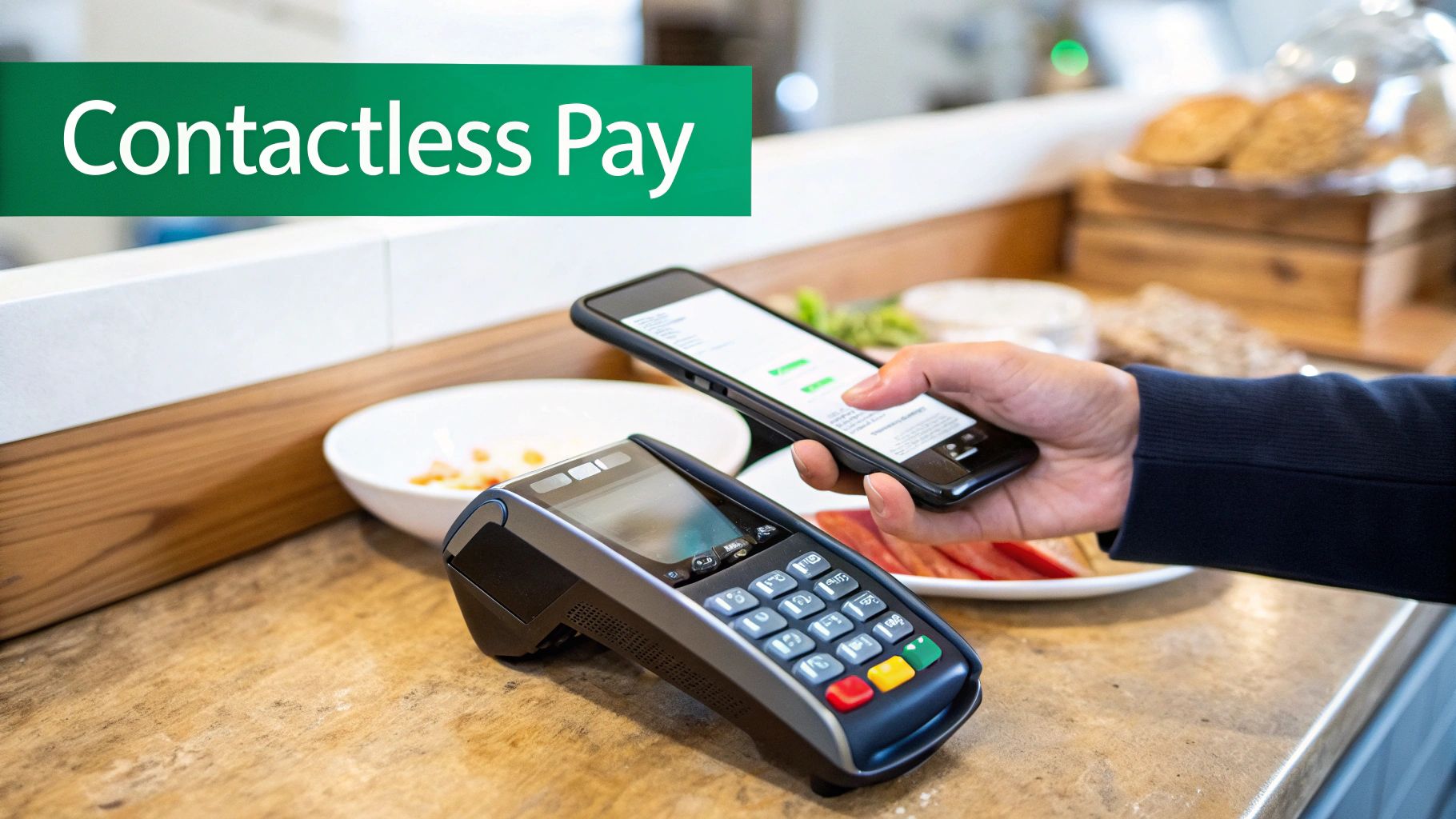
The shift towards contactless payment is one of the most significant and lasting restaurant technology trends to emerge in recent years. This technology enables customers to complete transactions without physical contact using methods like Near Field Communication (NFC) for tap-to-pay, QR codes scanned by smartphones, and digital wallets such as Apple Pay and Google Pay. This transition from traditional card swipes to secure, rapid digital transactions has redefined customer expectations for speed and safety.
What began as a necessity has now become a standard for convenience, drastically reducing wait times and improving table turnover. By embracing systems that support a wide range of digital payments, restaurants can cater to a broader, tech-savvy customer base. A modern, mobile POS like TackOn Table seamlessly integrates these payment options, offering a unified and secure checkout experience that enhances both operational efficiency and customer satisfaction.
Business Impact and Use Cases
The application of contactless payments is universal across the food service industry. For quick-service restaurants, tap-to-pay functionality is critical for speeding up drive-thru and counter service lines, directly impacting throughput. Cafes benefit from the quick, seamless transactions provided by digital wallets, keeping morning rushes flowing smoothly. In full-service dining, "Pay at the Table" QR codes empower guests to settle their checks on their own schedule, freeing up staff to focus on hospitality rather than processing payments. Learn more about how these solutions benefit QSRs.
Key Insight: Contactless payment is no longer just a feature; it's a core operational function that enhances security, accelerates service speed, and meets the modern consumer's demand for a frictionless experience.
Actionable Implementation Tips
Integrating a robust contactless payment system is a straightforward process with the right approach. Focus on a smooth transition for both staff and customers.
- Display Clear Signage: Prominently display decals and signs at your entrance and POS terminals indicating which contactless payment methods you accept (e.g., Apple Pay, Google Pay, Tap-to-Pay).
- Train Staff Thoroughly: Ensure all employees are comfortable processing various digital payments and can confidently guide customers through the process.
- Negotiate Processor Rates: Review your payment processing fees. As transaction volume increases, you may be able to negotiate more favorable rates for digital and card-not-present transactions.
- Implement a Backup System: Have a plan for internet or power outages, such as a cellular backup or an offline processing mode, to ensure you can always accept payments.
3. Ghost Kitchens and Cloud-Based Restaurants
The rise of delivery-first dining has propelled ghost kitchens, also known as cloud or dark kitchens, from a niche concept into a mainstream operational model. These are commercial cooking facilities built exclusively for delivery and takeout orders, with no traditional storefront or dine-in space. By eliminating front-of-house expenses, ghost kitchens allow operators to launch new virtual brands quickly, test menu concepts with minimal risk, and cater directly to the booming online ordering market.
This model is a prime example of how restaurant technology trends are reshaping the industry's physical footprint. Operations are data-driven, leveraging insights from delivery platforms to optimize menus, pricing, and promotions for specific neighborhoods. An agile, cloud-based system like TackOn Table is essential for managing multiple virtual brands from a single kitchen. Its multi-location control and all-in-one simplicity streamline orders from various third-party apps into one unified workflow, providing the analytics needed to make smart, real-time decisions.
Business Impact and Use Cases
Ghost kitchens offer unprecedented flexibility. An existing full-service restaurant can launch a delivery-only virtual brand (e.g., a burger joint or a wing concept) from its current kitchen to maximize underutilized capacity. Entrepreneurs can partner with providers like CloudKitchens to rent fully-equipped kitchen space and go live in weeks, not months. This model enables rapid expansion into new markets without the massive capital investment required for a traditional brick-and-mortar location.
Key Insight: Ghost kitchens decouple food production from the customer-facing experience, allowing brands to focus purely on creating high-quality, delivery-optimized food while leveraging technology to reach a massive online audience.
Actionable Implementation Tips
Launching or operating a ghost kitchen requires a focus on digital efficiency and brand management.
- Master Menu Engineering: Design menu items that travel well and maintain quality during transit. Focus on high-margin, popular dishes identified through local market data.
- Optimize Your Tech Stack: Use a POS that offers robust third-party delivery integrations to consolidate orders from DoorDash, Uber Eats, and others into a single, manageable interface.
- Create Distinct Virtual Brands: Develop unique names, logos, and marketing for each concept to capture different customer segments, even if they share a kitchen.
- Negotiate Delivery Fees: Work with third-party delivery platforms to secure favorable commission rates, or explore using your own drivers for local deliveries to improve margins.
4. Kitchen Display Systems (KDS) & Café Management Software
The chaotic era of paper tickets and shouted orders is officially over. Modern Kitchen Display Systems (KDS) digitize the entire order fulfillment process, replacing printers with robust, networked screens in the kitchen. When an order is placed at the POS, it instantly appears on the relevant KDS station, providing cooks with clear, legible, and prioritized instructions. This direct line of communication between the front and back of house eliminates errors, reduces ticket times, and creates a calmer, more organized kitchen environment.
This digital workflow is a cornerstone of operational excellence and a key part of today's restaurant technology trends. Advanced KDS platforms integrate directly with POS systems, online ordering portals, and delivery apps, consolidating all incoming orders into a single, manageable queue. By centralizing order management, systems provide managers with real-time data on ticket times and kitchen performance, turning operational insights into actionable improvements. When exploring alternatives to popular KDS solutions, look for simple, affordable systems that unify your entire operation without complex hardware.
Business Impact and Use Cases
The efficiency gains from a KDS are universal. Quick-service restaurants can route orders for burgers to the grill station and fries to the fryer station simultaneously, slashing fulfillment times. In a bustling café, a KDS ensures baristas see drink orders in the correct sequence, while bakers are alerted to pastry needs, making it essential café management software. For full-service dining, a KDS can pace the meal by timing when appetizers, main courses, and desserts are fired, ensuring a seamless guest experience from start to finish.
Key Insight: A KDS is more than a digital ticket-taker; it's a command center for your kitchen that enhances accuracy, boosts speed, and provides invaluable data on your back-of-house performance.
Actionable Implementation Tips
Transitioning to a digital kitchen workflow can be smooth with a strategic approach.
- Choose a Compatible System: Ensure your KDS fully integrates with your existing POS to avoid data silos and operational friction.
- Invest in Durable Hardware: Kitchen environments are harsh. Opt for commercial-grade, heat- and grease-resistant screens and mounts.
- Customize Station Workflows: Map the KDS displays to your kitchen's physical layout, creating logical stations (e.g., Grill, Fry, Expo) to direct orders efficiently.
- Use Performance Analytics: Regularly review KDS reports on ticket times per item and station to identify and resolve operational bottlenecks.
5. Automated Inventory Management and Food Waste Reduction
Manual inventory counts are a notorious drain on time and a major source of operational error. Modern restaurant technology is replacing clipboards and spreadsheets with automated systems that use AI, IoT sensors, and computer vision to provide a real-time, granular view of stock levels. These platforms monitor everything from ingredient usage linked to POS sales to expiration dates, ensuring you know exactly what you have and what you need.
This data-driven approach moves inventory management from reactive to predictive. By analyzing historical sales data, menu performance, and even external factors like seasonality, these systems forecast demand with remarkable accuracy. This minimizes over-ordering, reduces costly spoilage, and combats food waste, which directly impacts your bottom line. Integrating this technology with a comprehensive system like TackOn Table centralizes purchasing, recipe costing, and sales data, creating one of the most powerful restaurant technology trends for improving profitability.
Business Impact and Use Cases
The application of automated inventory is universal. A bustling café can use it to prevent running out of their most popular espresso beans during the morning rush, while a multi-location franchise can standardize recipes and purchasing across all sites to maintain consistency and control costs. Full-service restaurants leverage these tools for precise recipe costing, ensuring menu items are priced for maximum profitability. Food trucks can manage limited storage space efficiently, ordering just enough for an event without risking waste.
Key Insight: Automated inventory isn't just about counting what you have; it's about using predictive analytics to optimize purchasing, eliminate waste, and turn your stockroom into a strategic financial asset rather than a cost center.
Actionable Implementation Tips
Integrating an automated inventory system can be done in strategic phases to ensure a smooth transition and immediate impact.
- Integrate with Your POS: This is the most critical step. Connecting your inventory platform to your POS, like TackOn Table, automatically depletes ingredients as items are sold, providing the most accurate usage data.
- Start with High-Cost Items: Begin by tracking your most expensive or highly perishable goods, such as proteins and fresh produce, to see the quickest return on investment.
- Set Up Smart Alerts: Configure low-stock and expiration-date alerts to prompt timely reordering and prevent spoilage before it happens. See how much you can save with our inventory savings calculator.
- Empower Your Kitchen Staff: Involve your BOH team in the process. Their insights are invaluable for refining usage forecasts and identifying discrepancies between theoretical and actual food costs.
6. Robotic Process Automation and Kitchen Robotics
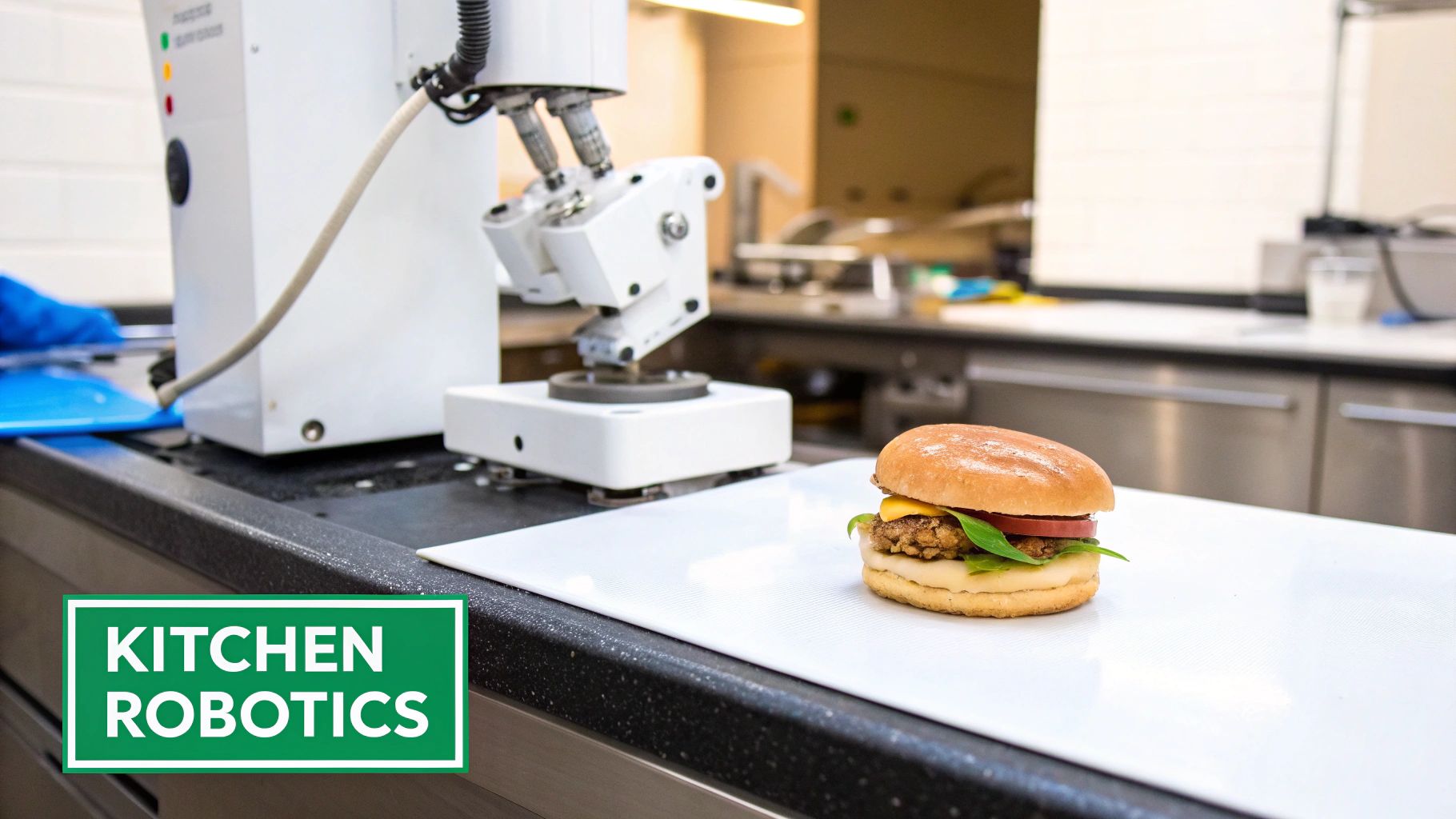
Once the realm of science fiction, robotics and automation are now tackling some of the most pressing challenges in the restaurant industry, from labor shortages to food consistency. Robotic process automation (RPA) involves using automated systems and robots to handle highly repetitive, rule-based tasks in both the front and back of house. This includes everything from Miso Robotics' famous burger-flipping arm, "Flippy," to fully automated dishwashing systems and autonomous delivery vehicles.
These systems are designed to work alongside human staff, not necessarily replace them. They excel at tasks that are prone to human error or are physically demanding, such as precise cooking, ingredient portioning, and tireless cleaning. This frees up employees to focus on higher-value activities like customer service, menu innovation, and quality control. For restaurant owners, this is one of the most transformative restaurant technology trends, offering a path to reduced labor costs, enhanced operational efficiency, and unwavering product consistency.
Business Impact and Use Cases
Automation's impact is versatile. Quick-service chains like White Castle have partnered with Miso Robotics to automate the fry station, ensuring perfectly cooked fries every time and reducing staff exposure to hot oil. High-concept restaurants like Creator by Momentum Machines have demonstrated the potential of fully automated burger creation. Meanwhile, companies like Starship Technologies are deploying autonomous robots for last-mile food delivery, navigating sidewalks to bring meals directly to customers' doors.
Key Insight: Kitchen robotics isn't about creating a "human-less" restaurant; it's about creating a more efficient and consistent operation by automating the most predictable tasks, allowing human talent to shine where it matters most.
Actionable Implementation Tips
Integrating robotics requires careful planning and a strategic approach. Start by identifying the most significant operational bottlenecks.
- Assess High-ROI Tasks: Analyze your kitchen workflow to identify which repetitive, high-volume tasks (like frying, dishwashing, or drink pouring) offer the best potential for a return on investment.
- Plan for Staff Repositioning: Frame automation as a tool to help your team. Plan to retrain staff for new roles focused on quality assurance, customer interaction, or robot maintenance.
- Focus on Consistency First: Prioritize automating tasks where consistency is critical to your brand, such as portion control or cooking specific items to exact standards.
- Budget for Ongoing Maintenance: Remember to factor in the long-term costs of software updates, maintenance, and potential repairs when evaluating the total cost of ownership.
7. Data Analytics and Business Intelligence Dashboards
Guesswork is no longer a viable strategy for restaurant growth. Modern data analytics and business intelligence (BI) dashboards are powerful platforms that consolidate information from your POS, inventory systems, and customer databases into a single, intuitive interface. These tools transform raw data into real-time, actionable insights on sales trends, menu performance, labor costs, and customer behavior.
Instead of manually sifting through spreadsheets, operators can instantly visualize key performance indicators (KPIs), identify patterns, and make informed strategic decisions. This comprehensive view is essential for optimizing everything from menu pricing to staff scheduling. An all-in-one system like TackOn Table provides this clarity out of the box, centralizing your operational data to reveal opportunities for cost savings and revenue growth, making it a cornerstone of current restaurant technology trends.
Business Impact and Use Cases
The application of BI dashboards is universal across the food service industry. A quick-service restaurant can use analytics to pinpoint its busiest hours and optimize staffing levels, reducing labor costs without sacrificing service speed. Cafes can track the popularity of seasonal drinks to perfect their promotional calendar, while multi-location groups can compare performance across all their sites to standardize successful practices and identify underperforming locations that need support.
Key Insight: Data analytics isn't just about reviewing past performance; it’s about using historical data to accurately forecast future demand, enabling smarter purchasing, better staff management, and more profitable menu engineering.
Actionable Implementation Tips
Leveraging data effectively starts with a clear and focused approach. You don't need a data scientist to get started.
- Establish a Baseline: Before making any operational changes, track your key metrics for a few weeks to understand your starting point.
- Focus on Key KPIs: Begin by tracking 3-5 critical metrics, such as food cost percentage, average check size, and table turnover rate, to avoid information overload.
- Integrate with Accounting: Connect your BI platform with your accounting software to ensure financial data is always accurate and up-to-date for precise profit and loss analysis.
- Schedule Regular Reviews: Make data a part of your weekly management meetings. Consistently reviewing dashboards with your team fosters a data-driven culture.
8. Online Ordering and Delivery Platform Integration
The rapid growth of off-premise dining has made managing multiple ordering channels a major operational challenge. Modern integration systems address this by consolidating orders from third-party delivery apps like DoorDash, Uber Eats, and Grubhub, alongside direct orders from your branded website or app, into a single, unified dashboard. This eliminates the need for a cluttered counter of separate tablets and streamlines the entire order fulfillment process from kitchen to customer.
This integrated approach ensures operational efficiency and data consistency, preventing missed orders and reducing manual entry errors. By centralizing order flow directly into the point of sale, restaurants can manage incoming requests from all channels as if they originated in-house. A system like TackOn Table offers this all-in-one simplicity, connecting your online storefront and third-party marketplaces directly to your kitchen display system, making it a pivotal piece of any modern restaurant technology trends strategy.
Business Impact and Use Cases
The impact of seamless integration is felt across all restaurant types. A quick-service restaurant can dramatically speed up its fulfillment times by having DoorDash and website orders fire directly to the kitchen line without staff intervention. Cafes can manage a rush of mobile coffee orders alongside in-person transactions from the same POS screen, while full-service restaurants can expand their reach through multiple delivery partners without complicating their existing operational workflow. This unified system provides a clear, comprehensive view of sales data from every channel.
Key Insight: True integration isn't just about combining order streams; it's about reclaiming control over your off-premise business, unifying your data, and ensuring a consistent brand experience no matter where the customer places their order.
Actionable Implementation Tips
Effectively managing your digital and delivery channels requires a strategic approach.
- Prioritize Your Branded Channel: Drive traffic to your own website or app by offering exclusive deals and loyalty rewards for direct orders, allowing you to retain more revenue and customer data.
- Optimize Menus by Platform: Tailor your menu offerings on third-party apps to feature items that travel well and have higher profit margins.
- Maintain Pricing Consistency: Ensure your pricing is consistent across all platforms to avoid customer confusion and protect your brand’s perceived value.
- Leverage Channel Data: Use analytics to understand which channels your customers prefer and identify your most profitable platforms, informing your marketing and partnership decisions.
9. Customer Relationship Management (CRM) and Loyalty Programs
In today's competitive landscape, repeat business is the cornerstone of profitability, and modern CRM and loyalty platforms are the tools that build it. These digital systems go far beyond simple punch cards, integrating directly with your POS to track customer purchase history, visit frequency, and preferences. This data allows for the creation of automated, targeted marketing campaigns, from personalized email offers to timely SMS notifications, turning first-time visitors into dedicated regulars.
This approach transforms marketing from a generic broadcast into a one-on-one conversation with each guest. By understanding what your customers love, you can reward their loyalty with offers that are genuinely valuable to them. For restaurant owners, this creates a powerful feedback loop that drives repeat visits and higher lifetime value, solidifying its place among essential restaurant technology trends. An all-in-one system like TackOn Table, which includes built-in CRM features, makes it simple to manage these relationships without complex third-party software.
Business Impact and Use Cases
The power of a dedicated CRM and loyalty program scales across all service models. A cafe can automatically send a "we miss you" offer with a free coffee to a regular who hasn't visited in a month. A full-service restaurant, like Fogo de Chão, can use its loyalty program to reward high-spending guests with exclusive event invitations. Quick-service brands like Panera have built digital empires on a foundation of seamless, app-integrated loyalty programs that make earning and redeeming rewards effortless for the customer.
Key Insight: A modern CRM is not just a contact list; it's a dynamic engine for building relationships. It enables you to reward your best customers, re-engage those at risk of churning, and turn valuable data into increased revenue.
Actionable Implementation Tips
Launching a successful loyalty program is a strategic process. Follow these steps to maximize engagement and ROI.
- Start with Simplicity: Begin with a straightforward points-per-dollar system before introducing more complex tiers or rewards.
- Segment Your Audience: Use purchase data to group customers (e.g., "lunch regulars," "weekend families," "high-spenders") and send them highly relevant, personalized offers.
- Incentivize Sign-Ups: Make enrollment frictionless and offer an immediate reward, such as a discount on their next purchase, to encourage participation.
- Track Your ROI: Monitor key metrics like repeat visit rate, average spend of loyalty members versus non-members, and offer redemption rates to prove the program's value.
10. Augmented Reality (AR) Menus and Virtual Dining Experiences
Augmented Reality (AR) is transforming the static menu into an interactive, visual feast, moving beyond a novel gimmick to become a powerful sales and engagement tool. Using their smartphone camera, guests can point at a menu and see a photorealistic 3D model of a dish appear right on their table. This technology demystifies complex or unfamiliar menu items, allows customers to visualize portion sizes, and creates a memorable, shareable "wow" factor that sets an establishment apart.
This immersive approach helps bridge the gap between menu description and the final plate, reducing order anxiety and encouraging guests to try new, potentially higher-margin items. For restaurant owners, AR represents a new frontier in customer experience, boosting engagement and driving sales through visual storytelling. While still an emerging part of restaurant technology trends, platforms integrating with mobile ordering systems are making AR more accessible than ever, allowing even small cafes to offer a futuristic dining experience.
Business Impact and Use Cases
The application of AR menus is incredibly versatile. A fine-dining restaurant can use it to showcase the intricate plating of a signature dish, while a cocktail bar can bring its most creative drinks to life with swirling animations and visual garnishes. For quick-service restaurants, an AR experience like KFC's chicken bucket campaign can turn packaging into a fun, interactive game, increasing brand engagement. Cafes can use it to show the difference between a latte and a flat white, educating customers and enhancing their ordering confidence.
Key Insight: AR menus turn ordering into an experience, not just a transaction. By allowing customers to "see" their food before they order, you eliminate purchase hesitation and create powerful, user-generated marketing content when they share the experience online.
Actionable Implementation Tips
Integrating AR doesn't require a massive budget or in-house development team. You can start small and create significant impact.
- Start with Signature Items: Focus your initial efforts on creating high-quality 3D models for your most visually appealing or best-selling dishes to maximize impact.
- Prioritize a Seamless User Experience: Ensure the AR feature is easy to access via a simple QR code scan and doesn't complicate or slow down the ordering process. Always provide a non-AR menu option.
- Leverage High-Quality Assets: Use professional food photography from multiple angles as the foundation for your 3D models to ensure they look appetizing and realistic.
- Market the Feature: Promote your new AR menu on social media and in-store signage to attract tech-savvy customers and generate buzz.
Restaurant Tech Trends: 10-Point Comparison
| Technology | Implementation complexity | Resource requirements | Expected outcomes | Ideal use cases | Key advantages | Key challenges |
|---|---|---|---|---|---|---|
| AI-Powered Ordering and Personalization | High — ML models, data pipelines, integration | Significant customer data, cloud compute, engineering, CRM integration | Higher AOV, improved conversions, personalized UX, better inventory signals | Large chains, apps with repeat customers, data-rich environments | Increased sales and loyalty; reduced decision fatigue | Privacy concerns, bias risk, high initial cost, complex integration |
| Contactless Payment and Digital Wallets | Low–Medium — POS updates and partner integration | NFC/QR-capable terminals, payment processor agreements, network connectivity | Faster checkouts, safer transactions, reduced cash handling | High-volume QSR, dine-in with quick turnover, outdoor service | Speed, hygiene, improved transaction security | Digital access gaps, connectivity dependence, transaction fees |
| Ghost Kitchens and Cloud-Based Restaurants | Medium — operational redesign and delivery integration | Kitchen space (shared or standalone), packaging, delivery platform contracts | Lower overhead, faster market entry, delivery-focused revenue | Delivery-heavy markets, brand testing, multi-virtual concepts | Lower real estate cost; rapid scaling and experimentation | Platform dependency, weak brand experience, quality control |
| Kitchen Display Systems (KDS) and Order Management | Medium — hardware + POS integration | Durable displays, POS/KDS software, staff training, network reliability | Reduced errors, faster prep, better throughput and analytics | Busy kitchens, multi-station operations, high order volume | Improved accuracy, communication, peak-hour scaling | Downtime risk, training needs, visibility and maintenance issues |
| Automated Inventory Management & Waste Reduction | High — sensors, CV, and forecasting systems | IoT sensors, cameras, software, supplier integrations, training | Reduced waste, lower procurement costs, improved cash flow | Multi-location operations, high-perishables kitchens | Waste reduction, cost savings, real-time visibility | High capital cost, integration complexity, data accuracy needs |
| Robotic Process Automation & Kitchen Robotics | Very High — robotics engineering and safety compliance | Robotic hardware, specialized maintenance, integration with ops | Lower labor costs, consistent quality, higher throughput | High-volume, repetitive-process kitchens, limited-menu concepts | Labor reduction, consistency, 24/7 operation potential | Very high CAPEX, limited menu flexibility, maintenance and perception issues |
| Data Analytics & Business Intelligence Dashboards | Medium–High — data consolidation and modeling | BI tools, data integration, analyst time, clean data sources | Better decision-making, profitability improvement, forecasting | Multi-location groups, data-driven operators | Actionable insights, scheduling optimization, menu profitability | Data quality dependency, learning curve, subscription and integration costs |
| Online Ordering & Delivery Platform Integration | Medium–High — API work and unified order routing | API integrations, branded app/web development, logistics coordination | Expanded reach, more orders, consolidated order management | Restaurants prioritizing delivery and direct channels | Access to large customer bases, direct-order margins | Third-party fees, integration complexity, platform competition |
| CRM & Loyalty Programs | Medium — system setup and marketing automation | CRM platform, POS integration, marketing channels, data capture | Increased CLV, higher repeat purchase rates, targeted campaigns | Full-service and chain restaurants focused on retention | Better customer targeting; higher repeat revenue | Privacy compliance, data maintenance, customer adoption |
| AR Menus & Virtual Dining Experiences | High — AR development and 3D content production | AR platform/app development, 3D assets, ongoing content updates | Increased engagement, clearer visualization, novelty-driven visits | Upscale or experiential venues, marketing-led launches | Differentiation, improved ordering confidence, social appeal | High development cost, limited audience, ongoing content upkeep |
Your Next Steps to a Smarter Restaurant
Navigating the landscape of modern hospitality means understanding and strategically adopting the right tools. We've explored a wide spectrum of restaurant technology trends, from the operational engine room of Kitchen Display Systems and automated inventory management to the futuristic customer-facing appeal of AR menus and AI-driven personalization. The central theme connecting all these innovations is a powerful trifecta: enhancing efficiency, elevating the guest experience, and driving profitability.
The journey from a traditional setup to a tech-forward establishment can seem daunting, but it’s a journey of a thousand small, smart steps, not a single giant leap. The key is to recognize that these trends are not isolated gadgets or temporary fads. They are interconnected components of a larger, smarter ecosystem. Your CRM and loyalty program feeds data into your personalization engine. Your online ordering platform must seamlessly communicate with your KDS. Your POS system should be the central nervous system that gathers data for your business intelligence dashboards.
From Trend to Action: A Strategic Roadmap
The most critical takeaway is that technology should solve problems, not create them. Chasing every shiny new object is a recipe for complexity and wasted investment. Instead, a focused, strategic approach is essential. Start by identifying your biggest pain points.
- Are long ticket times and kitchen errors hurting your reputation? Prioritize a modern KDS and explore streamlined tableside ordering.
- Is food waste and unpredictable inventory eating into your profits? An automated inventory management system is your next logical step.
- Struggling to build a loyal customer base and drive repeat business? A robust, integrated CRM and loyalty program will deliver the highest return on investment.
This targeted approach ensures each technological investment provides a clear, measurable benefit. The goal isn't just to be "modern"; it's to be more resilient, more profitable, and more connected to your customers.
TackOn Table: An All-in-One Toast vs Clover Alternative
This is where the true power of a unified system comes into play. Managing a dozen different software subscriptions is not just a headache; it creates data silos and operational friction. The most impactful restaurant technology trends are those integrated into a single, cohesive platform. This is the philosophy behind TackOn Table. We've built an all-in-one solution that acts as your central command center, a powerful yet simple Toast vs. Clover alternative designed for the modern restaurant owner.
Our system brings together a lightning-fast mobile POS, integrated online ordering, powerful customer loyalty tools, and insightful analytics under one roof. We believe that sophisticated technology should be accessible, affordable, and incredibly easy to use. With our simple 30-minute setup and transparent pricing, you can implement the very trends discussed in this article without the typical complexity or prohibitive cost. You don’t need to be a tech expert; you just need a partner dedicated to your success. By consolidating your tech stack, you can focus on what you do best: creating unforgettable food and hospitality.
Ready to stop juggling multiple systems and embrace a simpler, more powerful way to run your business? TackOn Table integrates these cutting-edge restaurant technology trends into one affordable, easy-to-use platform. Book a personalized demo today and see how our all-in-one system can streamline your operations and fuel your growth.