Inventory management is one of those behind-the-scenes jobs that can make or break a restaurant, café, or food truck. At its core, it’s about knowing exactly what you have on your shelves, from the last bottle of craft beer to every single avocado.
For food and beverage businesses, this isn't just about counting stuff. It's the critical link between your kitchen, your customers, and your bank account. Get it right, and you're protecting your profits. Get it wrong, and you're literally throwing cash in the bin.
Why Smart Inventory Management Is Your Restaurant's Secret Ingredient
We’ve all been there. It’s a slammed Friday night, the dining room is buzzing, and your signature burger is the star of the show. Then you hear the dreaded words from the kitchen: “We’re out of brioche buns!”
Just like that, your number one seller is off the menu. Customers are disappointed, and you've lost guaranteed revenue. This isn’t just a bit of bad luck; it’s a direct result of weak inventory management.
Running a tight ship in the food business means going way beyond a quick box count at the end of the week. It's a living, breathing strategy that connects what your customers are buying directly to what you're ordering from suppliers. Think of it as the central nervous system of your entire operation.
Beyond Counting Boxes to Controlling Costs
The real magic of solid inventory control is the clear, real-time window it gives you into your restaurant's financial health. Every tomato, every bag of flour, every bottle of wine sitting in your stockroom is tied-up cash. When that food spoils or goes unused, it's no different than setting a pile of money on fire.
For a business running on notoriously thin margins, even a small amount of waste can be the deciding factor between a profitable month and a painful loss.
Nailing your tracking process helps you master a few key things:
- Controlling Food Costs: When you know precisely what goes into each dish, you can calculate your real Cost of Goods Sold (COGS). This is crucial for pricing your menu profitably.
- Slashing Waste: Good tracking immediately shows you what’s not moving. This lets you adjust your orders before perfectly good food spoils on the shelf.
- Guaranteeing Availability: You'll never have to 86 a popular dish during a dinner rush again, which protects both your sales and your hard-earned reputation.
The goal isn’t just having enough stock. It’s about having the right amount of stock at the right time. Overstocking sucks up cash and leads to spoilage, while understocking means lost sales and unhappy customers.
The Modern Advantage: An All-in-One Restaurant POS
In the past, this kind of control meant hours of soul-crushing work with clipboards and clunky spreadsheets. Thankfully, that's no longer the case. Modern tools can turn this chore into a genuine competitive advantage for any restaurant, cafe, or food truck.
An integrated system like TackOn Table automates the whole process with all-in-one simplicity. Our platform comes with a mobile POS that depletes your inventory with every single order. When a guest orders a latte, the system automatically deducts the right amount of milk, espresso, and syrup from your stock levels. You get a live, accurate view of your inventory without lifting a finger.
This focus on affordability, adaptability, and an easy setup makes TackOn Table a powerful Toast vs Clover alternative. Unlike complex systems like Toast or Clover, we provide the power you need without the overwhelming features and high costs. Curious how much you could save? Check out our savings calculator to get a quick estimate.
With powerful multi-location control built right in, TackOn Table makes sophisticated inventory management for your small business not just possible, but genuinely effortless.
Alright, let's get the foundation of your inventory system built. This is where the magic happens, and it all starts with two core ideas: setting your par levels and picking the right way to count your stock.
These aren't just abstract business terms; they're the practical tools you'll use every day to stop running out of key ingredients and quit throwing money in the trash.
Laying the Groundwork with Par Levels and Counting Methods
Think of a par level as your safety stock. It's the absolute minimum amount of an ingredient you need to have on your shelves to get you through to the next delivery. Get this right, and you'll never have that sinking feeling when a customer orders the special you just ran out of.
Setting these levels isn't about guessing. It's a quick calculation based on how fast you sell something and how long it takes your supplier to show up.
Let's say your cafe cranks out about 100 lattes a day, and each one uses roughly 20 grams of espresso beans. That's 2,000 grams, or 2 kg, of beans flying out the door daily. If your coffee guy delivers every three days, you'll need at least 6 kg of beans just to cover that period. Your actual par level should be a bit more than that—maybe 7 or 8 kg—to give you a buffer for a surprise morning rush or a delivery delay.
Picking Your Inventory Counting Method
Once you know how much you should have, you need a reliable way to track what you actually have. There are a few ways to tackle this, and the best fit depends on your restaurant's size and how much hands-on control you want.
-
Periodic Inventory: This is the old-school, "all-hands-on-deck" count. You literally count every single item in your storeroom, walk-in, and freezer. It's usually done weekly or monthly and is essential for your financial reports, but it’s a huge time-sink and only gives you a snapshot of a single moment.
-
Perpetual Inventory: This is the opposite—a live, real-time method where every sale, delivery, and bit of waste gets logged the moment it happens. It offers the most accurate, up-to-the-minute data, but trying to do this by hand is a fast track to burnout.
For most busy owners, the sweet spot is a hybrid approach called cycle counting. Instead of one massive, painful count each month, you break it down into tiny, manageable chunks. You count a small section of your inventory every single day.
Maybe Monday is dairy and produce, Tuesday is dry goods, and Wednesday is booze and paper products. It becomes a simple, routine part of your opening or closing checklist.
Cycle counting turns a dreaded chore into a powerful daily habit. It helps you spot problems like waste, theft, or supplier short-orders almost immediately, not weeks later when the money is already lost.
This steady approach makes inventory accuracy a team effort instead of a burden that falls on one manager's shoulders.
The Power of an Integrated Restaurant POS
This is where pen-and-paper systems start to fall apart. Manually tracking every ounce of cheese and every bun used during a chaotic dinner service is almost impossible. It’s no wonder that 39% of small businesses in the U.S. still track their inventory by hand or don't track it at all. According to recent inventory management statistics, this leads directly to stockouts, overstocking, and a whole lot of wasted cash.
This is where a smart, integrated Restaurant POS like TackOn Table changes the game. Our system connects your sales directly to your stock levels, basically running a perpetual inventory count for you automatically.
When your kitchen sells a burger, our software instantly deducts one bun, one patty, two slices of cheese, and a dollop of sauce from your digital stockroom. This gives you a live, theoretical count to compare against your daily cycle counts, making it incredibly easy to see where things don't line up.
This flowchart shows exactly how you move from guesswork to smart management and real profit growth.
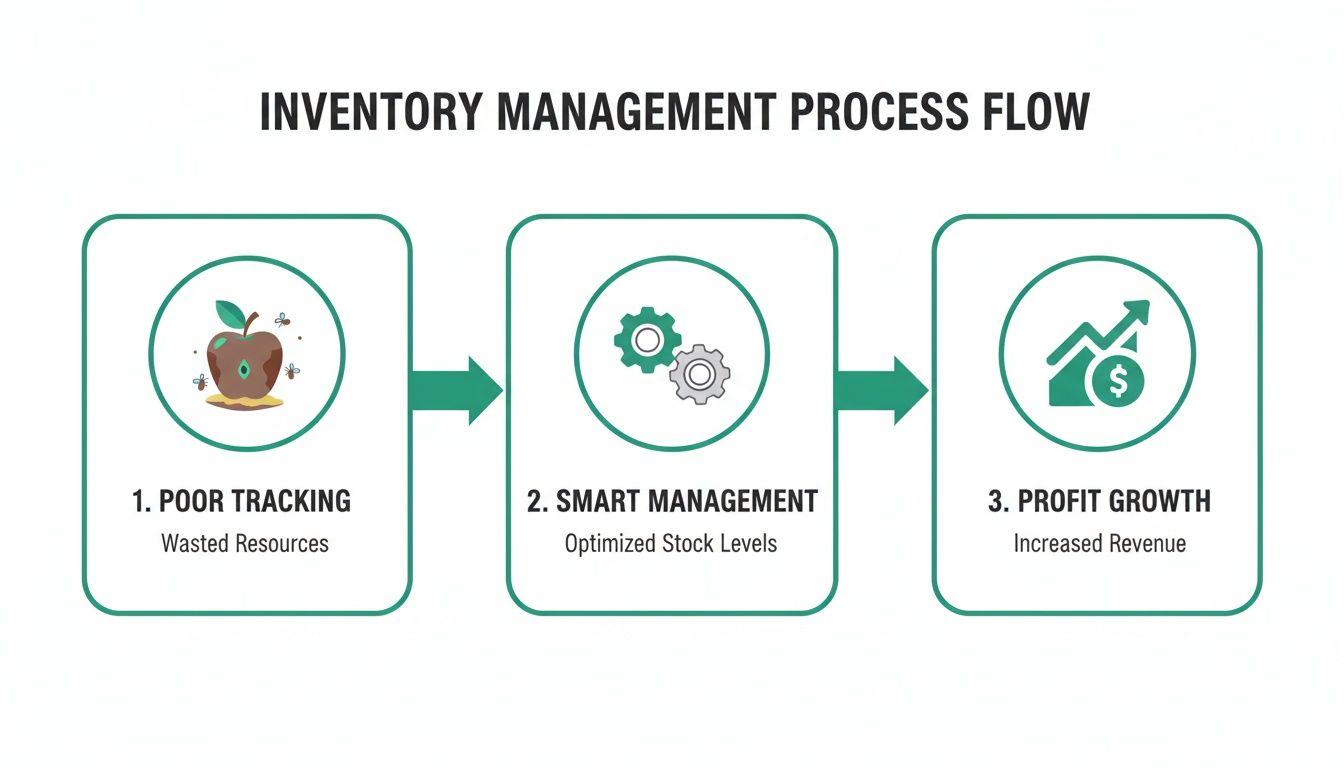
As you can see, a good system is the bridge between losing money on spoiled food and building a more profitable, sustainable business.
When you nail down your par levels and get into a consistent counting rhythm—all powered by the right tech—your inventory stops being a headache and starts becoming one of your strongest assets.
Ready to see how an automated system can make this a reality for you? Start your free trial or book a personalized demo and we'll show you how TackOn Table can make a difference.
How a Restaurant POS Creates Total Inventory Control
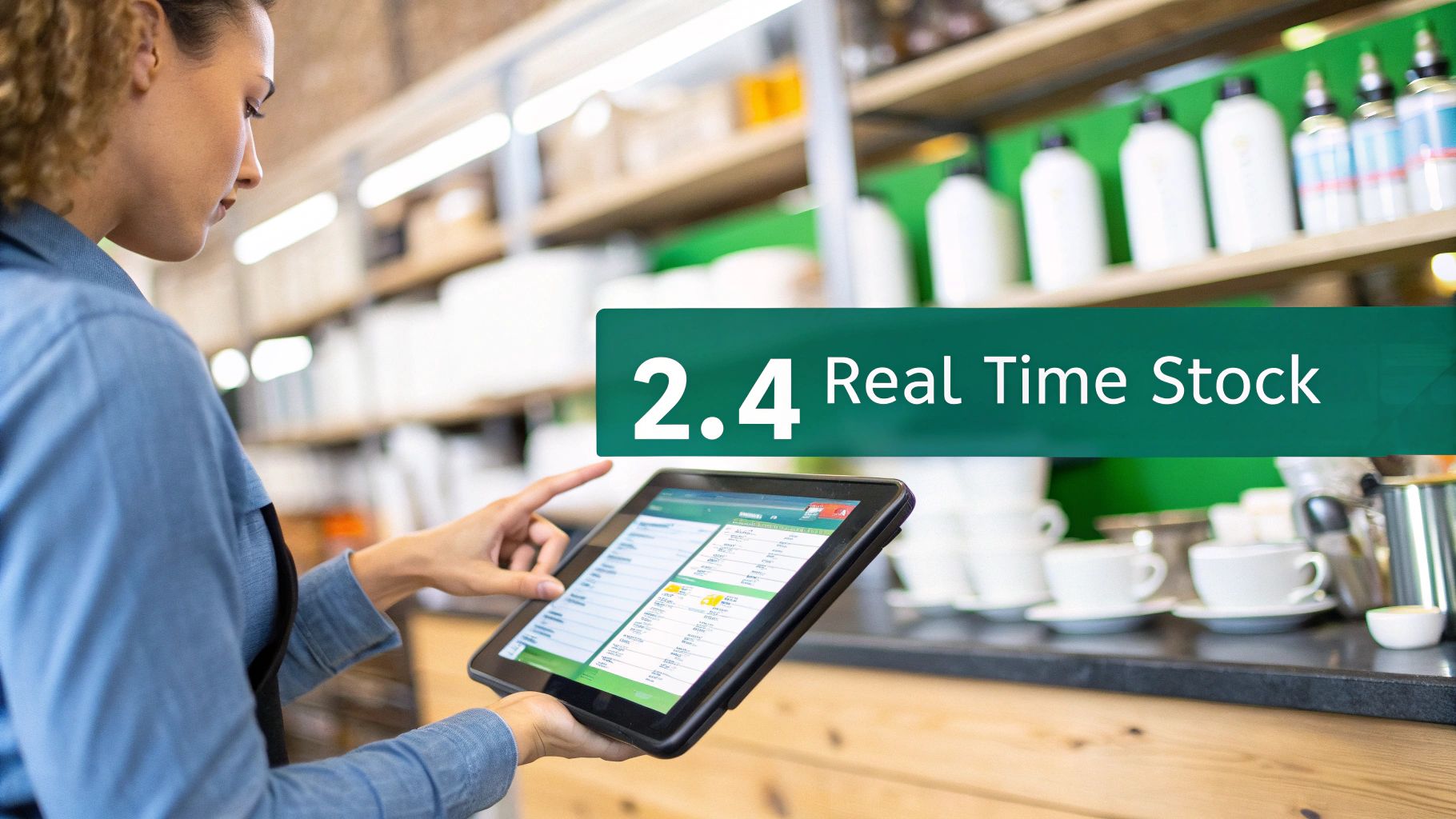
Still using clipboards and spreadsheets? That’s like trying to navigate a busy highway by only looking in the rearview mirror. You see where you’ve been, but by the time you spot a problem up ahead, it's usually too late. A cloud-based restaurant POS is your GPS, giving you a live, forward-looking view of your entire inventory in real-time.
This is where inventory management stops being a reactive, error-prone chore and becomes an automated, intelligent part of your business. A modern POS doesn’t just take payments; it becomes the central hub of your operation, connecting every single sale directly to the ingredients on your shelves.
From Manual Guesswork to Automated Accuracy
Think about the old way. Your week ends with a manager spending hours in the walk-in, manually counting every bottle, box, and bag. They scribble it down, punch the numbers into a spreadsheet, and try to make sense of it all by comparing it to purchase orders. It’s a slow, frustrating process filled with opportunities for human error.
Now, let's look at it with a modern system. With a POS like TackOn Table, every time a server rings up a "Spicy Chicken Sandwich," the software instantly deducts one brioche bun, one chicken breast, two pickles, and a half-ounce of spicy aioli from your digital stock count. This isn't a nightly batch update—it happens instantly, in real-time, for every item you sell.
Your inventory count is no longer a snapshot from three days ago; it's a live, constantly updating number that reflects your business at this very moment. This is the foundation of total control.
This automated depletion gives you a "theoretical" inventory count—what you should have on hand based on sales. Now when you do your quick daily cycle counts, you can immediately compare the physical reality to the theoretical number and spot discrepancies right away, not weeks later during a full audit.
Low-Stock Alerts: The End of the Dreaded 86
One of the most powerful, yet simple, features of an integrated system is automated low-stock alerts. You’ve already done the work to set your par levels for key ingredients. Just plug those numbers into the POS, and it will automatically notify you the second your supply of avocados or espresso beans dips below that critical threshold.
This feature is an absolute game-changer. It stops you from running out of a bestseller during the Saturday dinner rush, protecting both your revenue and your restaurant's reputation. It also helps you place smarter, more timely orders with suppliers, eliminating those expensive emergency runs to the grocery store.
The real win here is shifting from a reactive "Oh no, we're out!" mindset to a proactive, controlled purchasing strategy. The system tells you what you need before you even realize you need it. To truly gain total inventory control, consider integrating a robust restaurant inventory management system with your POS.
The Power of an All-in-One Café Management Software
For cafes and food trucks, where every square foot and every minute counts, this level of automation isn't a luxury—it's essential. TackOn Table’s all-in-one simplicity means your inventory, sales, and ordering systems are all perfectly in sync because they’re part of the same platform. No clunky integrations or separate software to manage.
Because it’s a mobile POS, you aren’t chained to a clunky terminal at the front counter. You or your manager can check stock levels, review sales reports, or even build a purchase order on a tablet while walking through the storeroom. This flexibility is invaluable, especially for owners who need multi-location control. You can see the inventory status of all your cafes from a single, clean dashboard, no matter where you are.
The difference between the old way and the new way is night and day. Let's break it down.
Manual vs Integrated POS Inventory Management
Upgrading from spreadsheets to a POS with built-in inventory management isn't just about new software; it's about fundamentally changing how you operate. You're swapping hours of manual labor for real-time data and swapping guesswork for genuine business intelligence.
| Task | Manual Method (Spreadsheets/Clipboard) | Integrated POS Method (TackOn Table) |
|---|---|---|
| Stock Counting | Weekly/monthly physical counts; time-consuming and error-prone. | Real-time automated depletion with every sale; quick daily cycle counts for verification. |
| Reordering | Guesswork based on old data; leads to overstocking or stockouts. | Automated low-stock alerts based on preset par levels; data-driven purchasing. |
| Food Costing | Manual calculations in spreadsheets; often inaccurate and weeks late. | Instant, real-time Cost of Goods Sold (COGS) reports with a single click. |
| Accessibility | Data is stuck on a single computer or clipboard, inaccessible remotely. | Cloud-based access from anywhere via mobile POS; perfect for multi-location control. |
Ultimately, one method keeps you chained to administrative tasks, while the other empowers you with real-time data and frees you up to focus on what matters: your food and your customers. By making the switch, you eliminate countless hours of tedious work, slash costly errors, and gain precise control over your profit margins. This is how smart inventory management for a small business becomes an engine for growth.
You can explore the full range of TackOn Table solutions to see how an integrated system can be tailored to your specific needs.
Tracking Waste, Voids, and Supplier Workflows
Knowing what you have on the shelves is only half the battle. The real money in this business is made—or lost—in the tiny, everyday details. We're talking about the steak that gets dropped on the floor, the case of lettuce that wilts in the back of the walk-in, or the round of drinks you comp for a VIP.
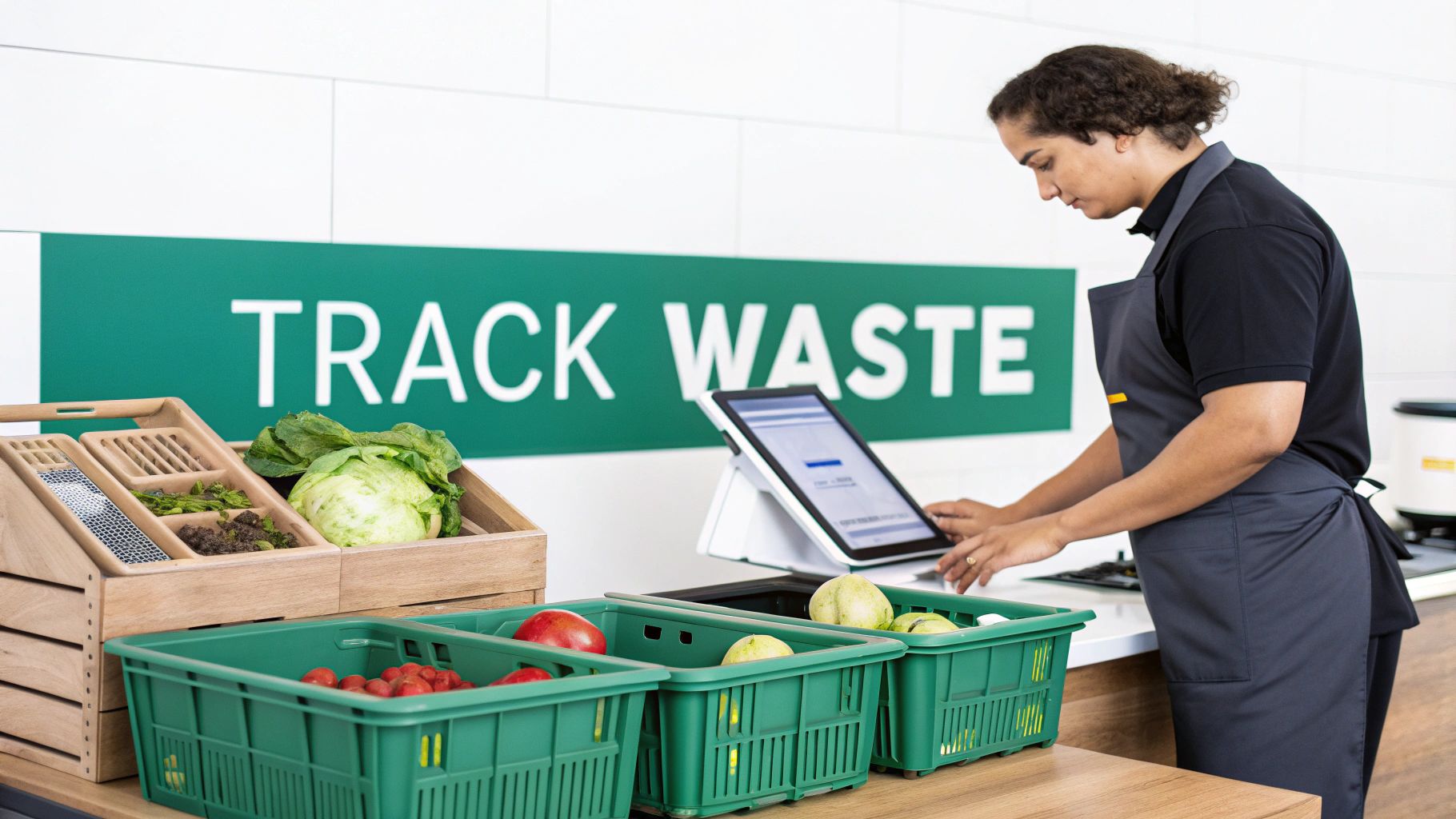
This is where you need to look beyond sales and start tracking what you lose. Every untracked item, no matter how small, is a direct hit to your profit margin. A modern POS system is your best tool for catching these invisible leaks before they sink you.
Pinpointing the Hidden Drains on Profit
Kitchens are chaotic. Mistakes are inevitable. The key is to make sure those mistakes are logged, otherwise, you're dealing with "ghost inventory"—items your system says you have, but are actually long gone. This completely wrecks your counts, messes up your purchasing, and inflates your food cost.
A good Café Management Software, like TackOn Table, has built-in functions to account for these variances right away. Instead of items just vanishing, you can give every one of them a clear reason for its departure.
- Waste: Did a line cook burn a tray of bacon? Log it under "Waste." That crate of avocados ripened too fast? Log it. This isn't about blame; it's about spotting patterns in spoilage or identifying training opportunities in the kitchen.
- Voids/Comps: When a guest sends back a meal, voiding it from their check is just the first step. A smart system automatically adds those ingredients back into your inventory count. If you comp a dessert for a regular's birthday, that needs to be tracked, too.
- Theft: Nobody wants to think about it, but employee theft happens. If your end-of-night counts on high-value items like premium liquor or filet mignon are consistently lower than what your sales reports say they should be, it's a huge red flag that demands a closer look.
By diligently tracking every single variance, you keep your data clean. Your theoretical inventory (what the POS thinks you should have) stays locked in with your actual, on-the-shelf count. And since a major goal here is to trim losses, you should also check out these valuable tips to reduce food waste for your kitchen operations.
Streamlining Your Supplier and Ordering Workflow
Once you have a tight grip on what's going out, you can get much smarter about what's coming in. An efficient ordering process saves a ton of time, prevents costly mistakes, and helps you keep your suppliers honest. You'll move from frantic, last-minute phone calls to a calm, predictable system.
The workflow itself is beautifully simple.
- Generate Purchase Orders (POs): Ditch the cocktail napkins and scribbled notes. Create clean, digital POs directly in your POS. A system like TackOn Table can even suggest orders for you based on sales velocity and your par levels.
- Receive and Verify Goods: When a delivery truck pulls up, don't just sign the paper and let the driver go. Pull up the PO on a tablet and check off each item as it comes off the truck. This is your chance to catch shorted items or incorrect products before they become your problem.
- Update Inventory and Reconcile Invoices: Once you've verified the order, a single tap adds all that new stock to your inventory counts. Later, when the invoice comes in, you can match it against the digital PO in seconds to ensure you're only paying for what you actually got.
This closed-loop process closes the door on the common errors that quietly eat away at your bottom line. It creates a perfect audit trail and makes managing multiple suppliers feel easy.
Using Key Metrics to Make Smarter Decisions
With accurate data flowing in from sales, waste logs, and purchasing, you can finally stop guessing and start managing by the numbers. Your POS dashboard is no longer just a sales tracker; it's a powerful command center for your entire operation.
Your Cost of Goods Sold (COGS) and inventory turnover rate aren't just obscure terms for your accountant. They are the vital signs of your restaurant's financial health, and you should be watching them constantly.
- Cost of Goods Sold (COGS): This is the direct cost of all the ingredients you used to produce what you sold in a given period. An integrated POS calculates this for you, giving you an instant snapshot of your profitability. If your COGS is creeping up, it’s a signal to investigate your portioning, check supplier pricing, or crack down on waste.
- Inventory Turnover Rate: This number tells you how many times you sold through your entire inventory over a specific timeframe. High turnover is great—it means your cash isn't sitting on a shelf collecting dust. A low turnover rate might mean you're over-ordering, or that a few menu items are duds and need to be re-evaluated.
By keeping a close eye on these KPIs, you can shift from putting out fires to making strategic, data-driven decisions that grow your business. You don't need to be a spreadsheet wizard to get these insights, either—the right tools make it straightforward.
Finding the Right POS: Toast vs Clover Alternatives
Choosing a Point of Sale system can feel overwhelming. You’ve got the giants like Toast and Clover practically shouting from every corner, positioning themselves as the only serious choice. But for most independent restaurant owners, their one-size-fits-all approach just doesn't fit.
Let's be real. Signing up with them often means getting tangled in long-term contracts, shelling out for pricey proprietary hardware, and paying for a mountain of features you'll never actually use. This is where a more nimble, common-sense alternative becomes a game-changer for a cafe, food truck, or neighborhood spot.
You don't need a system built for a massive restaurant chain. You need a partner that gets what actually moves the needle for your business: simplicity, fair pricing, and power where it really counts.
Why Simplicity and Adaptability Matter Most
As a small business owner, your time is your most valuable asset. You can't afford to waste hours training your team on a clunky interface or fighting with confusing software just to pull a simple report. This is exactly why we built TackOn Table to be a powerful TackOn Table vs Toast comparison. We focused on an easy setup and an intuitive design that anyone—from a new server to a seasoned manager—can pick up in minutes.
This straightforward approach extends to our hardware. Forget being locked into expensive, branded equipment that costs a fortune to replace. TackOn Table runs on standard, off-the-shelf devices like iPads.
This flexibility does more than just lower your startup costs. It gives you the freedom to set up your restaurant your way. Our mobile POS means you can run the whole show from a tablet—take orders tableside, manage the line at your food truck, or check inventory levels while you're still in the stockroom.
Transparent Pricing and Features That Work for You
Nothing kills a budget faster than hidden fees and confusing pricing tiers. We get it. That’s why our pricing is completely transparent, giving you access to robust inventory tools without the enterprise-level price tag.
TackOn Table packs all the essentials for total inventory control into one simple, accessible system:
- Real-Time Tracking: Every time you sell a burger, the system automatically deducts the bun, patty, cheese, and lettuce. You get a precise, ingredient-level view of your inventory, 24/7.
- Low-Stock Alerts: Just set your par levels for key items. We'll send you a heads-up before you run out, so you can avoid those last-minute, overpriced emergency supply runs.
- Multi-Location Control: As you grow, our platform scales with you. Manage menus, inventory, and reporting across all your locations from one simple dashboard.
The right POS shouldn't just be a cash register. It should be a partner in profitability. By making a complex job like inventory management feel easy, it frees you up to focus on what you love—your food and your customers.
This kind of integrated, data-driven approach is more important than ever. In mid-2025, many U.S. businesses started strategically increasing their on-hand inventory to protect against supply chain hiccups and potential tariffs. This wasn't just panic-buying; it was a calculated move to build resilience. TackOn Table gives you the clear, real-time data you need to make these same kinds of smart purchasing decisions with confidence.
Ultimately, choosing a POS is about finding a system that works for you, not against you. Legacy platforms were built for a different time. TackOn Table offers the all-in-one simplicity and straightforward pricing that modern, independent restaurants need to thrive.
Ready to see how a simpler, more powerful system can change your day-to-day?
Start Your Free Trial or Book a Personalized Demo to discover the TackOn Table difference.
Where Do You Go From Here?
You’ve got the playbook. You know the moves. Now, it's about putting this framework into action and turning your inventory process from a constant headache into a real profit center for your restaurant.
It really boils down to two things: building consistent habits and using the right tools to handle the grunt work. Things like daily cycle counts and diligent waste tracking are non-negotiable, but technology is what makes it all manageable.
This is where a system built specifically for independent operators comes in. An all-in-one platform like TackOn Table gives you the hard data you need to make smart, cost-saving calls without the overwhelming complexity. We designed it for the cafe, food truck, and small restaurant owner who needs all-in-one simplicity and tools that just work—like a mobile POS and straightforward multi-location control—without the enterprise-level price tag you might see with a Toast vs Clover alternative.
Stop letting your hard-earned profits walk out the door as untracked inventory. It's time to get a firm grip on your stock, slash your waste, and build a much more resilient, profitable business.
Ready to see what that actually looks like in your own kitchen? The next step is a simple one.
Book a Personalized Demo or Start Your Free Trial Today
Frequently Asked Questions About Restaurant Inventory
How often should a restaurant do a full inventory count?
What’s the biggest inventory mistake new café owners make?
How can I manage inventory for multiple locations effectively?
How does a POS system calculate my food cost percentage?
By combining smart, consistent habits with the right technology, you can tackle these challenges head-on and take firm control of your bottom line. TackOn Table is built to give you that all-in-one simplicity with the powerful features you need to master your inventory.
Ready to see how simple it can be? Start your free trial or book a personalized demo today.